Carl F. Bucherer Heritage Worldtimer – A Modern Tribute to Mid‑Century Wanderlust
The Heritage Worldtimer arrives as the newest chapter in Carl F.
By Vivir··Updated
In this review# Carl F. Bucherer Heritage Worldtimer – A Modern Tribute to Mid‑Century Wanderlust
The Heritage Worldtimer arrives as the newest chapter in Carl F. Bucherer’s effort to translate its archival DNA into a watch that feels unmistakably contemporary. Launched in 2024, the piece re‑imagines a 1950s world‑timer that once celebrated the post‑war optimism of global travel. It does so with a clean‑cut 39 mm stainless‑steel case, a twin‑crown layout, and the brand’s in‑house peripheral‑rotor movement, the CFB A2020. The result is a watch that looks at home on a business‑day wrist, yet carries enough technical intrigue to satisfy a collector who appreciates a well‑engineered complication. Below we break down the Heritage Worldtimer across the dimensions that matter most to a serious watch enthusiast.
---
## Heritage — the model's place in the brand's line and its launch context
Carl F. Bucherer has a long tradition of blending classic Swiss watchmaking with proprietary engineering. The Heritage Worldtimer is positioned as a “contemporary reinterpretation” of a model that first appeared in the brand’s archives in the 1950s. That original piece was conceived to mark the “new‑found optimism and wanderlust of the era,” a sentiment that still resonates in today’s hyper‑connected world.
In the current line‑up, the Heritage Worldtimer sits alongside the brand’s more sport‑oriented Peripheral models and its classic dress pieces such as the Heritage BiCompax Annual (launched 2019). While the BiCompax is a chronograph aimed at the mid‑tier market, the Worldtimer is a stand‑alone complication watch that showcases Bucherer’s peripheral‑rotor technology. Its launch in 2024 signals the brand’s intent to revive archival complications—not as museum pieces, but as wearable, technically sophisticated tools for the modern traveler.
The watch is offered in two primary finishes: a stainless‑steel version (priced at €7,500 on a strap and €7,900 with a metal bracelet) and a limited‑edition rose‑gold model (88 pieces at €14,800). The price points place the Heritage Worldtimer in the upper‑mid segment, competing with other Swiss manufacturers that pair in‑house movements with a world‑time or world‑timer complication.
---
## Design & Case — case dimensions, materials, dial
### Case
* **Diameter:** 39 mm – a size that balances presence with wearability on a range of wrist sizes.
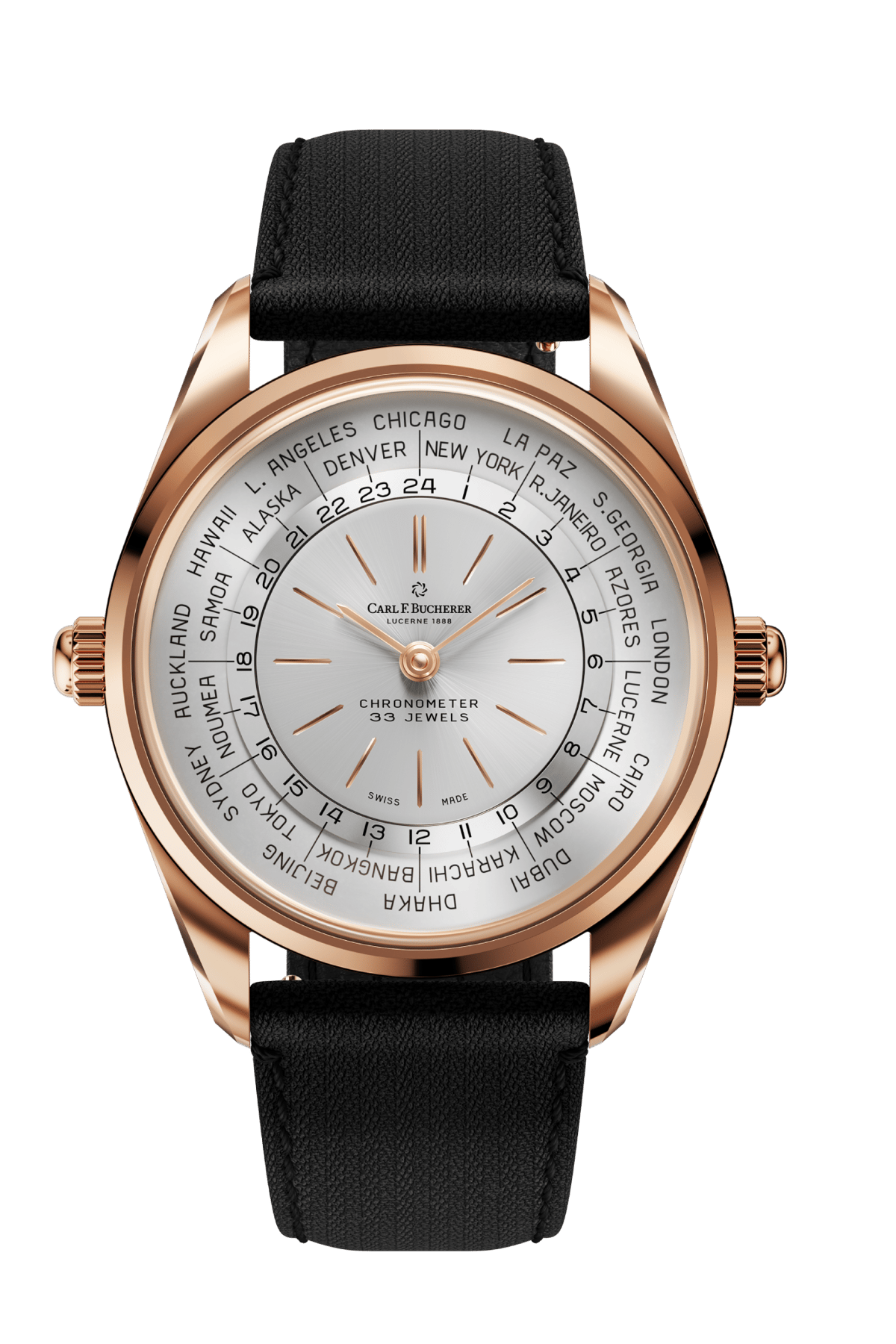
* **Material:** Polished stainless steel for the standard model; 18‑carat rose gold for the limited edition.
* **Water resistance:** 30 m (sufficient for everyday splashes but not for swimming or diving).
The case is deliberately restrained, echoing the clean lines of 1950s dress watches. Its thickness is modest, allowing the watch to sit comfortably under a shirt cuff. The twin‑crown arrangement is a notable design cue: one crown winds the movement and sets the time, while the second crown operates the time‑zone complication. Both crowns have been ergonomically reshaped, giving the user a confident grip without the “bulky” feel sometimes associated with dual‑crown systems.
### Dial & Complication
The dial is a muted, sun‑burst finish that provides a subtle contrast to the polished case. Hour markers are applied, with a mix of baton indices at 12 o’clock and luminous numerals at the remaining positions, ensuring legibility in low light.
At the heart of the dial sits the world‑timer city ring—a rotating disc that displays the names of major global cities. The ring is not fixed to a specific position relative to the 12 o’clock marker; instead, it encircles the dial and can be turned via the dedicated time‑zone crown. This design lets the wearer align any city with the central hour hand, effectively turning the watch into a “world‑timezone calculator.” While it does not operate like a traditional world‑time system (such as the Patek Philippe or Poyet‑Chronograph mechanisms), the rotating ring offers a tactile way to reference multiple zones at a glance.
An exhibition case‑back reveals the CFB A2020 movement in full view, showcasing the peripheral rotor that sits at the edge of the movement rather than the centre. The rotor’s placement reduces the visual obstruction of the balance wheel, granting the dial a cleaner appearance and reinforcing the brand’s engineering identity.
---
## Movement & Performance — caliber, power reserve, accuracy
The Heritage Worldtimer is powered by the **CFB A2020** automatic movement, a fully in‑house caliber that embodies Carl F. Bucherer’s “Peripheral Technology.”
* **Caliber:** CFB A2020 automatic, featuring a peripheral rotor that drives the mainspring from the outer edge of the movement.
* **Jewels:** 33, a typical count for a movement with a date and a world‑timer complication.
* **Power reserve:** Approximately 55 hours, giving the watch more than two days of autonomy after a full wind.
* **Chronometer certification:** The movement is COSC‑certified, meaning it meets the Swiss Official Chronometer Testing Institute’s stringent standards for accuracy and precision. The exact daily deviation is not disclosed, but COSC certification guarantees a performance well within the ±4 seconds per day range that the institute requires.
The peripheral rotor is a hallmark of Bucherer’s engineering. By moving the winding mass to the periphery, the design reduces friction on the balance wheel, potentially improving long‑term reliability and allowing a slimmer profile. The movement also drives the rotating city ring via the dedicated crown, meaning the complication is mechanically integrated rather than purely decorative.
A point of contention among purists is that the watch functions more as a “world‑timezone calculator” than a true world‑time. Traditional world‑time watches display multiple zones simultaneously without manual adjustment; the Heritage Worldtimer requires the wearer to rotate the city ring each time a new zone is needed. While this does not diminish the mechanical merit, it is a functional nuance worth noting for those who expect a classic world‑time operation.
---
## On the Wrist — wearability, lug‑to‑lug, comfort notes
At 39 mm, the Heritage Worldtimer lands in the sweet spot for contemporary dress watches. The case’s proportions keep the watch from feeling oversized on a 7‑inch wrist, yet it maintains enough presence to be noticed. Lug‑to‑lug measurements have not been published by the brand, but the overall case diameter and modest thickness suggest a comfortable fit without excessive overhang.
The twin crowns are positioned on opposite sides of the case, each with a distinct tactile profile. The winding crown (right‑hand side) offers a traditional feel, while the time‑zone crown (left‑hand side) is slightly larger, making it easy to locate and operate without removing the watch. The ergonomic redesign of both crowns mitigates the risk of accidental adjustments—a common criticism of dual‑crown watches in the past.
The stainless‑steel bracelet version comes with a polished link design that sits snugly against the wrist, while the strap variant (typically a high‑quality leather) adds a more classic dress feel. Both options benefit from the 30 m water resistance rating, meaning the watch can handle rain, hand‑washing, and brief exposure to water without concern.
On the comfort front, the peripheral rotor contributes to a lower centre of gravity, which can make the watch feel lighter on the wrist compared with a traditional central rotor of similar size. Reviewers have described the watch as “balanced,” noting that the weight distribution does not cause the wrist to fatigue during extended wear.
---
## When to Wear — occasion, setting and dress‑code fit
The Heritage Worldtimer is a versatile piece that straddles the line between dress and “smart‑casual” watch. Its polished case and refined dial make it suitable for business meetings, formal events, and even semi‑formal evening affairs. The world‑timer complication adds a travel‑themed narrative, making the watch an excellent companion for frequent flyers or globe‑trotters who appreciate a visual reminder of the cities they visit.
* **Business & formal:** Paired with a tailored suit and a leather strap, the watch presents a sophisticated silhouette that complements a classic dress code.
* **Travel & leisure:** The rotating city ring becomes a conversation starter on the plane or at a hotel lounge, allowing the wearer to quickly reference local times.
* **Smart‑casual:** The stainless‑steel bracelet version pairs well with a blazer‑and‑jeans combo, offering a touch of luxury without looking out of place.
Because the watch is not water‑resistant beyond 30 m, it is best kept away from swimming, snorkeling, or heavy water‑sports. However, it will comfortably survive everyday exposure to rain or a quick dip in a pool—situations most professionals encounter.
---
## Value & Verdict — price‑positioning + final take
### Pricing
* **Stainless‑steel strap:** €7,500
* **Stainless‑steel bracelet:** €7,900
* **Limited rose‑gold edition (88 pcs):** €14,800
In the Swiss market, the Heritage Worldtimer sits between the entry‑level luxury tier (typically €4‑6 k for in‑house automatic watches) and the high‑end complication segment (often €20 k+). The price reflects several value‑adding factors:
1. **In‑house movement** – The CFB A2020 is a proprietary caliber that showcases Bucherer’s peripheral‑rotor technology, a feature not widely available in this price bracket.
2. **Complication** – A world‑timer (or world‑timezone calculator) is a niche complication that adds functional interest beyond a simple three‑hand watch.
3. **Limited edition** – The rose‑gold version’s scarcity (only 88 pieces) justifies its higher price point for collectors seeking exclusivity.
When compared to similar offerings from brands like Patek Philippe (which offers true world‑time watches starting around €30 k) or Jaeger‑LeCoultre (with the Geophysic line in the €12‑15 k range), the Heritage Worldtimer provides a compelling blend of heritage, engineering, and price. It is not “accessible” in the mass‑market sense, but for a buyer seeking a Swiss‑made, in‑house movement with a world‑timer twist, the price feels justified.
### Verdict
Carl F. Bucherer’s Heritage Worldtimer succeeds in translating a mid‑century concept into a watch that feels both nostalgic and modern. Its 39 mm stainless‑steel case offers a contemporary size, while the twin‑crown layout and ergonomically refined crowns make operation intuitive. The CFB A2020 peripheral‑rotor movement delivers a respectable 55‑hour power reserve and COSC‑certified chronometer accuracy, underscoring the brand’s technical credentials.
The rotating city ring provides a functional, if manually operated, world‑timezone reference. While purists may note that the watch does not function as a true world‑time (it requires manual alignment of the city ring each time a new zone is needed), the compromise is transparent and does not diminish the watch’s overall appeal.
In terms of wearability, the watch is comfortable, well‑balanced, and adaptable to both strap and bracelet configurations. Its design is versatile enough for boardroom meetings, formal dinners, and the occasional airport lounge, making it a solid “everyday luxury” piece.
**Final score:** The Heritage Worldtimer earns a strong recommendation for collectors who value in‑house engineering, appreciate a nod to historic complications, and are comfortable with a manually adjustable world‑timezone function. At its price, it offers a rare combination of heritage storytelling, technical innovation, and understated elegance that is difficult to find elsewhere in the segment.
---
*All specifications and price information are drawn from Carl F. Bucherer’s official product pages and the Monochrome Watches review cited in the source data.*