Restraint, Done Properly
There is a particular kind of watch that asks nothing of you. It has no bezel to rotate, no pusher to press, no complication that requires a manual before wear. The Carl F. Bucherer Manero AutoDate is that watch, and the fact that it is easy to overlook is precisely the point. In a catalogue full of tourbillons and skeletonised chronographs, the Manero AutoDate does the harder thing: it tries to be correct.
Reference 00.10908.08.13.01 is the steel heart of the Manero AutoDate line — a three-hand-plus-date dress watch on an alligator strap, driven by the CFB 1965. On paper it competes with the IWC Portofino Automatic and the Omega De Ville Prestige. In the metal it competes by refusing to compete: no guilloché exuberance, no exhibitionist finishing, no heritage narrative the case cannot support. What it offers instead is a well-proportioned case, an honestly finished automatic, and a dial that reads cleanly from across a table.
This review works through the things that actually decide whether a watch stays in rotation after the honeymoon: case architecture, dial legibility, movement construction, wrist behaviour, and the ownership economics of servicing and resale.
Lucerne, 1888
Carl Friedrich Bucherer opened his workshop in Lucerne in 1888, and the company he founded has remained in the same family for three generations — a rarity in Swiss watchmaking and one that shaped the brand's character. Where the Geneva houses built their reputations on complications and competition chronometry, Bucherer built a business on retail reach and quiet technical ambition, and the Lucerne headquarters still sits above the family's original storefront.
That technical ambition became explicit in 2008 with the CFB A1000, a manufacture automatic with a peripheral oscillating weight — a genuinely inventive answer to the problem of rotor thickness. It announced that Carl F. Bucherer could engineer with the best of them. But manufacture movements are expensive, and a brand needs a volume model. The Manero line, developed in the same period, was that answer: a classical dress family built around proven outsourced calibres, finished and regulated in-house, and priced to sit against the established mid-luxury competition.
In 2023, Rolex acquired Carl F. Bucherer. Whatever the long-term consequences for the catalogue, the immediate effect for a buyer is simple: the brand is no longer a boutique curiosity, and the service network behind it is as solid as it has ever been.
What the Manero AutoDate Is
The name is not marketing. AutoDate describes the entire specification: an automatic movement, and a date. Nothing else. No power reserve indicator, no moonphase, no small seconds, no GMT hand. In a market where a dress watch is often expected to justify itself with visible engineering, that restraint reads as either confidence or laziness depending on your temperament. I think it is the former. The Manero AutoDate is a watch designed to be read at a glance and then forgotten.
It is also, crucially, a watch with a point of view about proportion. The bezel is narrow, the dial occupies the majority of the available surface, and the hands are long enough to reach their tracks. These sound like minimum requirements. Spend an afternoon handling dress watches at this price and you will discover how often they are missed.
Case and Dial
The case is the classic round dress formula, and it is executed with more nuance than the price suggests. The bezel is a narrow, fully polished ring that steps down into the case band; the lugs are polished on their upper surfaces and chamfered where they meet the case, so the transition catches light without shouting. It is not Grand Seiko-level zaratsu work — nobody at this price is — but the facets are crisp rather than soft, and the polishing is even across the surfaces.
The lugs curve downward steeply enough that the watch sits flat on the wrist rather than perching on top of it, which is the single most important thing a dress watch case can do. The crown sits close against the case band and is easy enough to grip for a weekly wind — though as an automatic you will rarely need to.
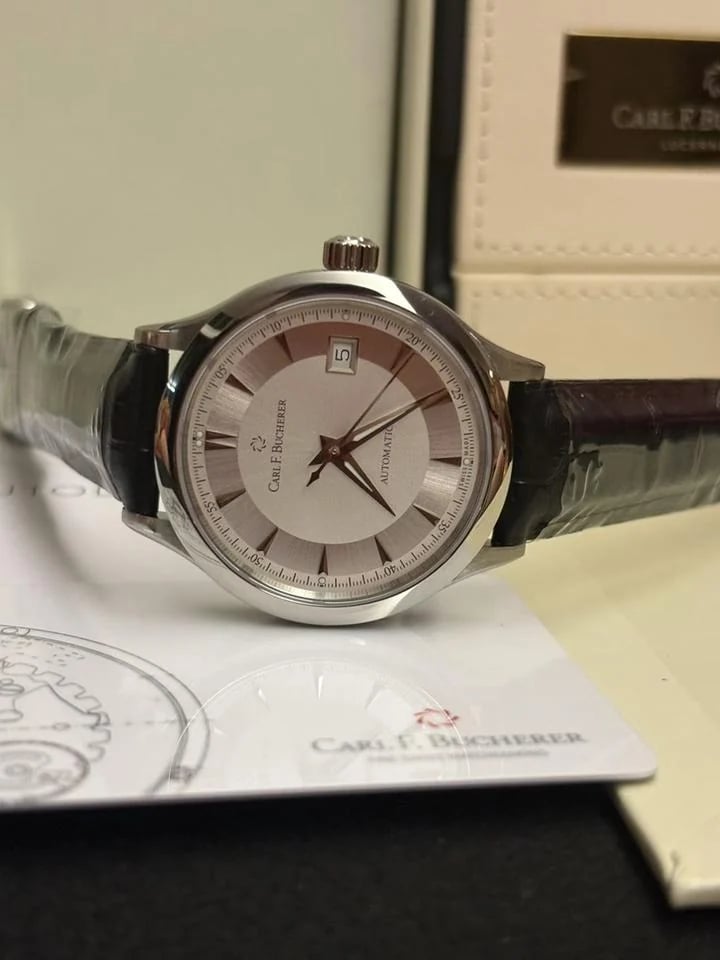
The dial is where the Manero AutoDate earns its keep. A silver-toned surface with fine sunray brushing radiates outward from the centre, and the applied indices are faceted batons with polished flanks and brushed tops — the kind of two-surface treatment that makes a dial look expensive in indirect light and legible in direct light. The hour and minute hands are similarly faceted, with a slight taper and enough surface area to read instantly. The seconds hand is a slim needle with a small counterweight, and it reaches cleanly to the minute track.
The date sits at three o'clock in a rectangular aperture with a stepped, polished frame — a small detail that separates a considered dial from an assembled one. The printing is restrained: the brand name and the model name, nothing more. There is no lume, which is correct. A dress watch with glowing indices is a watch that has not decided what it is.
Crystal is sapphire front and back, and the case back is a display aperture that shows the movement rather than hiding it. That is a small act of confidence from a brand that could easily have sealed the case and saved the cost.
The CFB 1965
Turn the watch over and the sapphire display back shows the CFB 1965, an automatic calibre built on the ETA 2892-A2 architecture and modified to Carl F. Bucherer's specification. This is worth stating plainly rather than apologising for: the 2892 is one of the finest thin automatic movements ever produced, and its use here is a feature, not a compromise. It runs at 28,800 vibrations per hour, carries roughly 42 hours of power reserve, and its slim, 11.5-ligne footprint is what allows a dress watch case to remain thin without hollowing out the movement.
The finishing is honest rather than exhibitionist. The mainplate is circular-grained, the bridges are decorated with Geneva stripes, and the rotor carries the brand's engraving. Screw heads are polished, the balance cock is chamfered, and the whole assembly is rhodium-plated for corrosion resistance. Under a loupe you will find machine-applied rather than hand-applied anglage, and the interior angles are not what a Lange owner would call finished — but this is a watch that costs a fraction of a Lange, and judging it by that standard is a category error. What matters is that the surfaces visible through the case back are consistently executed and pleasant to look at, which they are.
One thing the CFB 1965 is not: chronometer-certified. Carl F. Bucherer does not submit these movements to COSC, and regulation is done to a workmanlike rather than a laboratory standard. That is a fair trade at the price — certification costs money and buys paperwork — but it does mean accuracy varies between individual examples.
On the Wrist
The Manero AutoDate wears like a dress watch should: thin under a shirt cuff, balanced on the wrist, and almost unnoticeable after an hour. The case sits low, and because the lugs curve away quickly there is no gap beneath them on a wrist of average circumference. On a smaller wrist the case reads a touch generous but never oversized; on a larger wrist it stays comfortably within the bounds of classical proportion.
The alligator strap is supple from new and tapers to a pin buckle — a choice I appreciate, since a deployant clasp on a watch this slim adds bulk exactly where you do not want it. The strap's underside is lined in soft leather, and the stitching is even. It is not the most exotic strap in the segment, but it is comfortable, and it is the right width for the lugs, which sounds like a low bar until you handle watches that miss it.
Weight is modest — a steel case on leather, with no bracelet to add heft. If you are used to a sports watch on a bracelet, the Manero will feel almost insubstantial for the first day. That is the point. It disappears under a cuff and reappears when you need it.
Accuracy
An uncertified 2892-based movement in good adjustment will typically run within about ten seconds a day either way, and most examples settle into a narrower band once broken in. Expect a well-kept example to hold within roughly five to eight seconds of daily variation, with positional differences noticeable if you rest it crown-up overnight. It is not a watch you set by the second; it is a watch you set once a week and forget.
The automatic winding is efficient and the rotor is quiet — no rattling or whirring on the wrist, which is more than can be said for some movements at twice the price. The reserve of roughly 42 hours means a Friday-night-to-Monday-morning rest will leave it running, but only just. If it lives in a rotation, buy a winder or accept the ritual of resetting it.
Ownership
This is where buying a Carl F. Bucherer becomes genuinely sensible. Because the calibre is ETA-based, service is not a closed shop. Carl F. Bucherer's authorized network will handle it, but so will any competent independent watchmaker with access to 2892 parts, which keeps long-term ownership costs predictable and shortens turnaround times considerably. The brand does not publish a rigid service interval; the practical guidance for a movement of this type is to service when amplitude drops or timekeeping drifts, rather than on a strict calendar.
Parts availability is the thing to verify before buying pre-owned. Because the external components — dial, hands, crown, crystal — are brand-specific, cosmetic repairs go through Carl F. Bucherer, and that is where costs concentrate. Movement work, by contrast, is routine and unremarkable, which is exactly what you want from a watch you intend to keep for twenty years.
The Market
The Manero AutoDate launched at roughly four and a half to five thousand dollars in steel, which placed it squarely against the IWC Portofino and just under the Omega De Ville Prestige. On the secondary market it trades considerably lower — typically in the low-to-mid two thousands for a clean example with box and papers, and less for a watch without them. That is the standard trajectory for a mid-luxury dress watch from a brand with limited collector gravity, and it should be priced into your decision rather than mourned.
The honest read is that the Manero AutoDate depreciates. It is not a watch to buy as an asset; it is a watch to buy because you want to wear it, and the secondary market is doing you a favour by making that affordable. There is no meaningful auction history — Carl F. Bucherer does not yet have the vintage depth for that — and the Rolex acquisition has not, so far, produced the speculative lift some had hoped for. Buy it used, buy it well, and let someone else absorb the first depreciation.
Alternatives
If you want the same brief with a manufacture movement, the Omega De Ville Prestige is the obvious rival; its co-axial escapement and greater brand liquidity come at a higher entry price. The IWC Portofino Automatic is the established choice and wears slightly larger on the wrist, but its case detailing is less interesting. The Grand Seiko SBGR261 offers finishing that embarrasses almost everything near its price, though its philosophy of restraint is more austere and its case architecture considerably more assertive. And the Tudor 1926 delivers comparable reliability at a lower entry point with visibly less dial refinement.
At the affordable end, the Orient Bambino and the Seiko Presage Cocktail Time both capture the idea — round steel case, sunray dial, date at three — for a fraction of the money, and neither will embarrass you at a dinner. What they cannot replicate is the thinness, the quality of the applied indices, or the sense that someone made a deliberate decision about every surface.
Verdict
The Carl F. Bucherer Manero AutoDate ref. 00.10908.08.13.01 is a watch that understands its job. It is thin, legible, honestly finished and mechanically sound in a way that will outlast most of the trends currently competing for your attention. It does not offer the engineering theatre of an in-house movement or the resale comfort of a blue-chip name, and it does not pretend to.
What it offers is craft at a sensible price — particularly on the secondary market — from a house with a real history and, since 2023, a very solid parent. If you want a dress watch that disappears under a cuff and asks nothing of you, this is one of the more intelligent ways to spend the money.