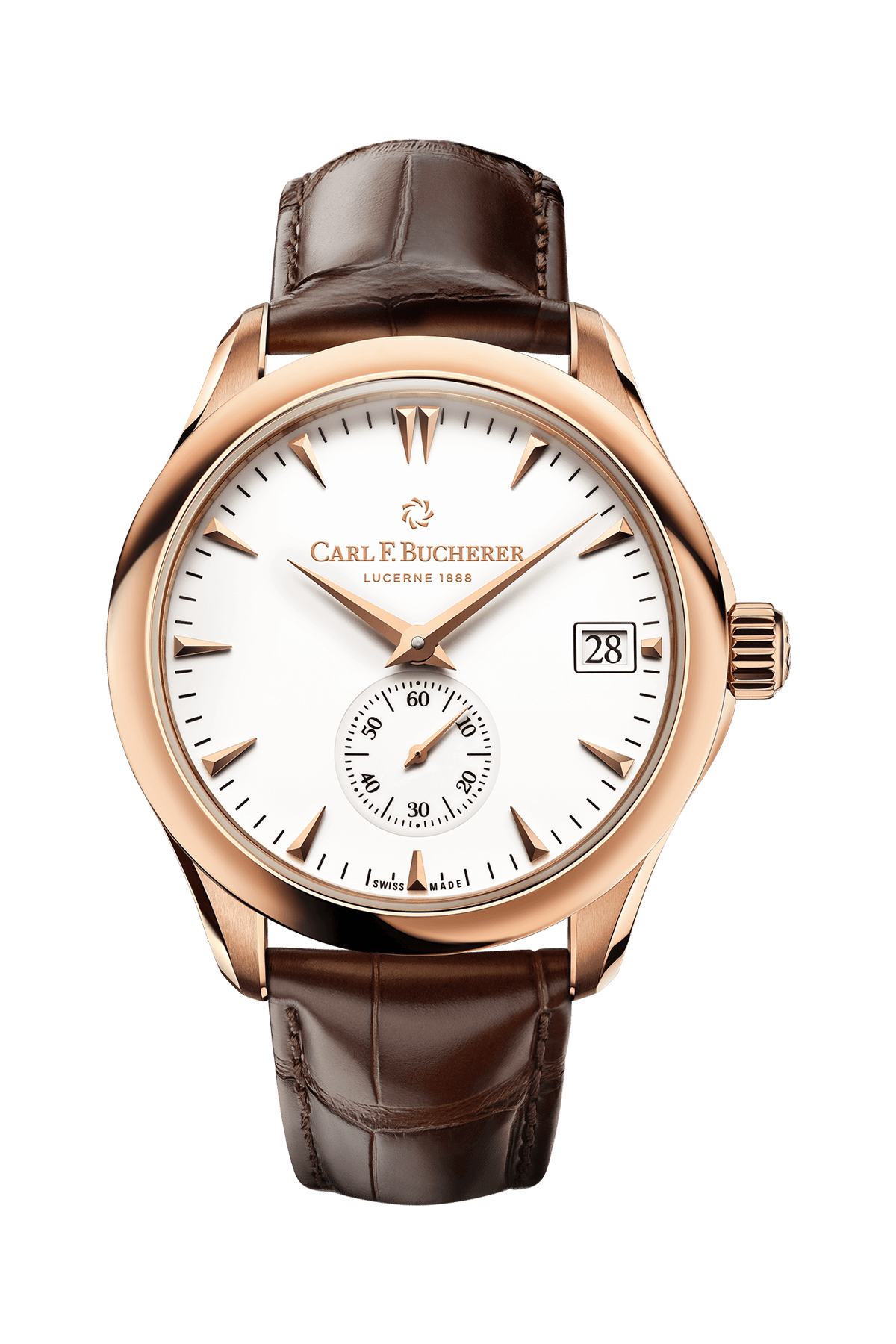
The Contrarian’s Choice: Why the Manero Peripheral Matters
In the current market, liquidity is king, and hype is the currency of the masses. But for the sophisticated collector—the one whose portfolio is diversified across more than just S&P 500 trackers and the occasional crypto play—the Carl F. Bucherer Manero Peripheral represents a different kind of value. It is a hedge against the mundane. While the rest of the world is chasing the same four steel sports watches, CFB has been quietly perfecting one of the most difficult complications in automatic winding: the peripheral rotor.
To understand the Manero Peripheral, you have to understand the 'Bucherer' name. For over a century, the Bucherer family has been the gatekeeper of luxury in Switzerland, operating the world's largest watch retail network. But Carl F. Bucherer, the manufacturing arm, is where the real alpha is found. They aren't just putting their name on generic movements; they are pushing the boundaries of what a 'standard' watch can be. The Manero Peripheral is the physical manifestation of that ambition.
Movement Architecture: The Peripheral Flex
Let’s talk about the Caliber CFB A2050. In a standard automatic watch, a heavy metal oscillating weight sits on top of the movement. It’s functional, but it’s a design compromise—it hides half the movement at any given time. The peripheral rotor, however, travels on a track around the outside of the movement. This requires incredible precision in ball-bearing engineering to ensure the rotor doesn't seize or cause friction-related energy loss.
The result? You get the convenience of an automatic with the unobstructed view of a manual-wind caliber. When you flip the Manero Peripheral over, you are greeted by the Geneva stripes, the anglage, and the rhythmic beat of the balance wheel without any visual obstruction. This is the kind of technical detail usually reserved for five-figure pieces from the likes of Breguet or Vacheron Constantin. In the Manero, you’re getting that same 'wow' factor for the price of a mid-tier Omega.
Market Dynamics: The Buy-Side Opportunity
From an investment standpoint, we have to be honest: Carl F. Bucherer does not hold its value at retail like a Rolex or a Patek Philippe. If you walk into a boutique and pay full MSRP, you are taking an immediate 30-40% haircut the moment you walk out the door. However, as an analyst, I see this as a massive opportunity on the secondary market.
The 'Smart Money' play here is to pick up a mint-condition Manero Peripheral on the pre-owned market. At the $4,000 to $4,500 mark, you are buying a COSC-certified, in-house, technically unique Swiss timepiece that has already bottomed out on its depreciation curve. With Rolex’s recent acquisition of the Bucherer retail empire, the brand visibility of CFB is only going to go up. This is a classic 'value' play in a market full of 'growth' traps.
Design and Aesthetics: Lucerne Elegance
The dial of the Manero Peripheral is a study in minimalism. The applied wedge-shaped indices and the dauphine hands are sharp, catching the light in a way that suggests a much higher price point. The small seconds sub-dial at 6 o'clock provides a nice visual anchor, while the date window at 3 o'clock is executed with a color-matched wheel—a small detail that many 'luxury' brands still get wrong.
The case finishing is a mix of brushed and polished surfaces. The bezel is thin, which allows the dial to appear larger and more open. This is a watch that doesn't need to be loud to be noticed. It is for the man who wears a Loro Piana 'Storm System' jacket—it’s expensive, it’s highly technical, but it doesn't have a giant logo on the chest. It is stealth wealth in its purest form.
The Verdict: Hold or Flip?
This is not a 'flip' watch. If you’re looking for a quick $500 profit, go try to get on a list for a Submariner. The Manero Peripheral is a 'hold.' It is a watch to be worn, enjoyed, and kept in a collection as the representative of Lucerne watchmaking. It is for the collector who has moved past the 'brand name' phase and is now entering the 'horological substance' phase of their journey.
In conclusion, the Carl F. Bucherer Manero Peripheral is one of the few watches left that feels like a secret. It offers a level of mechanical sophistication that is genuinely rare, wrapped in a package that is timelessly elegant. Buy it for the movement, keep it for the style, and laugh at the people paying five times the price for a watch with a movement that hasn't changed since the 1970s.