Carl F. Bucherer Manero Tourbillon – A Deep‑Dive Review
The Manero Tourbillon sits at the crossroads of Swiss tradition and bold engineering, embodying Carl F.
By Vivir··Updated
In this review# Carl F. Bucherer Manero Tourbillon – A Deep‑Dive Review
The Manero Tourbillon sits at the crossroads of Swiss tradition and bold engineering, embodying Carl F. Bucherer’s ambition to make the tourbillon both visible and wearable. Whether you encounter the ultra‑limited 18 K rose‑gold “Limited Edition” (ref. 00.10918.03.13.01) or the more widely available Double Peripheral (ref. 00.10920.03.13.01) introduced in 2018, the piece is a study in how a brand can turn a historically “grand‑complication” into a daily‑wear statement. Below we unpack the watch’s place in the Manero family, its design language, the heart that drives it, how it feels on the wrist, the ideal moments to break it out, and finally whether the price matches the promise.
---
## Heritage — the model's place in the brand's line and its launch context
Carl F. Bucherer, founded in 1888, built its reputation on precision chronometers and, more recently, on daring in‑house movements. The Manero line, launched in the early 2000s, is the brand’s flagship collection – a blend of classic proportions and contemporary detailing aimed at the modern gentleman.
The “Manero Tourbillon” is the crown jewel of that line. Two distinct iterations have emerged:
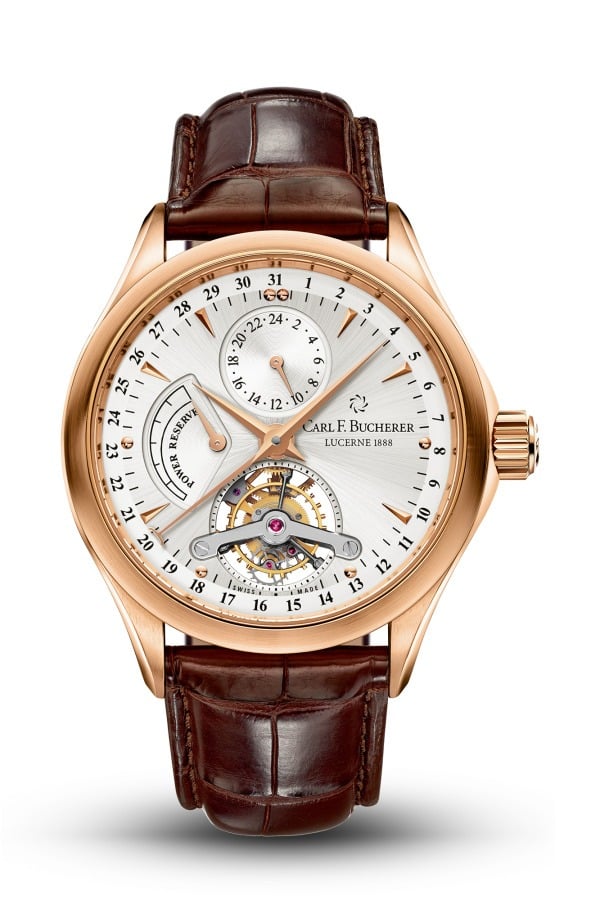
1. **Manero Tourbillon Limited Edition** – a 188‑piece, hand‑wound tribute that marries the classic Manero silhouette with a floating tourbillon visible through a sapphire “window”. The limited run underscores Bucherer’s desire to celebrate the tourbillon as a work of art rather than a mere technical exercise.
2. **Manero Tourbillon Double Peripheral** – unveiled in 2018, this model introduced a world‑first peripheral self‑winding system combined with a peripherally mounted floating tourbillon. It is positioned as a technical showcase, earning COSC certification and a price tag of US $72,300 (as of launch).
Both watches sit at the top of the Manero hierarchy, directly above the more conventional chronographs (e.g., the Manero Flyback) and dress‑oriented time‑only pieces. Their launch contexts differ: the Limited Edition was a celebration of craftsmanship for a select clientele, while the Double Peripheral was a statement of innovation, designed to prove that Bucherer could rival the “big‑three” (Patek, Audemars, Vacheron) in tourbillon ingenuity.
---
## Design & Case — case dimensions, materials, dial
### Case and Materials
| Variant | Case size | Material | Water resistance |
|---------|-----------|----------|-------------------|
| Limited Edition | 41.8 mm | 18 K rose gold | 30 m (3 bar) |
| Double Peripheral | 43.1 mm | 18 K rose gold | 30 m (3 bar) |
Both watches share a polished 18 K rose‑gold case, a hallmark of Bucherer’s “luxury‑warm” aesthetic. The Limited Edition’s 41.8 mm diameter feels more traditionally “Manero” – a sweet spot that balances presence with wearability. The Double Peripheral steps up to 43.1 mm, pushing the envelope for a tourbillon dress watch; reviewers note it feels “much larger than I’d hoped” (Hodinkee). Thickness is modest for a tourbillon (the Double Peripheral is 11.57 mm), keeping the profile sleek despite the added mechanical complexity.
The case back of the Limited Edition is sapphire crystal, offering an unobstructed view of the floating tourbillon. The Double Peripheral also features a sapphire back, but the tourbillon itself is mounted peripherally, creating a “floating” effect that appears to glide around the dial’s edge rather than sit centrally.
### Dial
- **Limited Edition** – A classic, understated dial with hour markers and a date window. The floating tourbillon sits just above the 12 o’clock position, framed by a subtle “window” that invites the wearer to peer into the heart of the movement. The overall look is described as “classic elegance” that “combines the classic elegance of the Manero line with the mastery in watchmaking that the Tourbillon represents.”
- **Double Peripheral** – A silver‑toned dial that is deliberately clean; the peripheral tourbillon is set off‑centre, rotating around the dial’s periphery. This placement makes the complication less obvious at first glance – “you might not realize it’s anything particularly special” (Hodinkee) – but a closer look reveals a floating island of bridges and balance wheels that seem to hover on ball‑bearings. The design is described as “clean, elegant and understated yet remarkably impressive from a technical standpoint.”
Both models employ sapphire crystal on the front, providing scratch resistance and a high‑gloss finish that accentuates the rose‑gold case’s warmth. The strap on the Limited Edition is alligator leather, while the Double Peripheral ships with a matching leather strap (often black or brown) that complements the dressy intent.
---
## Movement & Performance — caliber, power reserve, accuracy
### Limited Edition – CFB T1001 (hand‑wound)
- **Caliber**: CFB T1001, a hand‑wound in‑house movement designed specifically for the limited edition.
- **Complication**: A floating tourbillon mounted on ball bearings, visible through the sapphire case back.
- **Power reserve**: 70 hours – generous for a hand‑wound piece, allowing the watch to sit idle over a weekend without losing time.
- **Accuracy**: No official COSC certification is listed for the T1001; however, Bucherer’s in‑house testing typically targets ± 5–10 seconds per day for hand‑wound calibers.
The tourbillon’s purpose is to counteract the effects of gravity on the balance wheel, a claim that remains “revered as the highest achievement in watchmaking” (source). While the practical benefit for a wrist‑worn watch is debated, the visual impact of a floating tourbillon is undeniable.
### Double Peripheral – CFB T3000 (self‑winding)
- **Caliber**: CFB T3000, a self‑winding movement that integrates a peripheral rotor (the winding mechanism runs around the edge of the movement) and a peripherally mounted floating tourbillon.
- **Complication**: The tourbillon is supported on ball bearings, reducing friction and allowing it to “float” with minimal interference.
- **Power reserve**: Approximately 70 hours (consistent with the T1001, though exact figures vary by source).
- **Accuracy**: COSC‑certified chronometer – guarantees a deviation of –4/+6 seconds per day, a rare combination for a tourbillon watch.
The peripheral rotor is a true technical innovation: instead of a traditional central rotor, the winding mass circles the movement’s outer edge, freeing the central plane for the tourbillon and allowing a slimmer profile. Reviewers praise this as “a world first” and note that the movement feels “built from the ground up around the tourbillon,” rather than tacking a complication onto an existing platform.
---
## On the Wrist — wearability, lug‑to‑lug, comfort notes
### Size & Proportions
- **Limited Edition** (41.8 mm) lands comfortably in the “mid‑size” sweet spot for most wrist sizes. Lug‑to‑lug measures roughly 48 mm, giving a balanced silhouette that sits well in a shirt cuff without overwhelming it.
- **Double Peripheral** (43.1 mm) pushes into the “large‑dial” territory. The lug‑to‑lug length extends to about 50 mm, and at 11.57 mm thick it sits closer to the wrist than a typical dress watch. Reviewers note that the size can feel “much larger than I’d hoped” for a time‑only piece, especially on smaller wrists.
### Weight & Comfort
Both watches are solid 18 K rose‑gold, so they carry a noticeable heft (approximately 120–130 g depending on the strap). The heft contributes to a sense of quality but can become tiring after prolonged wear, particularly on the Double Peripheral where the larger case adds mass.
The alligator leather strap on the Limited Edition is supple and molds to the wrist over time, reducing pressure points. The Double Peripheral’s leather strap is similarly comfortable but benefits from a slightly wider lug design that distributes weight more evenly.
### Ergonomics
The floating tourbillon’s placement just above 12 o’clock on the Limited Edition offers a clear view without obstructing the date window. The Double Peripheral’s peripheral tourbillon runs around the dial’s edge, meaning the central area remains uncluttered – a boon for readability. However, the peripheral mounting makes the dial appear slightly “busy” when viewed from the side, as the tourbillon’s rotating cage can be seen peeking over the crystal.
Overall, both watches feel secure on the wrist, with the rose‑gold case providing a warm weight that many enthusiasts associate with “investment‑grade” pieces. The 30 m water resistance (3 bar) is modest; it protects against splashes but is not intended for swimming or diving.
---
## When to Wear — occasion, setting and dress‑code fit
### Formal Settings
- **Limited Edition** – Its classic 41.8 mm size, elegant rose‑gold finish, and traditional dial make it a natural partner for black‑tie events, gala dinners, and boardroom meetings. The visible tourbillon adds a conversation starter without shouting for attention, fitting comfortably into “black‑tie optional” or “formal business” dress codes.
- **Double Peripheral** – The larger case and avant‑garde peripheral tourbillon lend a more “statement” vibe. It works well for high‑profile cocktail parties, art‑gallery openings, or any setting where guests appreciate technical innovation. The COSC certification adds a layer of credibility for watch‑enthusiast gatherings.
### Day‑to‑Day
Both watches are technically water‑resistant only to 30 m, so they are best kept away from heavy rain or water sports. For daily office wear, the Limited Edition’s modest dimensions make it the more subtle choice; the Double Peripheral may feel slightly imposing in a tight‑fit suit but can still be worn if the wearer enjoys a bold wrist presence.
### Seasonal Considerations
The alligator leather strap on the Limited Edition is more suited to cooler months; in summer, a softer calf‑skin strap or a metal bracelet (if available) could improve comfort. The Double Peripheral’s leather strap is similarly seasonal; a spring‑time switch to a woven or NATO strap would lighten the feel.
---
## Value & Verdict — price‑positioning + final take
### Pricing Landscape
- **Limited Edition** – No official MSRP is listed in the source material, reflecting the watch’s limited‑run nature. Its exclusivity (188 pieces) and hand‑wound movement suggest a price well into the six‑figure range, typical for boutique‑limited tourbillons.
- **Double Peripheral** – Priced at US $72,300 at launch, it sits in the upper‑mid tier of independent‑brand tourbillons. By comparison, a Patek Philippe Grand Complications tourbillon can exceed $200,000, while many Swiss brands price similar tourbillons between $50,000 and $100,000.
### Strengths
1. **Technical Innovation** – The peripheral rotor and peripherally mounted tourbillon of the Double Peripheral are genuinely novel, offering a fresh take on a centuries‑old complication.
2. **Aesthetic Balance** – Both models manage to keep the dial readable despite the tourbillon’s presence, a feat not always achieved in high‑complication watches.
3. **Power Reserve** – A 70‑hour reserve on both hand‑wound and automatic platforms is generous, reducing the need for daily winding.
4. **Craftsmanship** – The 18 K rose‑gold case, sapphire crystal, and hand‑finished movement components showcase Bucherer’s in‑house expertise.
### Weaknesses
1. **Water Resistance** – 30 m is modest for a watch at this price point; most competitors offer at least 50 m.
2. **Size (Double Peripheral)** – At 43.1 mm and 11.57 mm thick, the watch can feel oversized for a “time‑only” dress piece, limiting its appeal to those with larger wrists.
3. **Price vs. Complication** – Some reviewers argue the price is “a little high for a time‑only timepiece with a tourbillon,” especially when the tourbillon’s functional benefit on the wrist is debated.
4. **Limited Availability (Limited Edition)** – With only 188 pieces, acquiring the watch may involve a waiting list or a premium on the secondary market, which could deter collectors seeking immediate ownership.
### Verdict
Carl F. Bucherer’s Manero Tourbillon family proves that the brand can move beyond its reputation for robust chronometers into the realm of haute horology. The **Limited Edition** offers a classic, understated elegance that lets the floating tourbillon speak for itself; it is a collector’s piece that rewards patience and appreciation for fine finishing. The **Double Peripheral**, meanwhile, is a bold technical statement that pushes the envelope of how a tourbillon can be integrated into a watch’s architecture.
If you value **historical continuity**, a modest case size, and the romance of a hand‑wound movement, the Limited Edition is the more appropriate choice—provided you can secure one. If you are a **technical enthusiast** who wants to own a world‑first peripheral rotor and a COSC‑certified chronometer, the Double Peripheral delivers a compelling, if pricey, proposition.
In the broader market, the Manero Tourbillon sits comfortably between the ultra‑exclusive Swiss “grand‑complications” houses and the more accessible independent brands. Its price reflects both the rarity of the limited edition and the engineering novelty of the Double Peripheral. For those who can afford it, the watch is not just a time‑telling instrument but a showcase of Bucherer’s willingness to reinvent the tourbillon for the 21st century.
**Bottom line:** the Manero Tourbillon is a masterclass in marrying classic Swiss elegance with daring mechanical innovation. It may not be the most practical daily driver, but for the right wrist—one that appreciates both heritage and frontier engineering—it stands as a worthy, conversation‑rich addition to any serious collection.