First, the context nobody can ignore
There is a version of this review that writes itself: handsome Swiss dress watch, proven movement, soft secondary market, buy it if you love it. That version is still broadly correct. But reference 00.10580.07.25.31.01 no longer exists in the market it was designed for. Carl F. Bucherer — the Lucerne house that spent more than a century putting watches on the wrists of people who came into the shop to buy jewellery — has been wound down as a watchmaking brand. Rolex SA bought the Bucherer retail group in 2023, and in late 2024 the decision came that the watch brand itself would not continue.
That is not trivia. It is the single most important fact about this watch for anyone buying one today. It determines what you should pay, what you should expect to get back, and how you should think about servicing a piece whose maker will no longer have a service desk with its name above the door. Once you have internalised that, the Pathos becomes a much easier watch to evaluate on its merits — because you can stop pretending it is something it was never going to be.
So let us do exactly that. The Pathos is a slim, classical, three-handed dress watch with a date, built around one of the most reliable thin automatics in the business. It is comfortable, restrained, and quietly competent. It is not a collectible and never will be. Both of those statements are true at once, and a serious collector should be able to hold them together.
A house with two identities, and the one that ended
Carl Friedrich Bucherer opened his shop in Lucerne in 1888, and the business he built was always slightly unusual: a watchmaker and a jeweller under one roof, family-owned through three generations, with a retail footprint that eventually became as significant as the watches carrying the family name. That dual identity shaped the product. Bucherer watches were never conceived as enthusiast objects first; they were conceived as things a well-dressed customer would buy in a well-appointed salon, alongside a bracelet or a necklace.
The modern catalogue reflected that. Manero carried the technical flag — chronometers, annual calendars, a tourbillon or two. Patravi did the heavy lifting commercially with the TravelTec and the ScubaTec. Heritage mined the archive for bi-compax chronographs. And Pathos sat at the dressy, elegant end: slimmer, quieter, less concerned with complications than with how the whole thing looked under a cuff.
That positioning explains both why the Pathos was good and why it is now cheap. It was never engineered to be a grail. It was engineered to be worn, by people who cared about how a watch looked with a suit and did not particularly care about forum bragging rights. The market has now repriced it accordingly — brutally, but not unreasonably.
What the Pathos actually is
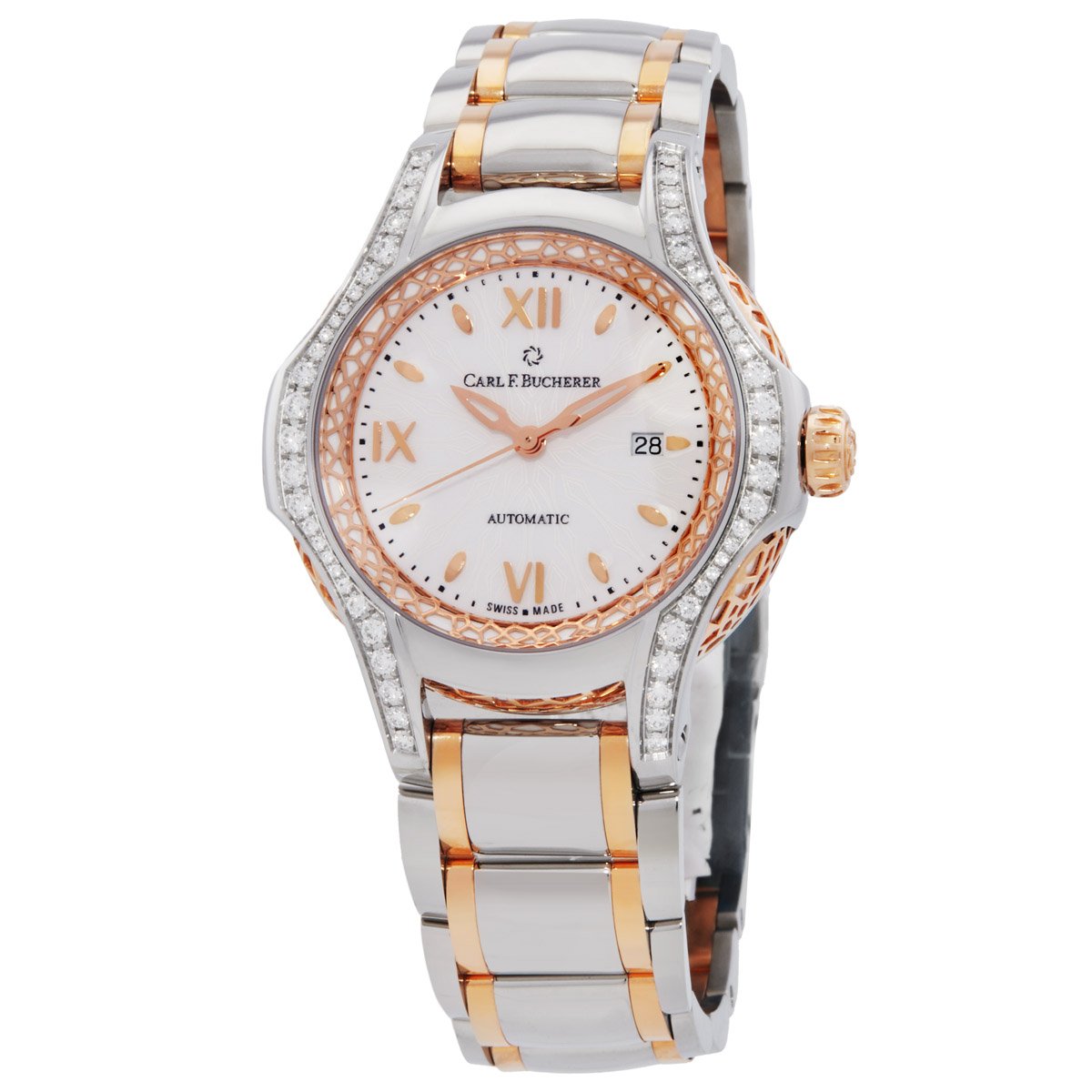
Strip away the branding and you have a round dress case with a thin bezel, a clean dial, applied hour markers, a fine minute track and a discreet date aperture. The design language is conservative to the point of anonymity, which in a dress watch is a feature, not a bug. There is nothing here that will look dated in fifteen years because there is nothing here that is trying to look current.
The sapphire crystal is flat-set and unobtrusive. There is no luminous compound anywhere on the dial, which is the correct decision for a watch of this type and also an honest admission that it is not a sports watch with a leather strap bolted on. The case finishing is what you would expect at the original price point and better than you might expect at the current one: polished surfaces where they catch light, restrained brushing where they do not.
It comes on leather, which is right, and it comes with a pin buckle, which is traditional and slightly annoying. A deployant would be more practical for daily wear and would preserve the strap far better. If you intend to wear this regularly, budget for a deployant conversion — it is the single cheapest upgrade you can make to the ownership experience.
The movement: a known quantity, which is the point
The Pathos runs the CFB 1963, an automatic built on the ETA 2892-A2 base that Bucherer modified and finished in-house. If that sounds like a disappointment, it should not. The 2892 is a genuinely excellent thin automatic — 4 Hz, around 42 hours of power reserve, robust, and famously easy to regulate and service. It is the reason so many slim dress watches from the 1990s onward still run well today.
What you do not get is spectacle. There is no in-house manufacture calibre here, no chronometer certification, and the finishing under the caseback is workmanlike rather than beautiful. Bucherer saved the movement pyrotechnics for the Manero line. On the Pathos, the brief was thinness and reliability, and the CFB 1963 delivers both.
For a buyer in 2025 and beyond, that base movement is arguably the best thing about this watch. It means the watch is not orphaned in any practical sense. Parts commonality is good, documentation is abundant, and any watchmaker who has been in business for more than a decade has serviced a 2892. When a brand dies, a proprietary in-house calibre becomes a liability. A well-documented ébauche becomes an asset — and the Pathos has the latter.
On the wrist
The Pathos is a watch that disappears, and that is meant as high praise. The case sits flat and low, the lugs curve away early, and there is no bezel bulk or crown guard to catch a shirt cuff. On leather it is light enough that you stop noticing it by mid-morning. Anyone who has worn a chunky 'dress' watch that fouled on a French cuff will understand why this matters more than any specification sheet suggests.
The trade-off is presence, and it is a real one. This is not a watch that reads across a dinner table. On a larger wrist it can look almost reticent, and if you are used to sports watches with mass and wrist authority, the Pathos will feel like wearing nothing much at all. That is the design brief executed faithfully. Whether it suits you is a question about your wardrobe, not about the watch.
It is comfortable enough for daily wear, and plenty of owners use it that way — but it is happiest under tailoring. It is a shirt-cuff watch, not a weekend watch.
Real-world accuracy
No chronometer certification here. A healthy example of this calibre family typically runs somewhere in the region of five to twelve seconds a day, with the usual position-dependent variation. That is entirely normal for a modified 2892 and honest for the price point.
The practical upside is that accuracy is adjustable rather than fixed. A competent watchmaker can regulate this movement quickly and cheaply, so a secondhand example running fast is a servicing conversation, not a reason to walk away. If you buy one, get it timed on a machine before you decide it is a problem — in most cases it will not be.
The market: what it is worth, and what it is worth to you
We have deliberately not quoted a retail figure. Original list prices on Pathos references varied by market and by year, and with the brand's own retail channel closed there is no current retail price to quote. The only number that matters now is the secondary one, and it sits in the low-to-mid four figures depending on condition, box and papers, and whether the example in question is the plain steel version or one of the gem-set executions.
That is a substantial discount to what these watches originally cost, and it is not going to reverse. There is no collector base of scale for Carl F. Bucherer, no auction record to anchor expectations, and no scarcity story to tell. The brand's closure removes any possibility of a future narrative that would lift prices. Watches like this do not become collectible when the maker stops; they become cheap. Occasionally a genuinely rare reference escapes that fate, but a steel three-hand date dress watch is not that reference.
Which is exactly why it is worth buying — if you were going to buy it anyway. At current money you are paying for a well-made Swiss automatic dress watch with a good movement, decent finishing and a design that will not embarrass you in ten years. That is a fair exchange. What it is not is a store of value. Anyone buying a Pathos as an investment is buying the wrong watch for the wrong reason, and the brand's discontinuation has simply made that clearer rather than changing it.
The honest holding recommendation is therefore short: buy to wear, keep it if you love it, and do not expect to sell it for what you paid. If that sentence makes you uncomfortable, this is not your watch.
What it competes against
At the current secondary price the Pathos sits in a crowded field of dress automatics, and it does not win on brand strength. Omega's De Ville Prestige offers a stronger residual story and a service network that is not going anywhere. Longines' Master Collection delivers a comparable classical brief with better liquidity. Tudor's 1926 brings a bracelet option and parent-company security. Baume & Mercier's Classima is the closest thing to a direct rival in intent and, unfortunately, in resale behaviour too.
Where the Pathos wins is on the wrist. It is genuinely slim in a way that several of those alternatives are not, and slimness is the entire point of a dress watch. If you have tried on the competition and found them slightly too thick, slightly too shiny, or slightly too eager, the Pathos is worth seeking out precisely because it is understated to the point of being overlooked.
At the bottom of the market, the usual suspects apply. Orient's Bambino, Seiko's Presage Cocktail Time and Tissot's Le Locle all deliver a similar visual idea for a fraction of the money. They are not as well finished, they do not wear as flat, and they do not carry the same pleasure of ownership — but anyone claiming the difference is night and day has not worn both.
Service and long-term ownership
This is where the brand's closure bites practically rather than emotionally. Servicing now runs through the Bucherer retail and service infrastructure rather than a standalone Carl F. Bucherer network, and parts availability for the case — crystal, crown, dial furniture — is the thing to confirm before you buy. The movement is the easy part; the 2892 base is universally understood. Confirm case components separately, and get that answer before money changes hands.
A roughly five-year service cadence is sensible for an automatic worn regularly. On the movement side, an independent watchmaker familiar with the 2892 can handle routine work for a fraction of what a factory-route service will cost — this is one of the few genuine advantages of buying a watch with an ébauche movement from a dead brand.
Verdict
The Pathos is a better watch than its market position suggests and a worse investment than almost anything else in its price bracket. Judged as an object to wear — slim, quiet, comfortable, mechanically sound, and finished with restraint — it justifies the secondhand money comfortably. Judged as an asset, it is a closed chapter from a closed brand, and it should be priced accordingly by anyone who understands what they are buying.
Buy the example you love, at a number you would be happy to lose, and wear it under a shirt cuff where it belongs. That is the whole thesis.