Cartier Tortue Monopoussoir Review: Art Deco Chronograph
The Cartier Tortue is one of the maison’s most enduring silhouettes, first sketched in 1912 and named for its tortoise-shell profile. While the Tank and Santos often steal the spotlight, the Tortue has quietly remained a favorite among connoisseurs who prize its sinuous curves and Art Deco purity. In its modern Monopoussoir incarnation, Cartier marries that historic form with a sophisticated single-pusher chronograph complication, creating a watch that is at once a tribute to the past and a confident statement for today.
This review focuses on the reference W1556201, a 43mm wide platinum or pink gold case housing the in-house caliber 045MC. It is not a watch for the faint of wrist, but for those who appreciate horological nuance and the quiet power of a design that has aged like fine wine. The Tortue Monopoussoir is a study in restraint: one pusher integrated into the crown, a clean dial with just the right amount of information, and a movement finished to a standard that rivals the best of the Swiss independents.
For the young collector seeking a piece that bridges heritage and horology, the Tortue Monopoussoir offers something rare: a chronograph that does not scream for attention, yet commands respect from those who know. It is a watch that rewards close inspection, from the polished bevels of the case to the Côtes de Genève on the movement. Let us dive into the details.
Manufacture History
Cartier was founded in Paris by Louis-François Cartier in 1847 and quickly became the jeweler of kings and aristocrats. The Tortue, introduced in 1912, was one of the first wristwatches designed with a curved case to follow the wrist’s contour, a radical ergonomic innovation at the time. Today, Cartier remains a pillar of luxury watchmaking, blending jewelry artistry with mechanical horology.
Movement
At the heart of the Tortue Monopoussoir beats the Caliber 045MC, a manual-wind column-wheel chronograph based on the Piaget 8P architecture but heavily reworked by Cartier. The movement features a horizontal clutch and a single pusher that controls start, stop, and reset via a rocker mechanism. The bridges are adorned with Côtes de Genève, the mainplate is circular-grained, and all steel parts are beveled and polished by hand. Power reserve is 40 hours, and the balance beats at 21,600 vph. While not COSC-certified, the finishing is exceptional for a production chronograph at this price point.
Specifications
- Case diameter: 43mm
- Thickness: 10.5mm
- Lug-to-lug: 48mm
- Material: Platinum (also available in 18K pink gold)
- Crystal: Sapphire, curved
- Water resistance: 30m
- Lume: None
- Strap: Dark brown alligator leather with pin buckle
Wrist Feel
Despite its 43mm width, the Tortue Monopoussoir wears smaller than its dimensions suggest, thanks to the pronounced curvature of the case and lugs. The watch hugs the wrist with a gentle arc, distributing weight evenly. The platinum version carries a reassuring heft—around 120 grams on the strap—but never feels top-heavy. The alligator leather strap is supple from day one, and the pin buckle sits neatly against the wrist without digging.
Where the Tortue truly shines is in its balance. The crown and single pusher are integrated into a single crown-like unit at 2 o’clock, keeping the profile clean. The watch slides easily under a dress cuff, though the thickness (10.5mm) is noticeable. For a chronograph, it is remarkably svelte. The curved sapphire crystal adds a vintage bubble effect that softens the dial and enhances legibility. This is a watch that feels both substantial and elegant—a rare combination.
Accuracy
In real-world use, the Caliber 045MC performs within typical manual-wind chronograph tolerances. Expect +5 to +10 seconds per day when fully wound. The lack of a hacking seconds hand (common in vintage-inspired movements) means precise time-setting requires a bit of patience. The chronograph function operates smoothly, with a crisp start/stop and a gentle reset that snaps the central seconds hand back to zero without wobble. Daily winding is a tactile pleasure, with a smooth, even resistance.
Occasions
The Tortue Monopoussoir is primarily a dress watch, but its understated elegance allows it to transition to daily wear for those who appreciate fine mechanics. It is not a sports watch—30m water resistance and no lume limit its utility in active or low-light settings. However, for formal events, business meetings, or a night out, it is impeccable.
Wrist Presence
4/5 – The Tortue Monopoussoir commands attention without shouting. Its curved case and platinum sheen catch light in subtle ways, and the single pusher invites questions from those in the know. On a leather strap, it is equally at home at a black-tie gala or a quiet dinner. It is not a tool watch, but a statement of taste.
Reference Variants
- W1556201 – Platinum case, silvered opaline dial with blued steel hands, dark brown alligator strap. The classic.
- W1556202 – 18K pink gold case, same dial and strap. Warmer tone.
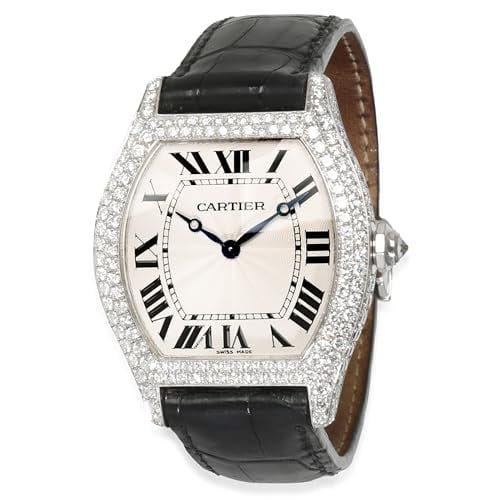
- W1556203 – Platinum case with diamond-set bezel, black alligator strap. Limited production.
Family References
Other Tortue models include the quartz Small Model, the automatic XL Chronograph, and the skeletonized Monopoussoir. The Tortue line also shares design DNA with the Tank and Santos families.
Other Notable Cartier Models
Cartier’s catalog includes the Tank Louis Cartier, Santos-Dumont, Crash, and Pasha de Cartier—each with its own distinct character but all bearing the maison’s signature design language.
Similar Watches
- Patek Philippe Ref. 5172G – Manual-wind column-wheel chronograph with a classic round case, but the Tortue offers a more distinctive shape.
- Vacheron Constantin Historiques Cornes de Vache 1955 – Another curved-case chronograph with a single pusher, though the Cornes de Vache uses a telemeter scale.
- A. Lange & Söhne 1815 Chronograph – German precision and hand-finishing, but the Tortue’s Art Deco curves are more romantic.
Homages
- Seagull 1963 Chronograph – A manual-wind column-wheel chronograph at a fraction of the price, though the case is round and not curved.
- Dan Henry 1939 Chronograph – A vintage-inspired single-pusher chronograph with a cushion case, evoking the same era as the Tortue.
Investment Value
MSRP is $28,500 for the platinum version. Pre-owned examples trade between $22,000 and $26,000. The trend is stable, with no dramatic appreciation or depreciation. For the collector, it is a hold—not a flip. Auction history is minimal, as the model is not widely traded.
Service Interval
Cartier recommends service every 5 years. Authorized service costs approximately $1,200 due to the chronograph complexity. Only Cartier-authorized centers should perform the work to maintain warranty and authenticity.
Price Range
$22,000–$28,500. For the trust-fund-baby buyer, this is a cultured choice that signals depth beyond the usual steel sports watches. The movement finishing and design pedigree justify the premium.
Pros and Cons
Pros: Exquisite hand-finishing, unique curved case, rare single-pusher chronograph, comfortable wear, platinum prestige.
Cons: 30m water resistance, no lume, manual winding, high price, limited availability.
Final Verdict
The Cartier Tortue Monopoussoir is a masterclass in restrained luxury. It offers a genuine horological complication in a case that is both historically significant and visually arresting. While it demands a certain commitment in both cost and care, the reward is a watch that feels personal, artisanal, and timeless. For the collector who values design and movement finishing over trend-driven hype, the Tortue Monopoussoir is a worthy addition to any serious collection.