Every serious collection eventually develops a gap that has nothing to do with money and everything to do with honesty. You own the dive watch, the chronograph, the dress piece — and then you find yourself reaching, day after day, for the cheap quartz in the drawer. The Casio AQ-240EAC is that watch, and it is worth understanding why it happens.
The 1980s twin-dial, revisited
The analog-digital 'combination' watch was one of the more interesting cul-de-sacs of the quartz era. In the mid-1980s, with digital displays suddenly cheap and analog hands suddenly unfashionable, several Japanese manufacturers tried to have it both ways: a conventional handset for quick reading, a digital window for everything else. Most of those watches were ugly. A few, including Casio's twin-dial designs, were quietly brilliant.
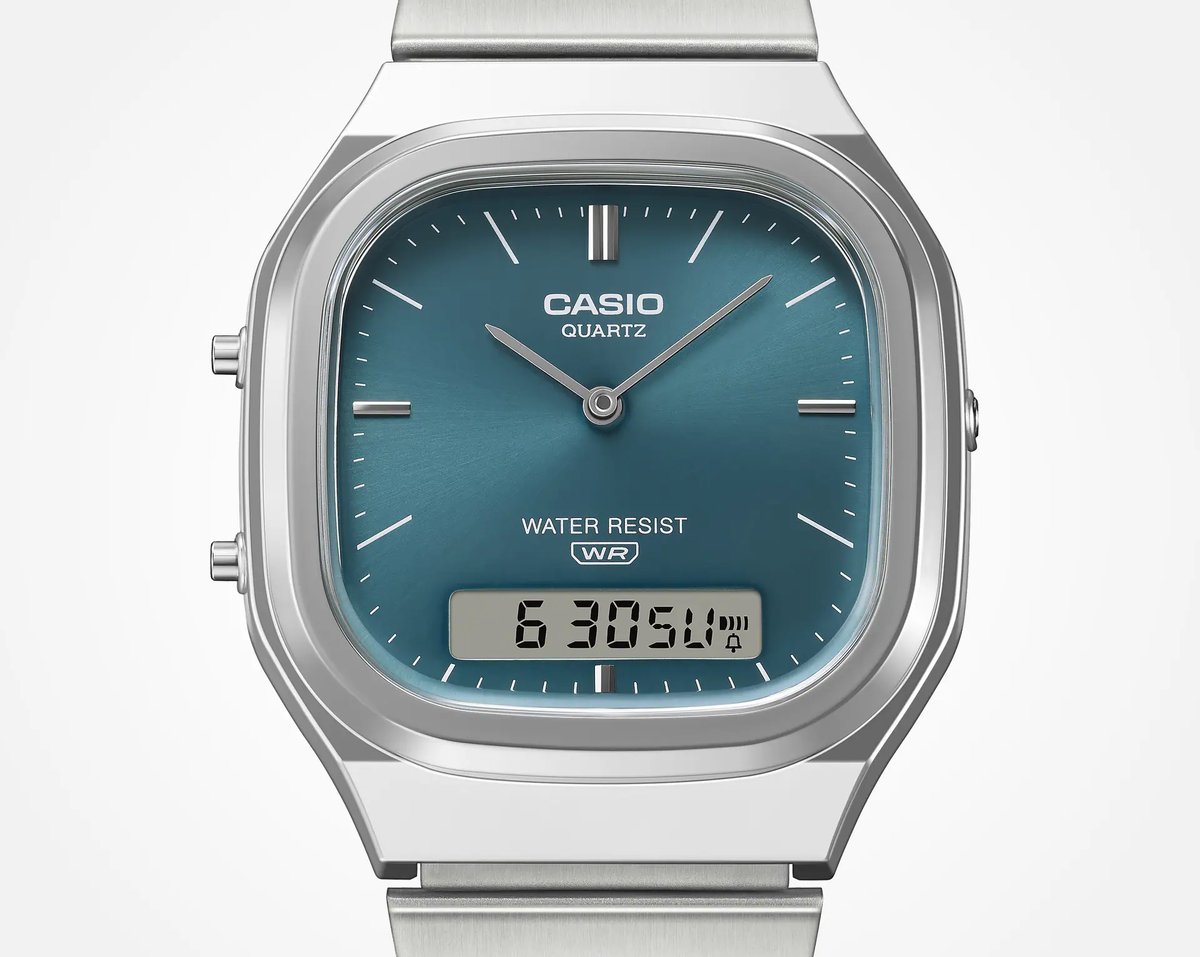
The AQ-240EAC is a modern restatement of that idea. There is a conventional analog dial with hour and minute hands, and set into the lower portion of the layout is a digital LCD that carries day, date and a second time zone. The dial architecture is the entire product here — the hands are wide enough to read at a glance, the digital aperture is large enough to actually use rather than squint at, and the whole thing is balanced in a way that cheap watches almost never are. There is a reason Casio has kept returning to this template; it works.
What the AQ-240EAC is not: a reissue, a limited edition, or a heritage piece with a story attached. It is a current-production Casio in a colourway that will be forgotten by the catalogue in a few years, and that is central to understanding what you are buying.
Brand context
Casio was founded in Tokyo in 1946 by Tadao Kashio and incorporated as Casio Computer Co., Ltd. in 1957. The company's first watch, the 1974 Casiotron, was one of the earliest digital watches with an automatic calendar — a small engineering detail that set the tone for everything that followed. The 1983 G-Shock then established the other half of the Casio identity: the idea that a watch could be simultaneously cheap, robust and culturally significant.
The AQ line sits at the junction of those two histories. It inherits the G-Shock era's functional honesty and the early-digital era's design language, and it does so at a price point that makes the whole exercise feel almost unfair to the competition. Casio makes its own modules; almost nobody at this price does. That vertical integration is why a watch this cheap can be this reliable.
The movement: quartz, and proud of it
Inside is a Casio in-house quartz module driving both a conventional handset via a stepper motor and a digital LCD. The two displays are set independently, which is the single most useful feature on the watch: you can run local time on the hands and a second time zone on the digital readout, or vice versa, without any of the fiddly sub-dial compromises that plague analog GMTs. For anyone who travels, this is a genuinely better solution than a fourth hand, and it costs a fraction as much.
Beyond that you get a day and date display, a daily alarm, and a 1/100-second stopwatch that will handle anything short of a track meet. There is no finishing to admire because there is nothing to finish — the engineering brief is longevity and low cost, and Casio has been executing that brief more consistently than any watchmaker on earth. Jewellery-grade movement architecture is not on the menu, and it should not be.
Power comes from a conventional cell. Casio's battery life in this class of module is measured in a small number of years rather than months, which means the watch is effectively always on. If you have ever wound a mechanical watch every morning for a decade, the absence of that ritual is either a relief or a small loss, depending on your temperament.
On the wrist
The first thing you notice is the size, or rather the absence of it. Casio has resisted the modern urge to inflate the twin-dial template, so the case sits inside the wrist line rather than on top of it. The lugs are short and tucked, which means the watch wears comfortably even on narrower wrists — a meaningful point, since this style of watch is often bought by people who find modern sports watches oversized. The case is stainless steel, with a profile that reads as deliberately retro rather than fashionably chunky.
The resin band does most of the comfort work. It flexes, it does not pull hair, and it does not care about sweat. The pin buckle is basic, the strap is replaceable, and none of it asks anything of you. On a hot day, through a long travel day, under a shirt cuff, the AQ-240EAC disappears in the way a good tool watch should. It is not a watch you notice wearing; it is a watch you notice not having to think about.
The trade-off is presence. This is not a watch that anchors an outfit or catches light across a room. It reads as considered and slightly witty rather than expensive, and for daily wear that is arguably a better register anyway. If you want wrist presence, put the money into a dive watch; the AQ-240EAC is not auditioning for that role.
Accuracy and day-to-day ownership
Casio's published tolerance for quartz modules in this class is measured in tens of seconds per month, which in practice means you will correct it roughly as often as you think about it, which is to say almost never. There is no positional variation, no temperature sensitivity worth noting, and no reason to baby it. Set it, forget it, and let the digital display handle the date so you never have to remember whether the month has thirty days.
Legibility in daylight is excellent; the dial furniture is large and the contrast is high. There is no lume, so after dark you are relying on ambient light and the LCD's own illumination. That is the one place where the format gives something up — a cheap dive watch will beat it at night. For a watch that spends its life between a desk and a train carriage, this rarely matters.
Water resistance is modest, as it is across this tier. Treat it as a watch that tolerates rain and hand-washing rather than one you swim in, and you will never have a problem. Casio's case sealing is reliable; the caution is about expectations, not engineering.
Where it fits: occasions
The AQ-240EAC is at its best in the gaps. It is a daily watch, obviously — it goes with jeans, a t-shirt and a weekend jacket without commentary. It is a casual watch in the specific sense that it does not take itself seriously. It is a surprisingly good office watch, because the dial is legible and quiet and the size disappears under a cuff. And it is an excellent travel watch, because the dual-time arrangement is more practical than most dedicated travel watches and the watch itself is the last thing you would worry about losing.
It is not a formal watch. It is not a sports watch in any technical sense. Where it wins is in the number of days per year it makes sense to wear — and for most collectors, that number is higher than for any mechanical piece they own.
Colourways and the AQ-240 family
Casio rotates dial finishes and band colours across the AQ-240 line, and the suffix on any given reference is best understood as a colourway code rather than a mechanical distinction. The case architecture and module family stay consistent, which means you can choose on aesthetics without worrying that you are buying the inferior version. If a particular dial finish appeals, buy that one; there is no collector's premium for any variant, because there is no collector's market for any variant.
Within the wider family, the AQ-230 is the better-known sibling and the one most buyers will cross-shop, offering the same twin-dial logic in a slightly different case treatment. The AQ-800 carries the template into a more contemporary case shape. All three exist for the same reason: the formula works.
Comparables worth considering
- Casio AQ-230A — the direct sibling. Buy whichever dial you prefer; the ownership experience is the same.
- Timex Q Timex 1979 Reissue — the same retro-quartz instinct at roughly four times the price, with a bracelet and more design swagger. Better finished, less useful.
- Tissot PRX Digital — proof that the integrated-bracelet, digital-dial formula scales up convincingly into luxury-adjacent territory. Five to ten times the money for a watch that does less.
- Braun BN0032 — for buyers who want the same era of functional design thinking with a stricter, more architectural dial.
None of these is a like-for-like substitute, which is the point. The Casio's advantage is not that it is better than the alternatives; it is that it delivers most of the daily usefulness for a fraction of the outlay, and makes the outlay irrelevant if it gets scratched or lost.
The investment case, honestly
There isn't one. The AQ-240EAC sells at retail for a sum you would not think twice about spending on dinner, and the pre-owned market sits well below that because there are millions of Casios and no scarcity whatsoever. The trend is depreciating and will remain so. There is no auction history to speak of, no reference-number premium, and no scenario in which this watch becomes a store of value.
What it does hold is usefulness. That sounds like a consolation prize and it is not: a watch that costs almost nothing, needs almost nothing and gets worn almost every day is doing the job watches were invented to do. If you are allocating capital, allocate it elsewhere and buy this with the change. If you are allocating wrist time, this deserves more of it than most of your box.
Service and longevity
Casio modules at this level are effectively sealed and disposable. There is no meaningful service interval to plan around; when the cell dies, any competent jeweller can replace it for a trivial sum, and if the module ever fails outright, replacing the watch is cheaper than repairing it. That absence of ownership friction is a genuine luxury, and it is one that mechanical collectors chronically undervalue.
The realistic failure points are the strap and the glass. Both are cheap to address. A mineral crystal will pick up micro-scratches over years of daily wear; a replacement resin band costs less than a coffee. Treat the watch as a consumable and it will outlast your expectation of it.
Verdict
The Casio AQ-240EAC is the rare cheap watch that survives serious scrutiny, because it does not pretend to be anything other than what it is: a well-proportioned, unusually legible quartz twin-dial at a price that makes every other consideration secondary. It will not appreciate, it will not impress a room, and it will not take a hard knock the way a G-Shock will. But it will get worn more than most of the collection, and it will teach you something about proportion and legibility that expensive watches often forget.
Buy one, stop thinking about it, and put the saved capital into the watch you actually want.