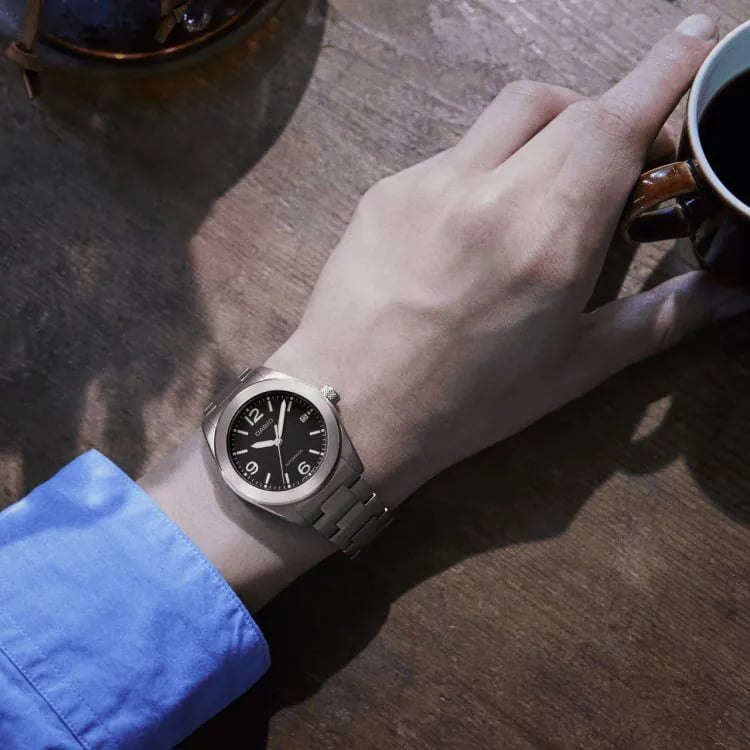
The Dawn of the Bio-Metric Wrist: The Casio CMK-100TD-1A
To understand the Casio CMK-100TD-1A, one must first revisit the cultural zeitgeist of 1999. We were on the precipice of a new millennium, obsessed with the 'Y2K' aesthetic—translucent plastics, brushed metals, and the promise that technology would soon become an extension of our biology. While the watch industry at large was slowly recovering from the Quartz Crisis by embracing mechanical heritage, Casio was leaning hard into the future. The Cyber-Max series was their manifesto, and the CMK-100TD-1A was its most refined expression.
Unlike the resin-heavy G-Shocks that defined Casio’s rugged reputation, the CMK-100TD-1A utilized titanium. This wasn't merely for show; it was a functional necessity. The watch is a behemoth by traditional standards, housing a complex array of sensors and a large LCD screen. In stainless steel, this would have been a lead weight on the arm. In titanium, it becomes an exercise in ergonomic possibility.
Case Geometry and Wearability
The first thing you notice when strapping on the CMK-100TD-1A is the lack of traditional lugs. The case flows directly into the titanium bracelet, creating a unified structure that wraps around the wrist. This integrated design is a double-edged sword. On one hand, it provides a seamless, futuristic look that feels incredibly secure. On the other, the 50.5mm lug-to-lug distance is essentially fixed. If your wrist is narrower than the 'span' of the watch head, you will experience 'the gap'—that space where the bracelet fails to make contact with the skin.
However, for those with a wrist circumference of 6.75 inches or larger, the wearability is surprisingly excellent. The case back is flat and sits low, and the 16.5mm thickness is mitigated by the fact that the edges are chamfered and sloped. It slides under a loose jacket sleeve with ease, though it will certainly fight with a button-down shirt. During a week of testing, I found that the titanium's thermal conductivity—or lack thereof—made it far more comfortable than steel in the early morning. It doesn't have that 'cold shock' when you put it on, and it breathes well during physical activity.
The Pulse Sensor: A Glimpse into the Past
The centerpiece of the CMK-100TD-1A is the infrared pulse sensor located at the 4 o'clock position. To use it, you place your fingertip over the sensor while the watch is in its 'Beat' mode. By modern standards, where an Apple Watch or a Garmin tracks your heart rate 24/7 via green light photoplethysmography on the wrist, the Casio feels primitive. You have to be still, and the reading takes several seconds to stabilize.
But there is a tactile joy in this interaction. There is a specific button on the side of the case that initiates the reading, and the LCD provides a 'heartbeat' animation that is pure 90s charm. For a daily wearer, this feature is less about medical-grade accuracy and more about the ritual of checking in with one's body. It’s a reminder of a time when 'smart' features were intentional actions rather than background processes. The calorie counter, which uses this pulse data alongside your age and weight settings, provides a rough estimate of energy expenditure during a workout—a precursor to the 'rings' we close today.
Legibility and Interface
The LCD on the Module 1845 is divided into several distinct zones. The main timekeeping area is large and crisp, but the upper third of the dial is dedicated to the 'Cyber-Max' graphical interface. Here, Casio uses a series of bars and icons to represent your heart rate zones and caloric progress. Even in direct sunlight, the mineral crystal and high-contrast LCD remain legible. The lack of a sapphire crystal is a minor grievance, but the bezel is slightly raised, providing a sacrificial barrier against door frames and gym equipment.
The backlight is a standard EL (Electro-Luminescent) panel, which glows with a soft blue hue. It isn't as bright as a modern 'Super Illuminator' LED, but it provides a perfectly uniform glow across the entire display, which is something I often miss in modern digital watches. Legibility at night is instantaneous, and the button for the light is easy to find by feel, located at the 2 o'clock position.
The Titanium Bracelet
The bracelet is where the 'TD' (Titanium Deluxe) designation really earns its keep. Each link is precisely machined with a slight taper toward the clasp. The clasp itself is a simple folding mechanism, lacking the micro-adjustment holes we see on modern divers, which is perhaps the watch's biggest daily-wear flaw. Finding a 'perfect' fit might require wearing it slightly loose or slightly tight, depending on your luck with the link sizes.
That said, the matte finish of the titanium is incredibly resilient to 'desk diving' scratches. While stainless steel shows every swirl and scuff, this grade of titanium hides wear remarkably well. The greyish, industrial tone of the metal gives the watch a 'stealth' feel that belies its actual size. It feels like a piece of military equipment rather than a piece of jewelry.
Daily Utility and Durability
Over a full week on the wrist, the CMK-100TD-1A proved to be a robust companion. I took it through several high-intensity interval training (HIIT) sessions and a few swims. The 100m water resistance is more than enough for daily life, and unlike many 'gadget' watches of the era, the seals on the sensor aperture are remarkably tight. I never experienced fogging or moisture ingress.
The accuracy remained flawless, as expected from a Casio quartz movement. But the real utility was in the alarm and stopwatch functions. The buttons have a satisfying 'click'—a mechanical feedback that many modern touch-screen devices lack. There is a confidence that comes with physical buttons, especially when your hands are sweaty or you're wearing gloves.
The Verdict for the Modern Collector
Is the Casio CMK-100TD-1A a practical choice for a one-watch collection in 2024? Probably not. Its pulse-sensing technology has been surpassed by every $30 fitness band on the market. However, for the collector who values the 'Daily-Wear' experience of a specific era, it is a masterpiece. It represents a moment when Japan was leading the world in miniaturized electronics, and they weren't afraid to experiment with bold forms and premium materials.
It wears lighter than it looks, tougher than it feels, and carries a sense of character that is often missing from today’s homogenized smartwatch market. It is a watch for the person who wants the functionality of a digital tool but the soul of a vintage machine. It is a reminder that the future we imagined in the 90s was one of metal, buttons, and tangible interaction—and on the wrist, that future still feels pretty good.