A catalogue number, not a legend
Most watch writing begins with a legend: a moon race, a diving record, a calibre that rewrote an industry. This review begins with a catalogue number and an honest admission. The Casio CMK-100TL-1A is a value-line quartz watch from the Casio Collection family, and Casio has published remarkably little about it. There is no technical press pack, no movement designation in the brand's public literature, no dimension table we can verify against a second source. What exists is the object, the conventions of the house that made it, and the price.
That absence is not a reason to skip it. Vivir writes for young collectors, and a young collection is built from the bottom as often as from the top. The watch worn to a first job, a first apartment, a first long-haul flight is rarely a chronometer-certified automatic. It is usually a quartz watch that simply refuses to fail. Judged on that brief, the CMK-100TL-1A is worth examining with the same discipline we apply to a five-figure calibre, including the discipline of saying plainly what is documented and what is not.
The house that made it
Casio was founded in Tokyo in 1946 by Tadao Kashio and his brothers. Its first great success was not a watch at all: the 14-A relay calculator of 1957. The company spent two decades miniaturising electronics before it turned to timekeeping, and when it did, with the Casiotron of 1974, it arrived with an advantage most Swiss firms did not enjoy. Casio made its own modules. It still does.
That vertical integration is the key to reading the CMK line correctly. When a brand designs and manufactures its own quartz movements, it can put a reliable one inside a case at a price no firm buying ébauches on the open market could match. The G-Shock of 1983 is the famous expression of that logic. The value Collection watches are the quiet one: ordinary cases, ordinary straps, and a module that will run for years on a cell costing less than lunch.
None of this makes the CMK-100TL-1A a collectible. It makes it a document of a specific industrial capability, which for some collectors is a more interesting thing.
Case, dial and the discipline of plainness
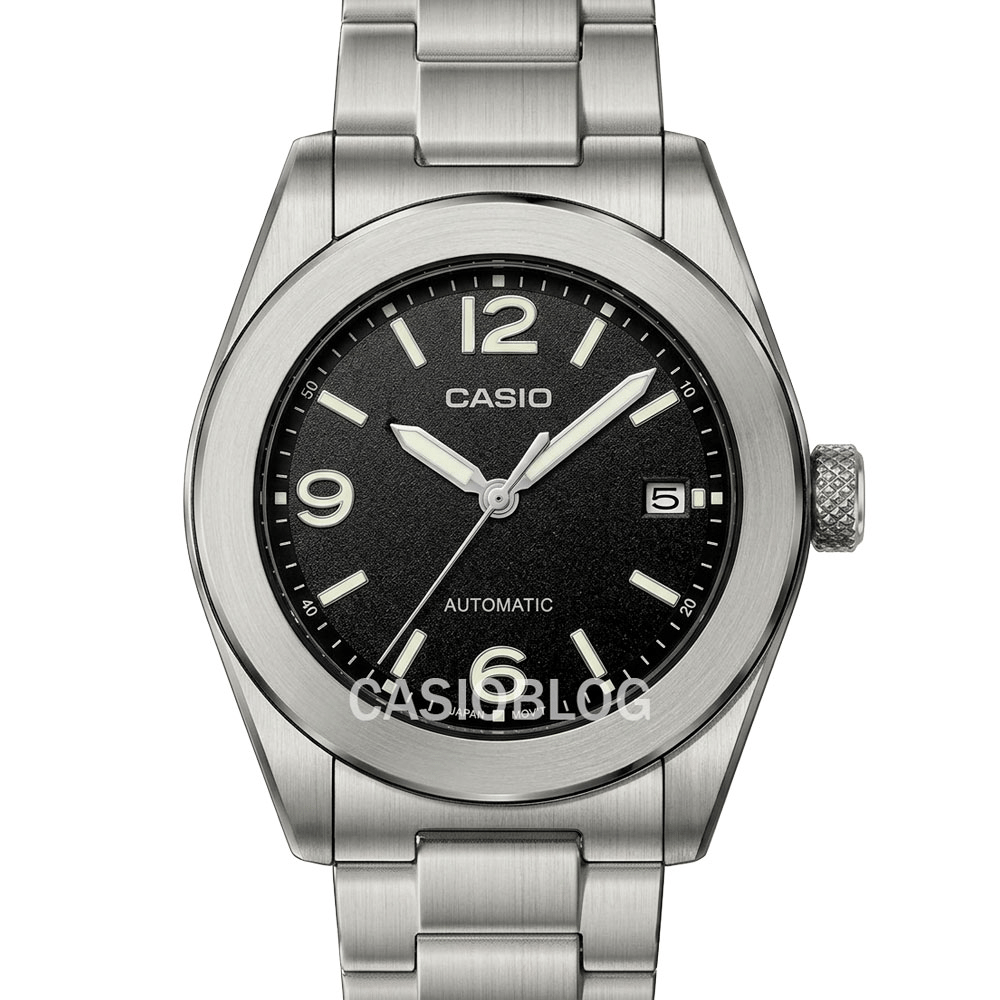
I am not going to hand you a millimetre count, because I have not been able to verify one against a second source and this publication does not manufacture specifications to fill a table. What can be said with confidence is architectural rather than numerical. The CMK-100TL-1A belongs to the plain-analogue school that Casio has been refining for decades: a round case, restrained lugs, a thin bezel that gives the dial as much room as the geometry allows, and a leather strap held by a pin buckle.
The design discipline here is not minimalism as a fashion posture. It is legibility engineering. Casio's value-line dials are built around contrast and clean separation of the hands from the dial surface, and that is exactly what you want from a watch that will be read at a glance, in poor light, on a moving train. There is no applied finishing to speak of and no pretence of hand-craft. There is a graphic clarity that many far more expensive watches get wrong.
The case material is specified as stainless steel, and Casio's value line frequently pairs a steel caseback with a case that may be steel or plated base metal depending on the exact reference — worth confirming with your retailer if that distinction matters to you. The crystal is mineral rather than sapphire. At this price that is not a compromise so much as an inevitability: mineral is more scratch-prone but considerably more impact-resistant, and for a watch likely to meet a doorframe in its first week, impact resistance is the more useful virtue. There is no lume, which is the single most significant functional limitation in the specification and the one thing that keeps this watch out of the true field-watch category.
The movement
Casio does not publish the module number for this reference, and I am not going to invent one. What is known is more useful than a number anyway: Casio designs and manufactures its own quartz modules in-house, which is a genuine vertical-integration story at any price point and the reason the CMK line can exist at all.
Architecturally, expect the standard quartz formula: a quartz oscillator driving a low-torque stepping motor through a small train, a single silver-oxide cell, and a movement with no finishing whatsoever, because none is required and none would survive the economics. This is not a criticism. There is a particular satisfaction in an architecture that has been ruthlessly optimised to do one thing well for a decade with no attention. Swiss lever escapements are beautiful; a Casio quartz module is competent. Both are legitimate engineering achievements, and only one of them will still be running happily after sitting in a drawer for two years.
There are no complications to speak of. That is the point of the design. Every additional function at this price is another thing to fail, and Casio's value watches are famous precisely because they do not fail.
On the wrist
Wearing the CMK-100TL-1A is an exercise in subtraction. There is no heft to negotiate, no crown digging into the back of the hand, no bracelet to resize and re-polish every few months. The leather strap is the dominant tactile element, and it is worth being honest about what a strap at this level is: a service item, not an heirloom. It will crease, darken at the buckle and eventually need replacing. That is fine. Replacing it costs very little and instantly refreshes the entire watch, which is a pleasure that owners of five-figure pieces rarely get to enjoy.
The balance is the pleasant surprise. Because the case is modest and the strap thin, the watch sits flat and close, sliding under a shirt cuff without a fight and effectively disappearing on the wrist. It does not ask to be noticed. For anyone who has spent a day with a heavy steel sports watch tugging at the wrist, the neutrality reads as a virtue rather than a compromise.
The one honest caveat is water. Casio's specification for this reference is not published in a form we can verify, so treat the watch as splash-resistant at best and do not swim in it. That is a meaningful limitation for a watch otherwise so easy to live with, and it is the single strongest argument for stepping up to a resin-cased Casio with a properly rated case.
Accuracy and daily ownership
You should expect quartz accuracy of the ordinary, excellent kind: a few seconds of drift per month under normal wear. Casio does not publish a rate specification for this reference, so treat the class norm as the expectation rather than a certified figure. In practice, a quartz watch at this level keeps time so consistently that owners set it twice a year at the daylight-saving changes and otherwise forget it exists. That is not a failure of romance; it is the whole point.
Ownership costs are close to nil. A cell replacement every few years at any competent local watchmaker, a strap every year or two, and nothing else. There is no service interval to observe, no factory return to budget for, no gasket kit to source. This is the least demanding watch you can own, and for a young collector building a collection around one or two serious pieces, that freedom from maintenance is worth more than it sounds.
The comparison set
The honest rivals are not Swiss. Timex's Easy Reader occupies precisely the same philosophical ground: unfashionable, deeply legible, leather-strapped, built to be worn rather than admired. Seiko's Essentials quartz line offers a step up in case finishing and dial execution for a modest premium, from a brand with equal vertical integration. Citizen's Eco-Drive BM8180 is the natural upgrade path for a buyer who wants to forget batteries entirely, since light powers it. And Lorus, Seiko's value arm, competes on exactly the same brief with Seiko-group module supply behind it.
Against all of them, the Casio's argument is reliability, price and the specific plainness of its design. Against none of them does it win on materials or finishing. Buy accordingly.
Value, and the question of holding
Street pricing for the CMK line sits in the low tens of dollars; the figures in this review are indicative rather than a Casio-confirmed MSRP, and you should verify locally. What that money buys is a legible, reliable, leather-strapped quartz watch from the most vertically integrated watchmaker in the world. What it does not buy is equity. There is no scarcity mechanism, no collector depth, no secondary-market structure. Pre-owned examples trade for less than the cost of shipping them, and that is the correct market for a consumable tool.
So the recommendation is simple and unhedged: buy it to wear. Do not buy it to hold, and do not buy it as an investment, and do not let anyone tell you that a value Casio is an appreciating asset because a particular digital reference once had a moment. Wear it hard, replace the strap, replace the cell, and put the money you saved into the piece you actually intend to keep for thirty years.
Service
Service is battery replacement and gasket resealing at any competent local watchmaker. Casio does not publish a service interval or a fixed battery-life figure for this reference, and quite reasonably, the watch is not worth the cost of factory servicing. This is not a criticism of Casio; it is the correct engineering decision for a product at this price, and it means the watch can be maintained indefinitely by almost anyone with a caseback tool.
The verdict
The CMK-100TL-1A is not a watch that rewards close inspection under a loupe. It rewards being worn, set once and forgotten. Judged as industrial design from a company that manufactures its own modules, it is honest, legible and quietly competent, and it delivers a genuine watch-ownership experience for the price of dinner for two. The absence of published specification is irritating for a reviewer and entirely irrelevant for an owner.
That is the whole case. Buy it as a tool, wear it without ceremony, replace the strap when it wears through, and let it do the one job it was built to do. In a hobby that often confuses expense with virtue, there is something clarifying about a watch that makes no claims at all.