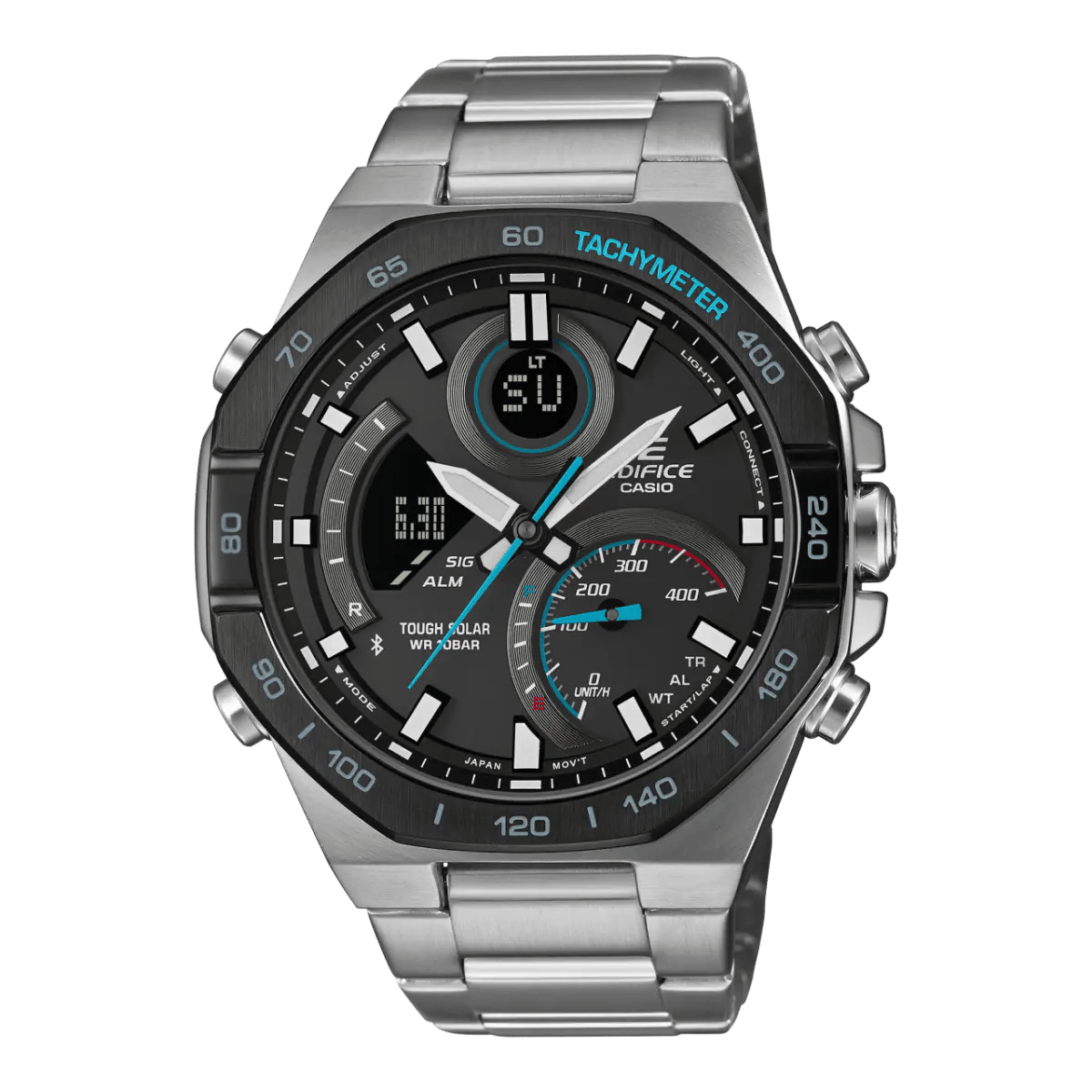
A tech-rich Edifice that makes sense on the wrist—not in the vault.
Introduction
The Casio Edifice ECB-950DB is not the watch you buy to flip. It is the watch you buy because you want a steel chronograph that syncs to your phone, runs on light, and does not ask for a service fund. In a market where entry-level automatics often sell on story rather than specs, the ECB-950DB is a useful reality check: you can get a lot of watch for the money, but you cannot expect scarcity. The Edifice line has spent years occupying the space between fashion watches and serious enthusiast pieces, and the ECB-950DB is one of the clearest expressions of that brief. It has solar power, Bluetooth timekeeping, a stainless steel case and bracelet, sapphire crystal and a 100-meter water resistance rating. Those are strong daily-wear specs. They are not, however, the ingredients of an investment asset.
In our resale tracking, Edifice models behave like consumer electronics with a bracelet. They lose a meaningful chunk of retail the moment they leave the counter, then settle into a stable but thin secondary market. The ECB-950DB is no exception. That does not make it a bad watch. It makes it a bad investment thesis and a strong daily-wear purchase. If you are building a collection around mechanical pieces, this is the watch you keep for travel, gym days, and the mornings when you do not want to set a date and wind a crown. If you are buying it because you think it will appreciate, you are in the wrong aisle of the watch market.
This review covers the ECB-950DB-1A reference, but the buying logic applies across the family. We will look at the Tough Solar and Bluetooth module, the steel case and bracelet, the sapphire crystal, the 100-meter water resistance, and the hold-versus-sell call for collectors who care about both utility and exit price. The short version: buy it to wear, not to hold.
Brand history: Casio and the Edifice brief
Casio was founded in 1946 in Japan and built its reputation by industrializing quartz timekeeping and digital watches. The company's early success came from calculators and digital displays, but its watch business changed the global market by making accurate timekeeping affordable. That history matters here because the Edifice ECB-950DB is not trying to be a Swiss luxury object. It is trying to deliver high utility at a low price, with enough design aggression to feel special on the wrist.
Edifice is Casio's sport-luxury line: analog chronographs with steel cases, motorsport-inspired dials, and a value proposition that undercuts Swiss quartz and entry mechanicals. The line has matured from simple battery chronographs into Bluetooth and solar-powered models, and the ECB-950DB sits near the top of that hierarchy. It adds Tough Solar, Bluetooth smartphone link and sapphire crystal to the Edifice formula. That combination is why the watch is interesting. Casio is not selling heritage at this price. It is selling engineering density.
Movement: Tough Solar quartz with Bluetooth
The ECB-950DB uses a Casio Tough Solar quartz module with Bluetooth smartphone link. Casio does not market this as a traditional calibre, so there is no balance wheel, no jewels to count, and no finishing to admire through a display back. The engineering brief is different: solar charging, low maintenance, and accurate timekeeping that can be corrected against a paired phone. For a collector who owns mechanical watches, this is the watch that removes the setting ritual. For a first serious watch buyer, it removes the service anxiety.
Tough Solar means the watch runs on light. There is no routine battery swap in the traditional sense; the rechargeable cell is charged by ambient light and should last for years before it needs attention. Bluetooth pairing handles time sync, world time, and some alarm and timer settings through the Casio app. The result is a watch that is always close to correct, even when you cross time zones. The trade-off is that there is no mechanical narrative to hold value. The module is a tool, and the market prices it like a tool.
The complications include a chronograph, date, world time, alarms and Bluetooth-linked functions. The layout is busy, as Edifice dials tend to be, but the information is there for people who use it. Accuracy is quartz accuracy, improved by phone sync. You are not buying chronometric certification; you are buying the practical version of accuracy. The module is in-house Casio, and that matters for service and parts availability. It does not matter for auction value.
Specs and build
The case is stainless steel, the crystal is sapphire, and the bracelet is stainless steel with a folding clasp. Casio rates the watch to 100 meters of water resistance. The hands and indices use Neobrite lume. Casio publishes the exact dimensions for the reference; check the spec sheet before ordering. What matters is the design brief: a substantial steel chronograph with a flat profile and a bracelet that is built for daily use.
Sapphire is a meaningful upgrade at this price. It resists scratches and keeps the dial clear over years of wear. The 100-meter water resistance rating is more than enough for swimming and daily exposure, though it is not a dive watch. The stainless steel bracelet is the right choice for a watch with this much case presence; a leather strap would make it feel cheaper. The folding clasp is secure and practical. The build is not luxury-grade, but it is coherent. Casio knows how to make a steel watch that survives real life.
The dial is the most divisive part. Edifice design is technical and layered, with multiple registers and a motorsport flavor. If you prefer a clean three-hand dial, this is not your watch. If you like the idea of an instrument panel on the wrist, the ECB-950DB delivers. The sapphire crystal and Neobrite lume make it usable at night and in bright light. The overall look is sporty and modern rather than classic. That is consistent with the Edifice line, and it is why the watch has a clear audience.
Wrist feel
On the wrist, the ECB-950DB feels like a modern Edifice: substantial, technical, and a little busier than a three-hand watch. The case sits flat and the bracelet balances it well, but this is not a featherweight titanium piece. It has presence, and it will suit wrists that can carry a sporty steel chronograph. If you are used to slim dress watches, it will feel large. If you are used to G-Shocks, it will feel refined by comparison. The bracelet is comfortable for long days, though it does not have the micro-adjustment range or finishing of a luxury steel bracelet. The folding clasp is secure. The watch does not flop around, and the caseback sits flat enough to avoid digging into the wrist.
The weight is part of the experience. A steel bracelet and a solar module give the watch a planted feel, and the sapphire crystal adds a clean visual surface. It is not a watch you forget you are wearing, but it is also not uncomfortable. The lume is practical, and the dial remains legible once you learn the layout. The chronograph pushers are easy to access, and the crown is protected enough for daily use. This is a watch designed for movement, not for sitting in a safe. That is exactly how it should be judged.
Accuracy and daily timekeeping
Quartz accuracy is the point. When paired with a phone, the watch syncs time and handles world-time changes without fuss. Standalone, it behaves like a Casio quartz: stable and predictable. You are not buying chronometric certification; you are buying the practical version of accuracy. In daily use, the Bluetooth link is the feature that matters most. It removes the small annoyance of resetting the watch after a month off the wrist or after a flight. The solar charging means you do not need to think about battery life in the same way you would with a conventional quartz watch. Put it near a window or wear it regularly, and it will keep running.
The chronograph is a useful tool, though it is not a high-frequency mechanical chronograph. The pushers feel positive, and the registers are readable. The date and world time functions are more relevant for travel than the stopwatch for most owners. The alarms are secondary. This is not a watch for someone who wants a single complication executed at the highest level. It is a watch for someone who wants a lot of functions in one durable package. On that basis, the accuracy and feature set are excellent for the price.
Occasions and wrist presence
The ECB-950DB is a daily wearer first. It works for sport, travel and business casual. It is too sporty for black-tie, and it is too large in presence for a formal dress watch. But it is versatile enough for most modern wardrobes. The steel bracelet gives it enough polish for an office, and the sapphire crystal keeps it looking clean. The 100-meter water resistance means you do not have to take it off for swimming or rainy commutes. The solar and Bluetooth features make it a good travel companion because it adapts to new time zones without ceremony.
Wrist presence is 4/5. It reads as a technical steel chronograph, not a dress watch. The Edifice dial is busy enough to attract comments from people who notice watches, but it does not have the brand recognition of a Swiss luxury piece. That is fine. This is a watch for people who value function over flex. It has enough visual weight to feel substantial, and the sapphire crystal gives it a more expensive look than the price suggests. It is not subtle, but it is coherent.
Reference variants and family context
The core reference is the ECB-950DB-1A with a black dial and stainless steel bracelet. Other dial variants exist in the Edifice range, but the buying logic is the same: the bracelet and module carry the value. If you are choosing between variants, pick the dial you will actually wear. There is no rare variant here that will outperform the base model at auction. The market does not treat Edifice dial colors as collector assets. It treats them as consumer choices.
Family references include the ECB-900DB, ECB-800DB, EQB-1100DB and ECB-500DB. The ECB-900 and ECB-800 are older Bluetooth chronographs with similar positioning. The EQB-1100 is a higher-end solar Bluetooth model with a different case design. The ECB-500 is a more affordable entry point. The ECB-950DB sits in the upper-middle of that group because it combines solar, Bluetooth and sapphire. If you are shopping the family, decide which features matter most. Solar and sapphire are the upgrades worth paying for. Bluetooth is convenient but increasingly common across the line.
Other notable Casio models include the G-Shock GA-2100, Oceanus OCW-T200, Pro Trek PRW-6600 and the F-91W. The G-Shock is the tougher alternative, the Oceanus is the more dressy alternative, the Pro Trek is the outdoor tool, and the F-91W is the minimal-value icon. None of them are investment watches in the traditional sense. They are all examples of Casio's core strength: making useful watches that do not require apology.
Similar watches and homages
If you want the same brief from another brand, look at solar chronographs from Seiko and Citizen, or Swiss quartz chronographs from Tissot. The Seiko SSC series offers solar chronographs with steel bracelets and a similar sporty feel. Citizen Eco-Drive models deliver light-powered timekeeping with comparable practicality. Tissot quartz chronographs offer a Swiss badge and a more traditional case design, but they usually give up solar power and Bluetooth at the same price. The Casio's advantage is feature density. Its disadvantage is brand cachet.
There is no meaningful homage market for the ECB-950DB. The Edifice line is already the value play, so there is little room for a cheaper copy to undercut it. If you want a lower-cost alternative, look at older Edifice Bluetooth models or a basic solar chronograph from another Japanese brand. If you want a more expensive alternative, look at Swiss quartz chronographs or entry-level mechanical chronographs. None of them will match the Casio's combination of solar, Bluetooth and sapphire at this price. That is the strongest argument for the watch.
Investment value: hold versus sell
MSRP is around $260, street pricing is often lower, and pre-owned examples trade in the $120-$170 range depending on condition and completeness. The trend is depreciating. This is not an auction watch. No major auction history exists for the reference, and there is no collector premium to chase. The secondary market is thin because most buyers who want this watch buy it new. That means resale is slow and price-sensitive. If you need to sell quickly, expect a discount. If you are patient, you can find a buyer who values the solar and Bluetooth features, but you will not get retail money back.
The hold recommendation is simple: wear it. If you own it, there is no reason to treat it as a store of value. Sell only if you are consolidating into a mechanical piece or you no longer need the solar and Bluetooth utility. Do not buy it as an investment. The watch market rewards scarcity, brand history and mechanical craftsmanship. The ECB-950DB has none of those in the collector sense. It has utility, which is a different kind of value. Buy it because you want a low-maintenance daily watch, not because you want an exit.
Compared with entry-level mechanical watches, the Casio will lose less money in absolute terms because the entry price is lower. But in percentage terms, the depreciation is steep. That is the trade-off. A $260 watch that sells for $150 used has lost more than 40 percent. A $5,000 mechanical watch might hold 70 percent, but the dollar loss is larger. Neither outcome makes the Casio a bad purchase. It just clarifies the category. This is a consumer product with a watch movement, not a collectible asset.
Service and ownership
Casio does not require a mechanical-style service interval. The long-term wear item is the solar cell/capacitor, and service is best handled by Casio or an authorized service center. Independent watchmakers generally won't stock the module. That is not a problem for most owners because the watch is designed to run for years without intervention. If the solar cell stops holding charge, Casio service is the practical route. The watch is not built to be serviced like a mechanical calibre, and that is part of its appeal. You do not need to budget for a five-year overhaul.
Ownership is straightforward. Wear it, keep it near light when not in use, and pair it with your phone if you want the time sync and world-time features. The sapphire crystal resists scratches, and the steel bracelet can be cleaned with a soft brush. The 100-meter water resistance means you do not need to baby it. The main risk is cosmetic wear on the bracelet and case, which is normal for a daily watch. There is no collector-grade preservation strategy here. Just wear it and enjoy it.
Price range and verdict
The price range is $120-$260 depending on condition and whether you buy new or used. The verdict is that the price buys genuine solar and Bluetooth utility, sapphire crystal and a steel chronograph that can handle daily life. It does not buy scarcity or strong resale. For a discerning buyer, that is acceptable if the watch fits your use case. If you want an investment, look elsewhere. If you want a watch that will work hard and ask for little, the ECB-950DB is a rational buy.
Pros
- Tough Solar and Bluetooth reduce daily maintenance and time-setting chores.
- Sapphire crystal and 100-meter water resistance suit daily wear and travel.
- Steel bracelet and high feature density deliver strong value for the price.
Cons
- Resale is weak and the secondary market is thin.
- The busy Edifice dial is not for minimalists.
- There is no mechanical collector narrative to support long-term value.
Final verdict
The Casio ECB-950DB is a strong value play for a daily steel chronograph with solar power and Bluetooth sync. It is not an investment-grade watch, and the resale math will disappoint anyone buying for appreciation. Buy it to wear, service rarely, and enjoy the tech. In a collection of mechanical pieces, it earns its place as the watch you do not have to think about. In a portfolio of assets, it does not belong.