A hundred and thirty dollars does not buy you heritage, hand-finishing, or a place in a queue. It buys you a steel case, a steel bracelet, a working chronograph, and the accumulated manufacturing discipline of the company that has made more timepieces than any other in history. The Casio Edifice EFR-109D is worth taking seriously — not as a novelty, but as a piece of industrial design executed to a brief.
Why This Watch Exists
The modern collector's instinct is to treat the entry-level quartz chronograph as a stepping stone: something to be worn until the real watch arrives. That framing misunderstands what a watch like the EFR-109D actually does. It is not a placeholder. It is a self-contained answer to a set of entirely reasonable questions — how do I tell the time accurately, time things when I need to, and look composed while doing it, without putting a significant sum of capital on my wrist?
Casio has been answering those questions for decades. The Edifice line was created in 2000 as the company's steel sports-chronograph proposition, and the EFR-109D is one of its more restrained expressions: a case with a chronograph bezel, a dial with sub-registers, a date aperture, and a three-link steel bracelet. Nothing here is trying to evoke a Swiss legend. It is its own object, designed within a manufacturing system that prizes repeatability and durability over decorative flourish.
For a young collector building a first proper watch wardrobe, that matters. The EFR-109D lets you learn what you actually want from a watch — how you use a chronograph, whether you prefer a bracelet or a strap, how much presence you are comfortable with — without committing serious money to the education.
Brand Context: Casio and the Edifice Line
Casio was founded in Tokyo in 1946 by Tadao Kashio, and its breakthrough product was not a watch but a compact electronic calculator. That origin is important. Casio came to horology as an electronics company, not as a movement atelier, and it brought with it an engineering culture oriented around miniaturisation, power efficiency, and shock tolerance. When the company turned to watches, it did so with the assumption that a timepiece should survive its owner.
The Edifice line, launched in 2000, applied that culture to the steel sports chronograph — a category historically dominated by Swiss and Japanese mechanical houses. Casio's proposition was simple: the same visual language, the same functional specification, a fraction of the price, and quartz reliability that no mechanical chronograph at any price can match for sheer measurement precision.
The EFR-109D sits near the accessible end of that line. It is not the most complicated Edifice, nor the most technically exotic — Casio reserves solar and radio-controlled movements for higher tiers. What it is, is honest: a mechanical-looking object built around an electronic heart, with no pretence about which is which.
Case, Dial, and Finishing
The case is stainless steel, and that single fact separates the EFR-109D from a large proportion of the sub-two-hundred-dollar market, where plated base metal and resin cases are common. Steel matters on a daily-wear watch: it resists the small knocks that dull plating, it does not discolor at the edges, and it can be refinished — by a competent polisher or, more practically, simply lived with until the scratches become part of the watch's history.
Finishing on the case is a mix of brushed and polished surfaces, executed with the consistency you would expect from Casio's production lines rather than the fluidity you would find on a hand-finished piece. The transitions are clean and the brushing is even; there are no wobbly edges or uneven reflections. This is industrial finishing done well, and it looks considerably more expensive than it is.
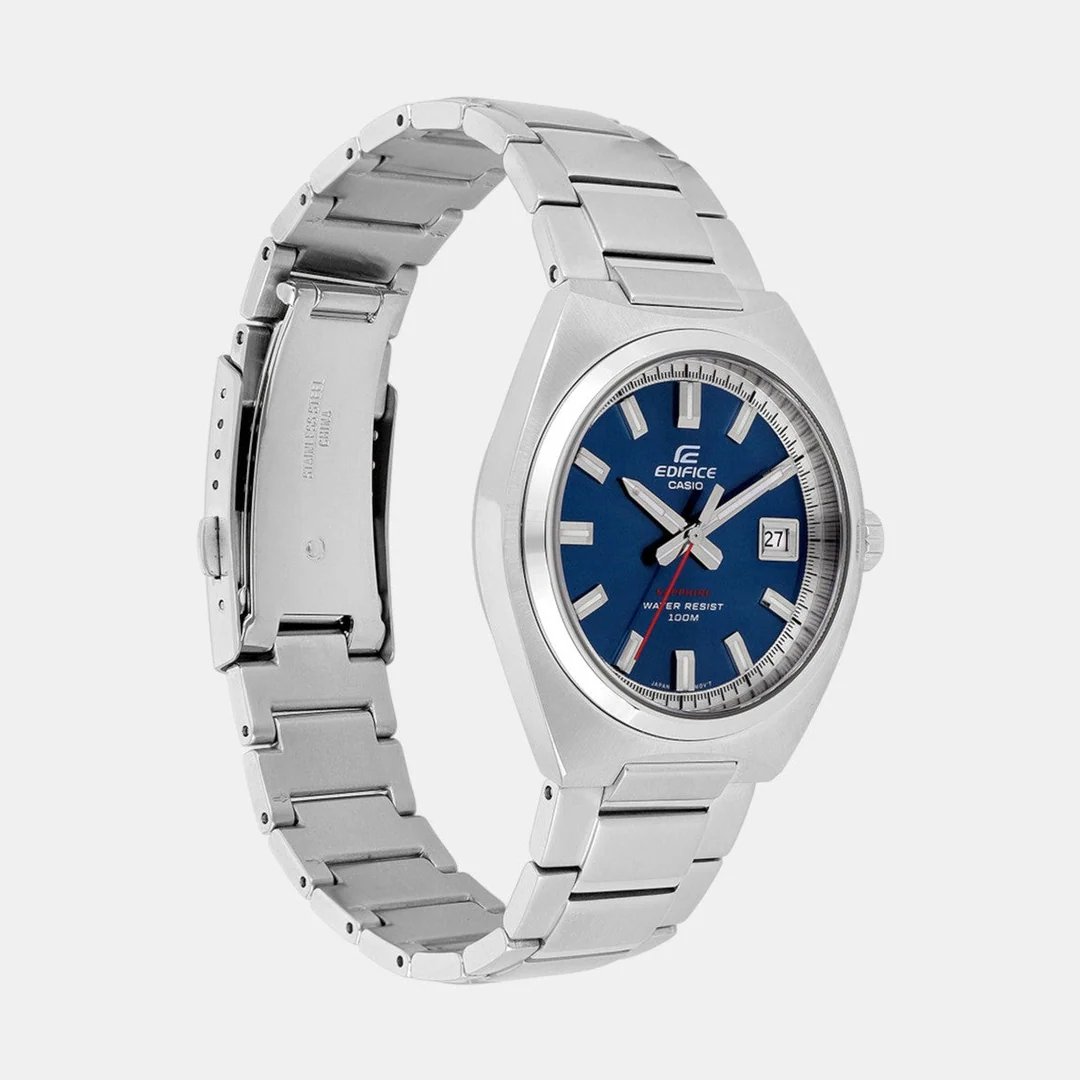
The dial is where the Edifice DNA is most visible. Sub-registers handle the chronograph functions, a date aperture keeps the daily information legible, and applied hour markers and hands give the dial enough depth to avoid the flat, printed look that afflicts cheaper chronographs. The crystal is mineral rather than sapphire — a rational cost decision, and the one place where the watch's price is genuinely visible. Mineral glass is perfectly clear and adequately scratch-resistant, but it will pick up fine hairlines over years of wear that sapphire would shrug off. The compensation is that replacement crystals are inexpensive and the swap is simple.
Luminous treatment is Casio's own Neobrite compound, applied to the hands and hour markers. It performs as a functional low-light aid rather than a spectacle; after a few hours in darkness the glow is modest. For a watch that will spend most of its life under office lighting or daylight, this is a reasonable trade.
The bracelet deserves separate mention. It is a three-link stainless steel design with a folding clasp, and it is the single element that most elevates the watch above its price bracket. Solid links, decent articulation, and a clasp that sits flat against the wrist rather than presenting an edge to it. The bracelet tapers toward the clasp, which keeps the visual weight balanced and prevents the watch from feeling like a cuff.
The Movement: Quartz, Honestly Considered
Inside is a Casio analog quartz chronograph module. Casio designs and manufactures its own quartz movements in its own facilities, which makes this a genuinely in-house calibre — a term usually deployed in far more rarefied contexts, but one that applies accurately here. The company that builds the module also builds the case that houses it and the bracelet that attaches to that case, which is more vertical integration than many Swiss houses can claim.
The architecture is industrial by design. A plated movement holder, a stamped and screwed-down caseback, a battery hatch that opens without drama. There is no anglage, no perlage, no Côtes de Genève — and to complain about that would be to misunderstand the object entirely. The module's job is to keep time to within a few seconds a month for years at a stretch, to drive a chronograph function that starts and stops with crisp authority, and to do so with no maintenance beyond an occasional cell change.
The chronograph itself is a joy in the specific way that quartz chronographs always are: the pushers engage cleanly, the reset snaps back to zero without hesitation, and the elapsed-time measurement is precisely accurate because it is derived from a 32,768 Hz oscillator rather than a column wheel and a train of gears. If you intend to actually use a chronograph — for cooking, for intervals, for timing a parking meter — this is the technology that does it best.
What you give up is the ritual. There is no winding, no rotor spinning up, no daily interaction with the mechanism. For some collectors that is a dealbreaker; for others it is the entire point.
On the Wrist
Wearing the EFR-109D is an uncomplicated experience, which is the highest compliment a daily-wear watch can receive. The bracelet articulates well enough that the watch settles into position and stays there, and the caseback sits close enough to the skin that there is no rocking or lifting as the wrist moves. Because there is no automatic winding module stacked inside, the watch carries less mass than its visual presence suggests.
The taper of the bracelet is doing real work here. Without it, a steel sports chronograph can feel like a shackle; with it, the watch reads as balanced, the visual weight falling away toward the clasp rather than sitting in a block on top of the wrist. Through a full day of typing, driving, and reaching, the EFR-109D stays quiet and unobtrusive.
It is worth being straightforward about one thing: this is a design language built for presence. The case reads as a full-size sports chronograph rather than a discreet dress piece, and on the smallest wrists it will look emphatic. That is not a fault; it is a choice, and it is the choice the category demands. But buyers who prefer their watches understated should look at a slimmer three-hander rather than expecting this one to disappear.
Presence, on our scale, is a three out of five. It is unmistakably a steel chronograph and it looks correct with a shirt cuff or a t-shirt. It will not start a conversation at a dinner party, and it will never look out of place at one either.
Accuracy and Daily Life
Quartz accuracy at this price is a solved problem. Casio generally publishes a tolerance in the region of plus or minus twenty seconds per month for its analog quartz modules, and real examples typically perform better than that. In practice, most owners will find themselves resetting the time a handful of times a year — usually prompted by a date change, a daylight-saving shift, or the battery dying rather than by measurable drift.
Compare that to a mechanical watch at ten or twenty times the price, which may drift by several seconds a day and requires a service every five to seven years at a cost that would replace the EFR-109D outright. There is a reason quartz conquered the world, and a week with this watch makes the reason obvious: it is simply correct whenever you pick it up.
The chronograph adds practical utility that most mechanical chronographs never deliver, because their owners are too conscious of wear to use them. Here the pushers can be used without a second thought, which means they actually get used — for timing a roast, for counting intervals, for the small daily measurements that a watch on the wrist is uniquely positioned to make.
Ownership and Service
Ownership costs are close to negligible. Servicing means a battery cell change, which any competent local watchmaker can perform in minutes, and which Casio's global service network handles inexpensively. There is no mechanical-style overhaul, no lubrication schedule, no gasket replacement cycle that requires a trip to Switzerland.
This changes the psychology of ownership in a way that collectors often underestimate. A watch that costs almost nothing to maintain is a watch you can wear without calculation — in the sea, in the workshop, on a bicycle, in a rental car. It removes the small background anxiety that accompanies an expensive mechanical piece, and for many people that freedom is worth more than the object's intrinsic sophistication.
Comparisons and Alternatives
The obvious alternative at a similar price is a Seiko quartz chronograph such as the SNDC33, which offers a comparable steel case, a slightly dressier dial treatment, and Seiko's own module. The Seiko is a legitimate rival; the choice between them comes down to dial design and bracelet feel rather than any meaningful gap in quality.
Buyers who dislike the idea of a battery should look at Citizen's Eco-Drive chronographs, which use a light-powered cell that effectively removes the maintenance cycle. The trade is a slightly higher entry price and dial designs that lean more conservative. For those who want a watch that is never touched except to be set, that is a compelling proposition.
Within Casio's own catalogue, the Edifice EFR-556D offers the same formula with a busier, more technical dial, and the EQS-920 line adds solar charging for a modest premium. The G-Shock DW-5600E is the other great Casio entry point — tougher, more casual, and even cheaper to own, but far less versatile with a shirt cuff.
What none of these alternatives offer is a meaningfully better-made steel bracelet at this price. That is where the EFR-109D earns its place.
Value Verdict
The EFR-109D sells in the region of one hundred and ten to one hundred and seventy dollars depending on market and configuration, and pre-owned examples trade between roughly forty-five and ninety. That is depreciation, but it is shallow depreciation in absolute terms — the cost of a year's ownership is smaller than a single dinner.
What the price buys is a solid stainless steel case and bracelet, a genuine chronograph function, quartz timekeeping that embarrasses far more expensive watches, and the manufacturing consistency of a company that has been perfecting this kind of object for decades. What it does not buy is a story to tell at a dinner party, a service history to preserve, or a value that will appreciate.
For a discerning buyer, that is a fair trade — arguably a generous one. The EFR-109D is not an investment. It is a tool, honestly made and honestly priced, and it will outlast most of the things you spend a hundred and thirty dollars on.
Final Verdict
The Casio Edifice EFR-109D succeeds precisely because it does not pretend. It is a steel chronograph with a quartz heart, built to a standard that its price does not require, and offered without mythology. Wear it as a first watch, a travel watch, or the watch you put on when you are doing something you would not do in anything more expensive.
It will keep time. It will time things. It will look right. And it will never ask anything of you beyond a battery every few years. In a hobby that increasingly rewards complexity and cost, there is something genuinely admirable about a watch that rewards simplicity instead.