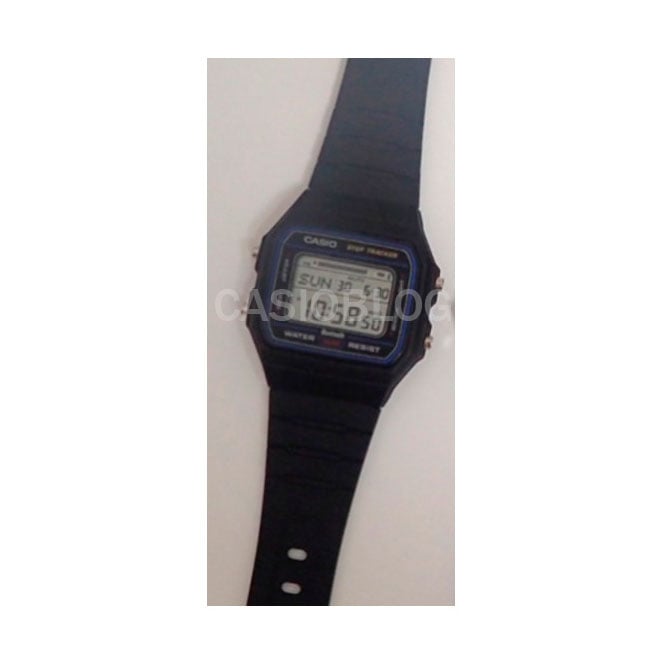
The Philosophy of the Minimum: Understanding the FB100W
To understand the Casio FB100W, one must first understand the era that birthed it. The 1990s represented a pivot point in consumer electronics. The bulky, angular aesthetics of the 1980s were being smoothed over by a new wave of 'organic' design. In Japan, this manifested as a drive toward miniaturization that didn't sacrifice utility. The FB100W, part of the celebrated 'Film Watch' series, was the culmination of Casio's efforts to make the timepiece an extension of the skin itself.
The nomenclature 'Film Watch' was not accidental. It referred to the Pela technology—a construction method where the watch module was essentially sandwiched within a thin, flexible laminate or high-performance resin. This allowed for a profile that was, at the time, revolutionary. While the Swiss were battling for thinness in mechanical movements with calibers like the Piguet 21, Casio was achieving similar goals through the radical reimagining of the quartz module's physical footprint.
Technical Deep Dive: Module 1275
At the heart of the FB100W lies the Module 1275. In an era where digital modules were becoming increasingly bloated with features like compasses, thermometers, and remote controls, the 1275 was a return to purity. Its architecture is strictly horizontal. By spreading the components—the quartz crystal, the integrated circuit, and the liquid crystal display—across a wider but shallower plane, Casio's engineers were able to shave precious millimeters off the case height.
The LCD itself is a marvel of 90s clarity. It utilizes a high-contrast segment arrangement that prioritizes the primary time display while keeping the secondary functions (date, alarm, and dual time) accessible via a single-button toggle. The power management of the 1275 is equally impressive, squeezing two years of life out of a minuscule battery, a necessity given the limited volume of the case interior.
The Ergonomics of Resin
The use of resin in the FB100W is often misunderstood by those accustomed to the weight of 316L stainless steel. However, in the context of the Film Watch, resin was a deliberate choice, not a cost-cutting measure. Resin allowed for the complex, integrated geometry required to make the strap flow seamlessly from the case. This creates a monolithic structure that distributes the weight of the watch evenly across the wrist, eliminating the pressure points common in traditional lug-and-spring-bar designs.
The tactile experience is one of softness and flexibility. The watch flexes with the movement of the wrist, a quality that Casio specifically engineered to appeal to a younger, more active demographic. This was the 'athleisure' of horology before the term existed—a watch that could be worn during a morning run and still look sharp under the neon lights of a Shibuya club.
Aesthetic Analysis: A Study in 90s Futurism
Visually, the FB100W is a study in restraint. The bezel is minimal, almost non-existent, serving only to frame the mineral crystal. The branding is subtle, a departure from the bold 'G-SHOCK' or 'PROTECTION' text found on its more rugged siblings. The color palettes offered were typically monochromatic or utilized subtle pops of teal and magenta, reflecting the graphic design trends of the mid-90s.
The dial layout is balanced, with a clear hierarchy of information. The inclusion of a dual-time function speaks to the increasing global connectivity of the decade. It was a watch for the 'digital nomad' before the lifestyle was codified, providing a simple, reliable way to track time across borders without the bulk of a traditional GMT watch.
The Collector's Perspective: Why the FB100W Matters Today
For the modern collector, the FB100W offers a unique proposition. It is a 'pure' digital watch. In an age of smartwatches that demand daily charging and constant attention, the FB100W is a set-and-forget instrument. It represents a peak in the evolution of the standalone digital watch—a time when the technology was mature enough to be reliable but had not yet been superseded by the multifunctionality of the smartphone.
Finding an FB100W in good condition today is a challenge. The very resin that makes it so comfortable is also its Achilles' heel. Over decades, the plasticizers in the resin can evaporate, leading to 'resin rot'—a condition where the material becomes brittle and eventually crumbles. Consequently, New Old Stock (NOS) examples have seen a steady climb in value on the secondary market, particularly among Japanese and European collectors who prize 90s ephemera.
Conclusion: The Legacy of the Film Watch
The Casio FB100W is more than just a timepiece; it is a piece of industrial art. It encapsulates a specific moment in Japanese design history where the goal was to harmonize technology with the human body. Its thinness is not a gimmick, but a functional triumph that provides a wearing experience unlike anything else in the horological world.
For those who appreciate the technical nuances of quartz movements and the bold experimentation of late 20th-century design, the FB100W is a essential study. It proves that greatness in horology is not measured by the number of zeros in the price tag, but by the clarity of the vision and the precision of the execution. As we look back at the giants of the 90s, the FB100W stands tall, precisely because it is so incredibly small.