The Strategic Appeal of the G-Shock GW-2500
In the world of professional horology, the term 'tool watch' is often applied to luxury divers that rarely see a swimming pool, let alone the ocean floor. However, when we pivot to the Casio G-Shock GW-2500, the terminology regains its literal meaning. As an analyst at Vivir, I often encounter collectors who have reached 'peak mechanical'—they own the Royal Oaks and the Nautiluses, yet they find themselves lacking a piece that can withstand the rigors of a transatlantic flight or a weekend in the backcountry without the looming fear of a $2,000 service bill. The GW-2500 is the sophisticated answer to this dilemma.
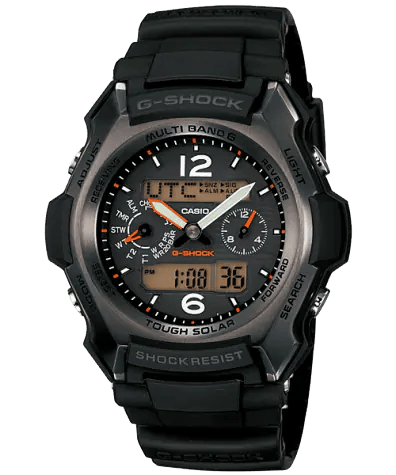
Released as part of the Gravity Defier series, the GW-2500 was engineered to meet the specific needs of pilots. This meant high G-force resistance, multi-timezone capability, and, most importantly, instantaneous legibility. While later models in the Gravitymaster line moved toward a purely analog interface, the GW-2500 utilized a sophisticated four-window LCD layout integrated into the analog dial. This 'Ana-Digi' approach provides the best of both worlds: the quick-glance timekeeping of traditional hands and the precision data delivery of a digital screen.
Technical Architecture: The 5064 Module
At the heart of the GW-2500 is the 5064 module. For the serious collector, the movement is always the starting point of any valuation. While quartz is often dismissed by purists, the 5064 is a marvel of electronic engineering. It incorporates Casio's 'Tough Solar' technology, which utilizes a high-capacity solar-charging system. This system is capable of generating power from even the dimmest fluorescent lighting, ensuring that the watch remains operational for months in total darkness.
Furthermore, the inclusion of Multi-Band 6 atomic timekeeping adds a layer of 'set-and-forget' luxury. The watch receives calibration signals from six transmitters around the globe (Japan, China, USA, Germany, and the UK). This ensures that whether you are landing in Heathrow or Haneda, your watch is accurate to the second. From an investment standpoint, this reliability makes the GW-2500 a 'benchmark' piece—the watch you use to set your mechanical chronometers.
Market Dynamics and Resale Value
When analyzing the secondary market for G-Shocks, we look for 'discontinued demand.' The GW-2500 was eventually succeeded by the GW-3000 and GW-3500, but many enthusiasts argue that the 2500 remains the peak of the lineage. Why? Because the 3000 moved to a fully analog display that many found cluttered and difficult to use for complex functions like the 1/100th-second chronograph. This has created a steady demand for the GW-2500 on the pre-owned market.
Currently, a GW-2500 in excellent condition commands a price close to its original MSRP, a rarity for non-limited quartz watches. The 'B' variant, with its black ion-plated bezel and negative display, is particularly sought after by collectors who prefer a tactical aesthetic. However, the standard GW-2500-1A, with its brushed steel bezel, offers a more 'executive' look that bridges the gap between a tool watch and a daily wearer. We categorize this as a 'Stable' asset; it is unlikely to see a parabolic price increase, but its floor is remarkably high due to its legendary durability and the dwindling supply of clean examples.
Design Language and Ergonomics
The design of the GW-2500 is heavily influenced by cockpit instrumentation. The large, luminescent hands are shaped like flight instruments, and the sub-dials are positioned to provide maximum information without obscuring the primary time. The case construction uses a 'hollow structure' that protects the module from shocks by suspending it within a resin and steel cage. This is not just marketing; it is a proven engineering solution that has allowed G-Shocks to survive falls from 10 meters.
On the wrist, the GW-2500 defies its 47mm dimensions. The lug-to-lug distance of 52mm is mitigated by the downward curve of the resin strap, which allows the watch to hug the wrist. This is a critical factor for the modern collector who may be moving away from the 'oversized' trend of the mid-2010s toward more wearable, functional proportions. The weight is balanced, and the materials are chosen for skin comfort over long periods, making it an ideal travel companion for long-haul flights.
The Collector’s Verdict
Is the GW-2500 a 'luxury' watch? In the traditional sense, no. But in the context of 'luxury utility,' it is a cornerstone. It represents an era of G-Shock where the focus was on perfecting the interface between man and machine. For the young collector building a balanced portfolio, the GW-2500 serves as the 'rugged' pillar—a watch that offers immense horological value, historical context, and a level of reliability that no mechanical watch can match.
In summary, the GW-2500 is an underrated asset. It is a watch that has proven its worth in the cockpits of fighter jets and on the wrists of global travelers. As the market for early 21st-century digital-analog hybrids continues to mature, the GW-2500 will likely be remembered as one of the most successful executions of the pilot watch concept. Whether you are buying it as a 'beater' for your Patek Philippe or as a standalone piece of engineering history, the GW-2500 is a sound acquisition.