Brand context: Casio and the Mudmaster mission
Casio was founded in Japan in 1946 and became a global force in electronic timekeeping before launching G-Shock in 1983. The G-Shock formula was simple and radical: a watch that survives shock, vibration, water and rough handling without asking the wearer to treat it like a fragile heirloom. Over the decades, that formula expanded into specialized families, including Master of G, which covers Rangeman, Mudman, Gulfmaster and Mudmaster models.
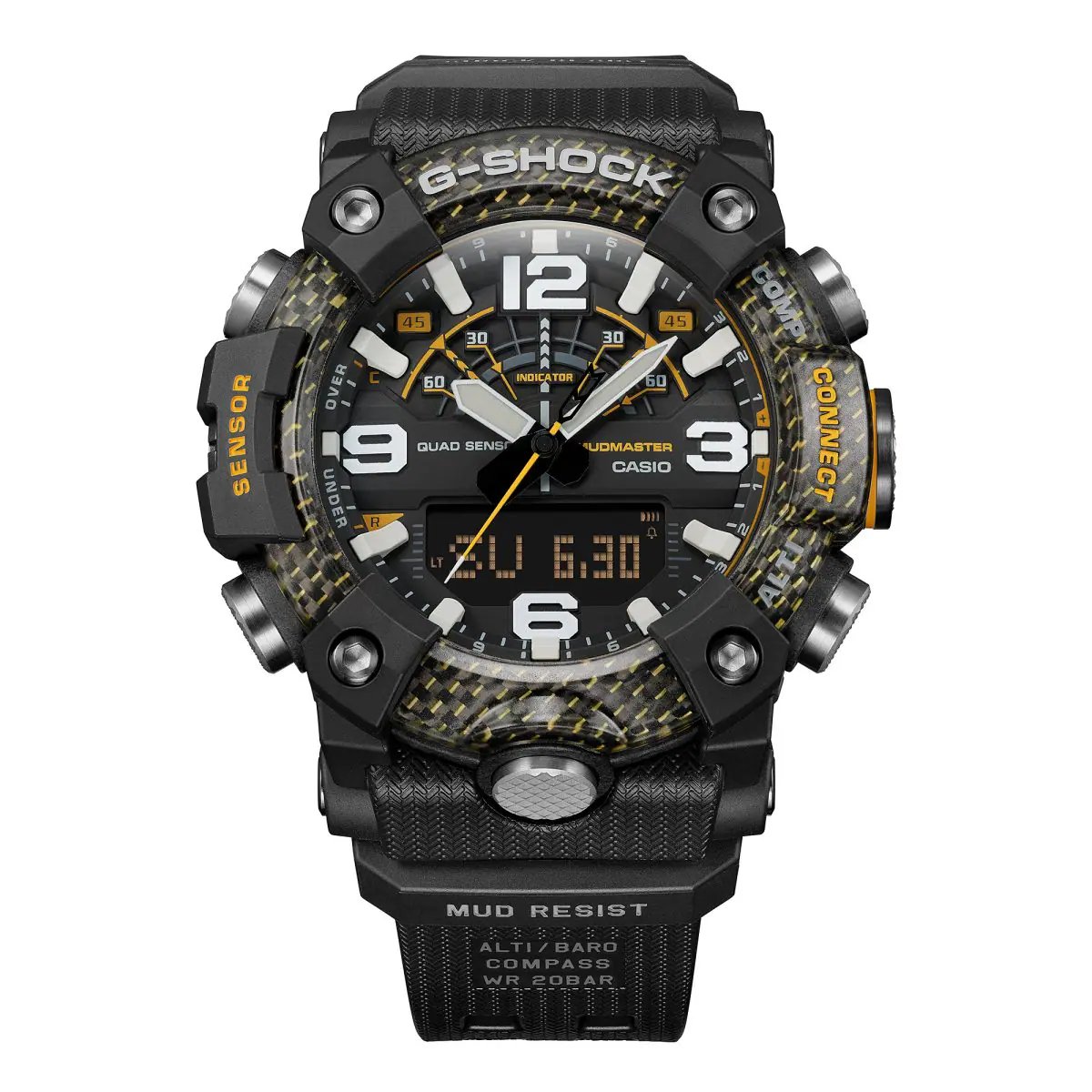
The Mudmaster branch is aimed at field, rescue and outdoor environments where mud, dust and debris are part of the job. The GG-B100 family moved the Mudmaster formula into Casio's Carbon Core Guard era and added Bluetooth-linked Quad Sensor functionality. The GG-B100Y-1A is a yellow-accented member of that family, which means it shares the same tool-focused architecture as the other GG-B100 variants. It is not a limited-edition mechanical object. It is a modern G-Shock instrument.
Movement and technology
The GG-B100Y runs Casio's Module 5590 quartz movement. This is not a movement you evaluate by finishing, jewel count or beat rate. You evaluate it by what it can do in the field. The module powers a Quad Sensor suite: a compass, an altimeter and barometer, a thermometer and a step counter. It also supports Bluetooth connectivity to the G-Shock Connected or CASIO WATCHES app, which handles time sync, watch settings and some mission-log functions.
Power comes from a button-cell battery with an approximate two-year life. That is a key point for collectors who are used to automatic watches. The GG-B100Y is not a Tough Solar model. You will eventually need a battery change, and that is part of the ownership math. On the other hand, the battery platform keeps the watch simple and avoids the solar-panel aesthetics that some buyers dislike.
Complications include world time, a chronograph, alarms, a calendar and the sensor displays. Accuracy is quartz-typical. Casio rates this class of module to around plus or minus 15 seconds per month, but Bluetooth time sync makes that largely academic when the watch is paired to a phone. If you leave Bluetooth off, it behaves like a dependable quartz watch. If you use the app, the timekeeping is effectively set for you.
Specifications that matter
| Reference | GG-B100Y-1A |
|---|---|
| Movement | Quartz Module 5590 |
| Power | Approx. 2 years, battery |
| Case material | Carbon-reinforced resin |
| Crystal | Mineral |
| Water resistance | 200 m |
| Lume | Neo-brite |
| Strap | Resin |
| Clasp | Pin buckle |
| Key functions | Compass, altimeter/barometer, thermometer, step counter, Bluetooth, world time, chronograph, alarm, calendar |
The specification sheet tells you what the GG-B100Y is for. Carbon Core Guard construction is Casio's way of protecting the module while keeping the case as light and tough as possible. The Mud Resist design targets dust and mud ingress around the buttons and case structure. The 200-meter water resistance rating means swimming and surface water sports are within scope, though this is not a dive computer. The mineral crystal is the practical weak point for scratch resistance, but it is consistent with the tool-watch brief and the price point.
How it wears
The GG-B100Y wears like a proper Mudmaster: substantial, tall on the wrist and visually broad. It is not a subtle watch, and it will not slide under a tight shirt cuff. The resin strap is compliant and integrates with the case in a way that keeps the package from feeling loose, but the watch remains top-heavy enough that first-time G-Shock buyers should expect an adjustment period. On the trail, that presence is reassuring rather than annoying. The bezel and strap are designed to take knocks, and the whole object feels like it can be worn hard without the anxiety that comes with a polished steel case.
For daily wear, the GG-B100Y is comfortable in the way a utility watch is comfortable: secure, stable and forgettable once you stop thinking about it. It is not a dress watch, and it does not try to be. The analog-digital layout is readable, the buttons are usable with gloves, and the resin strap handles sweat and rain without complaint. The main caveat is bulk. If you have a smaller wrist or prefer a watch that disappears under a cuff, this is not the G-Shock to start with.
Accuracy and real-world timekeeping
As a Bluetooth-linked quartz G-Shock, the GG-B100Y is effectively exact when it syncs to a phone. Casio rates the quartz module to a typical G-Shock tolerance of around plus or minus 15 seconds per month, but in practice the app connection means you will rarely see meaningful drift. If you leave Bluetooth off and treat it like a standalone quartz watch, expect it to behave like a good quartz watch: reliable, stable and not something you need to fuss over.
For field use, the compass, barometer and altimeter are the functions that matter more than seconds per month. The GG-B100Y is not a GPS navigation watch, so buyers who need route tracking and mapping should look at a Garmin or Suunto. The Casio's strength is environmental awareness and timekeeping in a package that does not need a charging cable every few days.
Occasions and wrist presence
This is a sport, daily and travel watch. It works for hiking, camping, field work, commuting in bad weather and travel where you want an alarm, world time and a watch that can take a beating. It does not work for formal wear. The GG-B100Y is too large, too resin-heavy and too visually aggressive for a suit-and-tie context. That is not a flaw; it is a category decision. Trying to make a Mudmaster into a dress watch is the wrong use case.
Wrist presence is high. The yellow accents on the GG-B100Y-1A make it more visible than the blackout variants, and the analog-digital dial gives it a technical instrument look. On the wrist, it reads as a tool rather than a piece of jewelry. That is exactly what the Mudmaster line is supposed to do.
Reference variants and family positioning
The GG-B100Y-1A is the yellow-accented variant in the GG-B100 Mudmaster family. Buyers who prefer a more subdued look can choose the GG-B100-1B blackout or the GG-B100-1A3 with green accents. The GG-B100-1A9 is another high-visibility yellow-accent option. These variants share the same module, sensor suite and general case architecture. The differences are primarily color and strap detailing.
Within the broader G-Shock catalog, the GG-B100 family sits above simpler digital models and below GPS-enabled G-Shock products such as the GBD-H2000. It is also distinct from the MR-G line, which is Casio's premium metal G-Shock territory. The Mudmaster is not a luxury object. It is a specialized tool, and the GG-B100Y should be judged on that basis.
Similar watches and alternatives
The most obvious alternative for outdoor buyers is the Garmin Instinct 2X Solar. It offers GPS, navigation and a broader software ecosystem, but it also asks you to live with a smartwatch interface and regular charging. The Suunto Vertical goes further into adventure-watch territory with serious navigation tools. The Casio Pro Trek PRW-3500 is a more traditional triple-sensor alternative with a different aesthetic. The Luminox Navy SEAL 3500 offers tactical ruggedness and strong night visibility, but it does not match the GG-B100Y's sensor suite.
For budget buyers, the Timex Expedition Grid Shock and Casio G-Shock GBD-800 offer rugged digital functionality at lower prices. The Skmei 1278 is a loose Mudmaster-style budget homage that mimics the look without the durability or sensor capability. None of these are substitutes for the GG-B100Y if you specifically need the Quad Sensor package and G-Shock construction.
Investment and resale reality
The GG-B100Y is a depreciating consumer watch. The MSRP and current retail are around the 380-dollar mark, while pre-owned examples typically trade in the 160 to 250 dollar range depending on condition, completeness and colorway. That is not a collector market with meaningful auction history. It is a healthy user market. People buy these watches to wear them, and the secondary prices reflect that.
If you are a serious collector, the correct framing is simple: this is not an asset. It will not appreciate like a steel sports watch from a Swiss maison, and it will not reward you for leaving it in a safe. The value case is utility per dollar. At pre-owned prices, the GG-B100Y offers a lot of capability for the money. At retail, it is still reasonable for a Master of G tool watch, but you should expect depreciation from day one.
Service and ownership
Service is straightforward compared with mechanical watches. There is no movement overhaul schedule in the traditional sense. The main service items are battery replacement, gasket inspection and general cleaning. Casio service centers and competent watchmakers can handle routine work. The watch is designed to be used, so do not baby it. Rinse it after saltwater exposure, keep the buttons free of grit and replace the battery when the display or sensor performance tells you it is time.
Pros and cons
Pros
- Quad Sensor suite covers compass, altimeter/barometer, thermometer and step tracking.
- Bluetooth time sync and app-linked functions add practical daily convenience.
- Carbon Core Guard construction and Mud Resist design support hard outdoor use.
- 200-meter water resistance and mineral crystal are appropriate for the category.
- Strong value on the secondary market for a Master of G tool watch.
Cons
- Large, tall wrist presence will not suit every collector.
- Non-solar battery platform requires periodic cell replacement.
- Mineral crystal is less scratch-resistant than sapphire.
- Resin strap and tool-watch finish limit formal wear.
- Weak resale and no meaningful investment case.
Final verdict
The Casio G-Shock GG-B100Y is a legitimate field tool, not a collectible. It delivers the Mudmaster formula with Quad Sensor utility, Bluetooth convenience and real 200-meter water resistance at a price that makes sense for daily abuse. Buy it if you want a watch that can handle mud, weather and travel without ceremony; do not buy it expecting Rolex-style value retention.
For the serious collector, the GG-B100Y works best as a complement rather than a centerpiece. It is the watch you grab when the conditions are bad, the itinerary is unpredictable and the mechanical pieces stay home. Judged on that basis, it is excellent. Judged as an investment, it is a non-starter. That clarity is part of its appeal.