The Evolution of Digital Realism: A Technical Analysis of the Casio LF-40W
In the high-stakes world of luxury horology, we often speak of 'soul' as something exclusively found in the rhythmic oscillation of a balance wheel. However, as we turn our attention to the Casio LF-40W, we must broaden our definition. There is a profound intellectual soul in the way this timepiece manages information. The LF-40W is a direct descendant of the 'Twin Graph' series from the 1980s, a period where Casio experimented with digital representations of analog movement. This was not merely for novelty; it was an attempt to provide the intuitive readability of hands with the uncompromising accuracy of quartz.
Architecture of the Module 3553
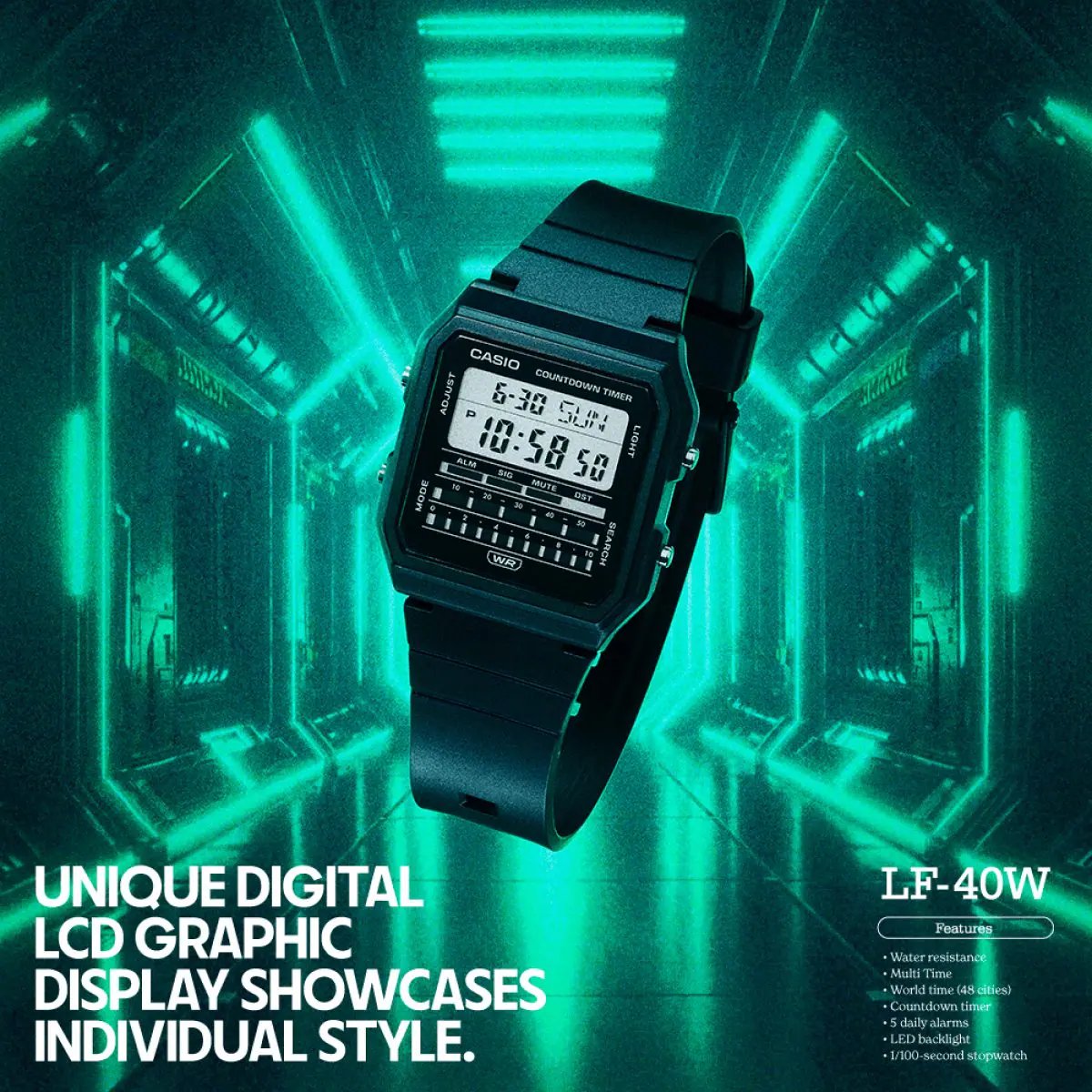
At the heart of the LF-40W lies the Module 3553. To the uninitiated, it is a simple quartz circuit. To the horologist, it is a marvel of miniaturized logic. The display is divided into several functional zones, each serving a specific temporal purpose. The most striking is the circular LCD at the 10 o'clock position. This 'analog' window uses radial segments to indicate seconds in timekeeping mode, or to track the progression of the countdown timer. The fluidity with which these segments activate is a testament to the refinement of Casio’s liquid crystal technology.
The primary time display sits at the bottom, utilizing a classic seven-segment font that is both crisp and legible. Above it, a multi-functional map and indicator bar provide context for the world time and alarm settings. The integration of these elements requires a complex mapping of the LCD driver, ensuring that despite the density of information, the 'dial' never feels cluttered. The Module 3553 also incorporates a world time feature with 29 time zones, a 1/100-second stopwatch, and a countdown timer with a 24-hour range—complications that, if executed mechanically, would require a movement of immense size and cost.
Material Science: The Bio-Based Frontier
One cannot discuss the LF-40W without addressing its construction. In a significant move toward sustainability, Casio has utilized bio-based resins for the case and the band. These resins are derived from renewable organic resources, such as castor oil and corn. While this might seem secondary to the watch's horological merit, it represents a technical achievement in polymer stability. Creating a bio-resin that maintains the structural integrity, UV resistance, and tensile strength of traditional petroleum-based plastics is a formidable engineering challenge.
The result is a material that feels distinct on the skin. There is a certain 'warmth' to the bio-resin that is absent from the colder, more rigid plastics of the past. The matte finish of the case absorbs light rather than reflecting it, emphasizing the geometric purity of the rectangular silhouette. The resin crystal, while softer than sapphire, offers a clarity that is perfectly suited to the high-contrast LCD beneath it. It is a reminder that in horology, innovation often happens in the chemistry lab as much as at the watchmaker's bench.
Ergonomics and the 18-Gram Profile
The LF-40W measures 33.2mm in width and 38.9mm lug-to-lug, with a remarkably slim profile of 8.6mm. In an era where 'oversized' has become the default, these dimensions are refreshingly restrained. The watch disappears on the wrist, yet its visual impact remains significant due to the 'Twin Graph' layout. The buttons—four in total—are recessed slightly to prevent accidental actuation while remaining tactile enough for easy operation. The 30 meters of water resistance is, admittedly, the watch's Achilles' heel, limiting its utility to daily splashes rather than aquatic adventures. However, within its intended environment—the urban landscape and the office—it excels.
The Twin Graph Legacy
Collectors of vintage Casio will immediately recognize the DNA of the AE-20W and AE-21W in this model. Those original 'Twin Graph' watches are now highly sought after on the secondary market, often fetching prices far exceeding their original retail value. The LF-40W is not a 1:1 reissue, but rather a modern reinterpretation. It strips away some of the more aggressive 'tool watch' styling of the 80s in favor of a cleaner, more minimalist aesthetic that resonates with the current 'quiet luxury' trend. It is a watch that understands its history without being enslaved by it.
Conclusion: A Discerning Choice
For the sophisticated collector, the Casio LF-40W serves as a palate cleanser. It is a watch that celebrates the joy of digital precision and the cleverness of Japanese engineering. It proves that horological interest is not predicated on a high price tag or a Swiss pedigree. Instead, it is found in the integrity of the design, the relevance of the materials, and the history it carries on its digital face. At its accessible price point, it is perhaps the most honest watch on the market today—a technical achievement that anyone can own, and everyone can appreciate.