Manufacture History: Casio's Quiet Authority
Casio was founded in 1946 in Tokyo, Japan, as Kashio Seisakujo, and incorporated as Casio Computer Co., Ltd. in 1957. The company's early reputation was built on calculating machines, but its horological identity was forged in the quartz revolution of the 1970s and then cemented by the G-Shock in the 1980s. Casio did not merely participate in the quartz era; it helped define it. The brand's willingness to treat electronics as a legitimate horological medium has produced a lineage that ranges from the F-91W to the Oceanus, from the cheapest digital watch to solar-powered radio-controlled chronometers.
The MTS-120D-7AV sits within Casio's standard analog collection, a category that rarely receives the reverence afforded to the G-Shock or the Oceanus. These are watches built for department stores, corporate gifts, and everyday wear. They are not designed to be collector's items. They are designed to be reliable. That context matters because it explains the MTS-120D-7AV's priorities: legibility, durability, and low maintenance rather than decoration or mechanical intrigue.
Movement and Architecture: Conventional Quartz, Honestly Executed
The MTS-120D-7AV is powered by a Casio quartz module. Casio does not emphasize a caliber number in the consumer-facing materials for this reference, and that is consistent with the watch's purpose. The movement is a conventional stepping-motor quartz caliber with a date complication. It is in-house in the sense that Casio designs and manufactures its own quartz modules, though the term carries less weight in this price bracket than it does in Swiss mechanical watchmaking.
Quartz architecture is worth understanding because it explains the ownership experience. A quartz oscillator, typically vibrating at 32,768 Hz, divides its signal down to one pulse per second. A stepping motor converts that pulse into mechanical motion, advancing the hands. The system is efficient, accurate, and inexpensive to produce. There is no mainspring, no escapement, no balance wheel, and no need for the kind of regulation that occupies a mechanical watchmaker's day. The trade-off is that the movement is not meant to be admired. It is hidden beneath a closed caseback and finished to industrial standards rather than decorative ones.
That is not a criticism. The MTS-120D-7AV's movement is asked to do one thing: keep time reliably. The date function is a simple calendar disc, and the hands are set through a conventional crown. The seconds hand advances in one-second increments. The watch is not COSC-certified, and it does not claim to be. It is a quartz watch, and it should be judged by quartz standards: accuracy over months, not seconds per day.
Casio's consumer materials do not always publish a single battery-life figure across every market for this reference, but a quartz watch of this type will need a battery replacement every few years. That is the extent of its routine maintenance. For a collector accustomed to five-year mechanical service intervals and four-figure bills, the MTS-120D-7AV's ownership model is almost absurdly simple.
Case, Dial, and Finishing: The Discipline of Restraint
The case is stainless steel, and the crystal is mineral. Those two facts set the watch's material ceiling. There is no sapphire here, no ceramic bezel, no titanium. The case is finished with a combination of brushed and polished surfaces, but the polishing is not the mirror-grade work one finds on a Grand Seiko or a Rolex. It is clean and consistent, which is what matters at this price. The MTS-120D-7AV does not pretend to be something it is not.
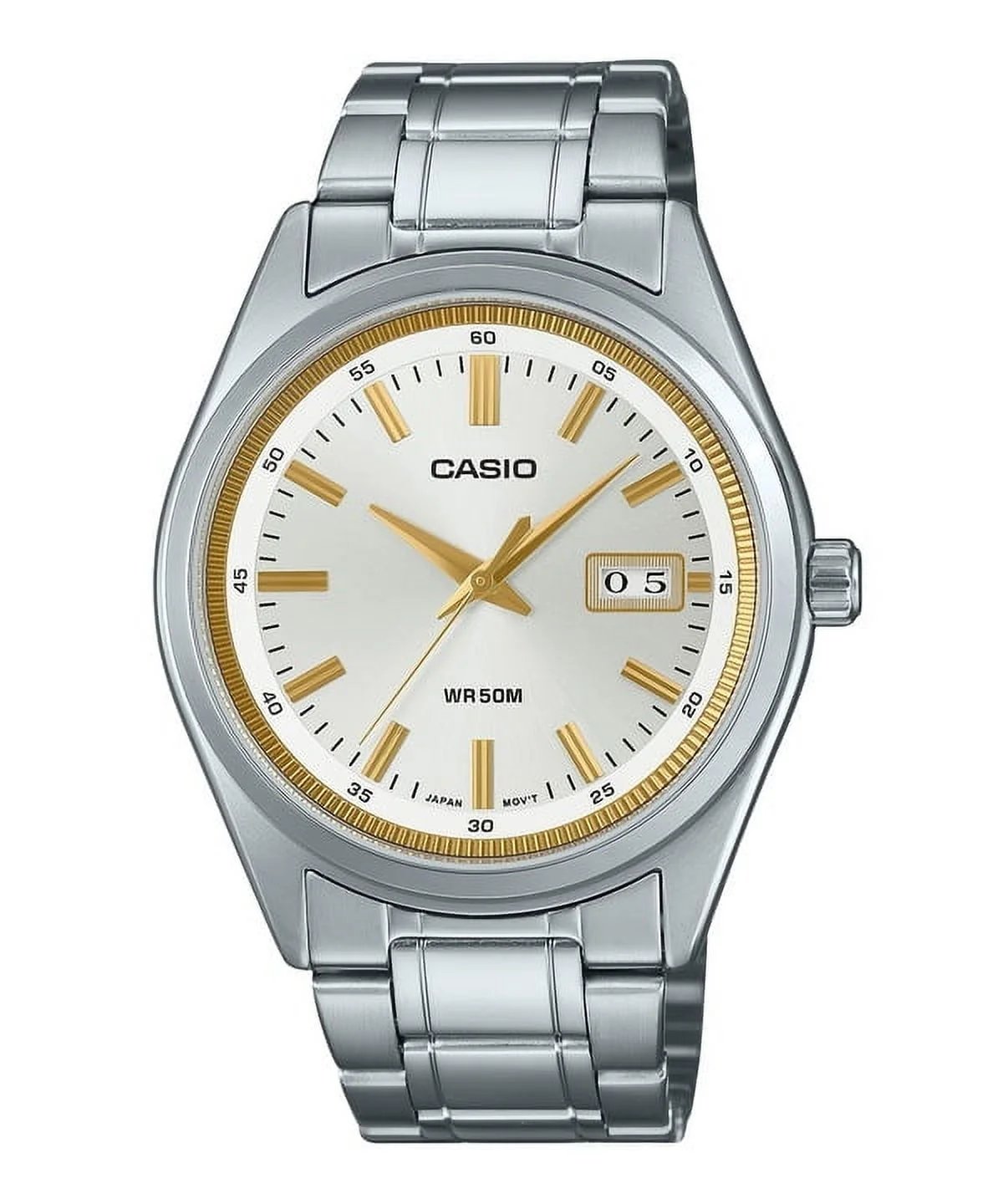
The dial is silver-toned, and it is the watch's strongest visual asset. The applied indices are simple and legible, and the date window at 3 o'clock is integrated without drama. The hands are sword-shaped and easy to read at a glance. There is a modest application of Neobrite luminous material on the hands, which is enough for low-light legibility but not enough for serious night-time use. This is a dress-sport watch, not a dive watch. The water resistance is rated to 50 meters, which covers handwashing, rain, and accidental splashes but not swimming or diving.
The bracelet is stainless steel and closes with a folding clasp. It is not a bracelet that will inspire poetry. The links are functional, the finishing is basic, and the clasp is stamped rather than milled. But it is comfortable, adjustable, and appropriate to the watch's price. The end links fit the case cleanly, and the bracelet does not rattle excessively. If you are accustomed to an Oyster bracelet or an integrated bracelet from a luxury sports watch, the MTS-120D-7AV will feel like a step down. If you are coming from a resin-strap digital watch, it will feel like a significant upgrade.
One of the most impressive aspects of the MTS-120D-7AV is its restraint. The dial does not try to simulate a chronograph, a GMT, or a dive watch. It is a three-hand watch with a date. That is all. In a market flooded with busy dials and unnecessary complications, this simplicity is a feature. It makes the watch easier to read, easier to wear, and easier to live with.
On the Wrist: Comfort, Balance, and Presence
The MTS-120D-7AV wears like a traditional dress-sport watch. Its proportions are conservative, and its weight is modest. On a leather strap, it would disappear under a cuff; on its steel bracelet, it has just enough presence to feel like a proper watch without dominating the wrist. The case sits flat and does not dig into the back of the hand. The crown is small but easy enough to grip for setting the time and date.
Balance is the key word. The watch does not feel top-heavy, and the bracelet does not pull the case around during the day. The folding clasp sits comfortably against the wrist, and the links articulate smoothly enough for a watch at this price. I wore it for full days at a desk and found no hotspots or pressure points. It is not a watch you notice constantly, and that is a compliment. A daily watch should recede into the background until you need it.
The wrist presence is deliberately low. This is a 2/5 watch in terms of visual impact. It will not draw comments from strangers, and it will not compete with a luxury sports watch. It will, however, look appropriate in almost any setting. It pairs well with a shirt and trousers, a polo and chinos, or a casual jacket. It is not a formal dress watch in the strict sense, but it is clean enough for business casual and understated enough for a dinner where you do not want your watch to be the center of attention.
Occasions: daily wear, dress, travel, and office. It is not a sports watch in the technical sense, though it can handle the light activity of everyday life. It is not a formal watch in the sense of a thin gold dress watch, but it is versatile enough for most social situations. The MTS-120D-7AV is at its best when it is the only watch you own, or the watch you reach for when you do not want to think about what you are wearing.
Accuracy and Daily Use: What to Expect
Casio does not publish a model-specific accuracy rating for the MTS-120D-7AV in every market, but conventional quartz performance is the relevant benchmark. A quartz watch at this price will typically keep time to within a few seconds per month under normal conditions, though temperature, battery condition, and positional variation can affect the rate. In practice, you will set it a few times a year. You will not wind it. You will not worry about magnetization or shock in the same way you might with a mechanical watch. It is a low-attention timekeeper.
The date function is simple and reliable. The crown pulls out to set the time and date, and the action is positive enough for a watch at this price. The hands are legible in most lighting conditions, and the modest Neobrite lume provides enough visibility for a dark room or a night drive. It is not a lume monster, and it does not need to be.
The battery will need replacement every few years. That is the main service event. A full movement service is rarely economical for a watch at this price; if the module fails, replacement is often the more sensible path. This is not a watch you buy for generational ownership. It is a watch you buy for reliable daily use.
Value and Investment: The Honest Economics
The MTS-120D-7AV has a manufacturer's suggested retail price of around $59.95, and current retail pricing is often closer to $49.95. Pre-owned examples typically trade in the $20-$35 range, depending on condition and whether the original bracelet and packaging are included. The trend is depreciating, as it is for almost every entry-level quartz watch. There is no meaningful auction history for this reference, and it is not a watch that collectors chase at Phillips or Christie's.
That does not make it a bad purchase. It makes it a different kind of purchase. The MTS-120D-7AV is a tool, and tools depreciate. You buy it for the timekeeping, the legibility, and the stainless-steel case. You do not buy it as a store of value. If you are looking for a watch that will hold its value, this is not it. If you are looking for a watch that will hold its time, it is more than adequate.
The price buys you a stainless-steel case, a mineral crystal, a reliable quartz movement, a date complication, and a bracelet that is functional rather than luxurious. It does not buy you sapphire, advanced finishing, or collector cachet. Whether that represents value depends on what you want from a watch. For a first mechanical-feeling watch, a travel beater, or a gift, it is excellent value. For a collection built around investment-grade references, it is irrelevant.
Comparisons and Context
Within Casio's own lineup, the MTS-120D-7AV sits alongside the MTS-120D-1AV, which offers the same platform with a black dial. Earlier MTS-100D and MTS-110D references occupy similar territory: stainless-steel cases, quartz movements, and simple analog dials. Above this price point, the Casio Edifice line adds chronographs and more aggressive styling, while the Oceanus line moves into solar-powered, radio-controlled territory. The G-Shock GW-M5610 is a different kind of watch entirely, but it shares Casio's ethos of functional reliability.
Among comparable watches from other brands, the Seiko SUR307 is a natural alternative. It offers a similar minimalist brief with a stainless-steel case and a clean dial. The Citizen BI5000-52E is another affordable metal-cased quartz watch with a legible layout. The Timex Fairfield is a lower-cost dress watch that prioritizes simplicity. None of these watches is a direct substitute for the MTS-120D-7AV in every respect, but they occupy the same mental space: affordable, legible, and honest.
There are no meaningful homages to the MTS-120D-7AV. It is not a watch that has been copied by microbrands or celebrated in design circles. It is an original entry-level design, and that is part of its charm.
Service and Ownership
Service for the MTS-120D-7AV is straightforward. Battery replacement can be handled by any jeweler or watch repair shop, and it is inexpensive. A full movement service is rarely worth the cost. Casio's authorized service centers can handle repairs, but for a watch at this price, local battery replacement is usually sufficient. The watch is not designed to be serviced like a mechanical caliber, and that is consistent with its purpose.
Final Verdict
The Casio MTS-120D-7AV is a quiet watch in a loud market. It does not have the mechanical intrigue of an automatic movement, the finishing of a luxury piece, or the investment potential of a collectible reference. What it has is clarity of purpose. It is legible, reliable, comfortable, and affordable. It asks nothing of you except that you wear it and change the battery when the time comes.
For a young collector building a collection, it is a useful reminder that watchmaking is not only about complications and precious metals. It is also about the discipline of making a simple object well. The MTS-120D-7AV does that. It is not a watch you will pass down to your children. It is a watch you will wear until the battery dies, and then you will replace the battery and wear it again. In its own modest way, that is a kind of integrity.
Pros and Cons
- Pros: Legible silver dial with date; stainless-steel case and bracelet; reliable quartz movement; very affordable; comfortable on the wrist.
- Cons: Mineral crystal; basic bracelet finishing; limited water resistance at 50 meters; no collector investment value; modest lume.