Casio W-221HD Review: The Quiet Competence of a Digital Standard
Casio's W-221HD is not a watch that asks to be admired under a loupe. It is a tool watch in the original sense: a quartz digital with a stainless-steel bracelet, a mineral crystal, 100-meter water resistance and a battery life measured in years rather than hours. For young collectors, it is useful precisely because it strips watchmaking back to legibility, robustness and cost.
In a market obsessed with movement finishing, the W-221HD offers a different kind of architecture: a pragmatic case assembly, a folded-link bracelet, a mineral crystal and an LCD module. The comparison is not to a mechanical caliber but to a pocket calculator—honest, serviceable and engineered to disappear into daily life.
This review treats it as what it is: an accessible digital standard. We will look at the case and bracelet, the quartz module, real-world accuracy and whether the W-221HD makes sense for a collector who already owns finer watches.
Manufacture history: Casio and the democratization of quartz
Casio was founded in 1946 as Kashio Seisakujo and became Casio Computer Co., Ltd. in 1957. The company built its reputation on calculators, electronic instruments and quartz timekeeping, helping turn accurate timekeeping into a mass-market product rather than a luxury preserve. The W-221HD belongs to Casio's Standard Digital line, a family defined less by horological ambition than by dependable daily function.
That context matters. A watch like this is not trying to compete with a mechanical chronometer; it is continuing a lineage of practical electronics. Casio's digital watches became cultural objects because they were cheap, tough and legible. The W-221HD is a quieter expression of that idea, with a metal bracelet that pushes it slightly toward daily-wear polish.
The Standard Digital line has always been about doing a few things well. Time, date, alarm, stopwatch and light are the core functions, and Casio has refined them across decades. The W-221HD does not need a manufacture story about hand-finished bridges to be meaningful. Its history is the history of quartz itself: the technology that made accurate watches ordinary, and in doing so changed what a watch could be.
Movement and architecture: quartz as a tool, not a compromise
The W-221HD runs on a Casio quartz digital module. There is no decorated bridge, no Geneva striping and no exhibition caseback—and that is the correct brief. The module is an integrated electronic movement designed for long service life, low maintenance and predictable timekeeping. Its oscillator beats at the standard quartz frequency of 32,768 Hz, and Casio's battery estimate is approximately ten years. That figure is the real power reserve here: not a mainspring barrel, but a lithium cell that lets the watch sit in a drawer without drama.
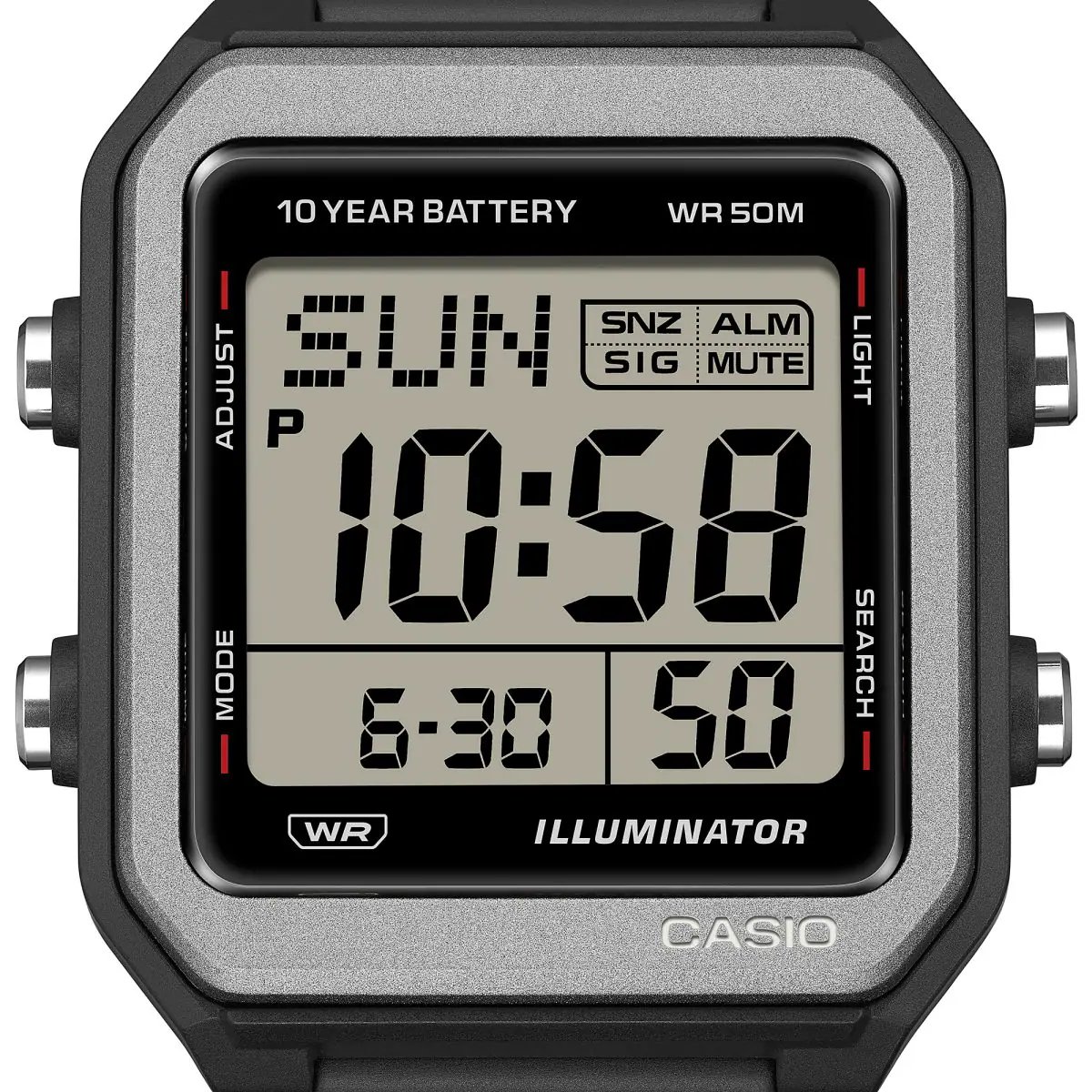
Complications are practical rather than romantic: a daily alarm, a 1/100-second stopwatch, a calendar and an LED backlight. The display is a classic segmented LCD, which is legible in normal light and usable in the dark via the light button. There is no lume, because lume belongs to analogue watches; the backlight does the job more directly. In place of jewels and finishing, the W-221HD offers a sealed, serviceable module and an accuracy spec that most mechanical watches cannot match day to day.
The absence of mechanical architecture is not a flaw in this context. A quartz digital module is a different discipline: circuit design, power management, display contrast and durability. Judged on those terms, the Casio module is a proven piece of engineering. It is not in-house in the sense of a haute horlogerie caliber, but it is Casio's own technology, built for a watch that must work every day.
There is also something refreshing about a movement that does not ask for attention. You do not wind it, you do not set it down on a timing machine, and you do not worry about magnetic fields in the same way. The W-221HD is designed to be forgotten until you need it. That is a legitimate design goal, and the module fulfills it.
Case, crystal and bracelet: honest materials
The W-221HD pairs a stainless-steel bracelet with a stainless-steel bezel and a mineral crystal. These are the right materials for the price. Mineral crystal is softer than sapphire and will pick up fine scratches over years of use, but it is tough enough for daily life and inexpensive to replace. The stainless-steel bracelet gives the watch a more formal, desk-ready look than a resin strap, while the digital display keeps it firmly casual.
The bracelet is a folded-link design with a fold-over clasp. It does not have the solidity or micro-adjustment of a luxury bracelet, and it will rattle slightly if you shake your wrist. That is part of the honesty of the object. The clasp secures reliably, the links are easy to size, and the steel finish hides everyday wear reasonably well. This is not jewelry-grade finishing; it is durable, functional hardware.
Water resistance is rated to 100 meters, which is more than enough for swimming, showering and daily exposure. That rating is a key part of the W-221HD's appeal: it turns a cheap digital into a genuinely carefree watch. You do not need to baby it at the sink, in the pool or in the rain. The case assembly feels sealed and purposeful, with the kind of utilitarian confidence that Casio has refined over decades.
The crystal is mineral, not sapphire, and that is worth stating plainly. Sapphire would be more scratch-resistant, but it would also push the price upward and make less sense in a watch meant to be replaced or serviced cheaply. Mineral glass is the pragmatic choice. If it scratches, you can live with it, polish it lightly or replace it without heartbreak.
On the wrist: how the W-221HD wears
The W-221HD wears like a compact instrument. It is light enough to forget about, and the steel bracelet gives it a little more visual weight than a bare resin Casio. The case sits flat and unobtrusive, which makes it easy to wear under a shirt cuff or with a T-shirt. The LCD is angled for quick reading, and the buttons are recessed enough to avoid accidental presses while remaining usable with a fingernail.
Comfort is good for a bracelet watch at this price. The folded links are not as supple as a high-end bracelet, but they articulate adequately, and the clasp does not dig into the wrist in normal wear. The bracelet may pull a hair occasionally, and the lack of micro-adjustment means you should take time to size it properly. Once fitted, the watch balances well and stays put. It feels like a tool you can wear for a week without thinking about it—which is exactly the point.
The digital display is easy to read at a glance, though the viewing angle matters more than on an analogue watch. In dim light, the LED backlight is effective and simple. The buttons require a deliberate press, which is good for avoiding accidental changes. The overall wrist experience is one of low friction: no winding, no date-change anxiety, no concern about knocking it against a doorframe.
Accuracy and daily ownership
Casio rates this family of quartz modules to around ±30 seconds per month, and real-world examples often do better. That is not chronometer accuracy in the COSC sense, but it is more than sufficient for daily life. You will not need to reset it often, and when you do, the digital interface makes it simple. The auto-calendar handles month lengths, and the 12/24-hour format is selectable.
Daily ownership is refreshingly low-friction. There is no winding, no date-setting fuss and no service anxiety. The battery should last about a decade under normal use, though heavy use of the backlight and alarm will shorten that. When the display dims or the light weakens, a battery replacement is straightforward. The watch is not designed for collector-grade preservation; it is designed to be used, and that is a virtue.
The alarm and stopwatch are basic but useful. The stopwatch measures to 1/100 second, which is more precision than most daily tasks require but handy for timing intervals or workouts. The daily alarm is loud enough to be useful without being disruptive. These are not advanced complications, but they are the right ones for the watch's purpose.
Occasions and wrist presence
The W-221HD is at home as a daily watch, a sports companion and a travel beater. The 100-meter water resistance and digital functions make it useful for swimming, gym sessions and trips where you do not want to worry about a mechanical watch. The stainless-steel bracelet gives it enough polish for casual office wear, though it is not a formal watch. It reads as purposeful and understated rather than luxurious.
Wrist presence is modest: about 3/5. It does not announce itself across a room, and that is part of its charm. The steel bracelet catches light and gives it more wrist presence than a plastic digital, but the overall impression is of a competent tool rather than a status object. For a young collector building a wardrobe, it fills the role of the watch you grab when you do not want to think about a watch.
Reference variants and family context
The common reference is the W-221HD-1AV, which pairs the standard LCD display with a stainless-steel bracelet. Casio's model naming can be regional and occasionally confusing, so buyers should confirm the exact reference and bracelet type before ordering. The W-221HD sits alongside other Standard Digital models such as the W-221H, W-216H and W-800H. These are siblings in spirit rather than strict successors: they share the same utility-first approach, with variations in case shape, display layout and strap or bracelet options.
Within Casio's broader catalog, the W-221HD is also related to the F-91W and A158W in ethos, if not in case design. The F-91W is the archetypal cheap digital; the A158W is the metal-bracelet retro option; the G-Shock DW-5600E is the tougher square-cased alternative. The W-221HD carves out a middle ground: more polished than a resin-strap beater, less armored than a G-Shock, and still inexpensive enough to treat as a daily tool.
For collectors, the family tree matters less than the role. The W-221HD is not a rare reference and does not have a hidden origin story. It is a standard Casio digital with a metal bracelet. Its appeal is that it does that job well, without pretending to be something else.
Similar watches and alternatives
If you want the same formula with a resin case and strap, the Casio W-800H is the obvious alternative. It offers similar digital functionality and long battery life in a lighter, more plasticky package. The Casio A158W is the choice for a slimmer metal-bracelet digital with a more retro profile. The Timex T49961 offers a comparable everyday-digital experience with 100-meter water resistance and a different brand flavor. And if durability is the priority, the G-Shock DW-5600E is the natural step up, with shock protection and a more substantial case.
For buyers who want a metal-bracelet digital but prefer a more modern feature set, Casio's own range includes models with world time, countdown timers and tougher cases. Those watches add capability but also complexity and cost. The W-221HD remains appealing because it does the basics well and does not pretend to be more than it is.
Among homage-adjacent budget watches, the Casio F-91W and A158W are the closest in spirit, while the Skmei 1123 offers an even cheaper resin-digital alternative. Those watches are not replacements for the W-221HD in build, but they show how broad the market is for simple, legible digital timekeeping. The Casio remains the safer choice for consistency and support.
Investment value and service
The W-221HD is not an investment. Its MSRP is around $40, current retail is similar, and pre-owned examples typically trade for $15 to $30 depending on condition and bracelet wear. The trend is depreciating, as with most mass-produced quartz watches. Auction history is effectively nonexistent; this is not a watch that appears in collector auctions. Buy it to wear, not to store.
Service is simple. There is no routine mechanical service interval; the main maintenance item is battery replacement. A jeweler or Casio service center can handle it, and the watch does not require authorized-only care. The module is robust, and the case is sealed well enough for normal use. If the crystal scratches, it can be replaced inexpensively. The bracelet can be cleaned with a soft brush and mild soap. This is low-stress ownership in the best sense.
For a young collector, the value proposition is clear: the W-221HD costs less than a routine service on a mechanical watch. It will not appreciate, but it will also not demand attention. That makes it a useful tool rather than a liability.
Pros and cons
Pros: 100-meter water resistance, long battery life, stainless-steel bracelet, mineral crystal, legible LCD, LED backlight, low price and easy ownership. Cons: no lume, basic folded-link bracelet and clasp, limited features compared with modern digital watches, and no collector value. The W-221HD is not trying to win a finishing competition; it is trying to be the watch you never worry about.
Final verdict
The Casio W-221HD is a quiet, competent digital standard. It offers the core virtues of a tool watch—legibility, water resistance, long battery life and a metal bracelet—at a price that makes pampering unnecessary. For a young collector, it is an excellent second or third watch: the one you wear when a mechanical piece would be overkill. It is not luxurious, but it is honest, and that honesty has its own kind of appeal.