Why the DS-7 Chrono Auto matters
Certina occupies an interesting corner of the Swiss watch landscape. It is not trying to be a status symbol, and it is not chasing the revival-of-a-1960s-diver trend with limited editions and waiting lists. It is a brand that has built its name on dependable, well-priced watches that survive real life, and the DS-7 Chrono Auto is the clearest expression of that in the current catalogue. It is a steel sports chronograph with an automatic movement, a bracelet, a sapphire crystal and the DS double-security construction that has been Certina's calling card since 1959. On paper it is a sensible, almost conservative proposition. On the wrist, it is better than that.
I approached the week with a certain amount of scepticism. Value-priced chronographs often feel like they are assembled from a parts bin, with thin bracelets, clunky pushers and dials that look busier in person than in photographs. The DS-7 does not fall into that trap. It feels like a coherent object rather than a collection of features, and that coherence is what makes it worth talking about.
The watch we tested was the blue-dial version on the steel bracelet, which is likely to be the volume seller. The dial is a sunray blue that shifts from navy to slate depending on the light, and it is the strongest argument for choosing this version over the black. It gives the watch a bit of life without turning it into a fashion piece.
Certina, briefly
Certina was founded in Grenchen in 1888 by Adolf and Alfred Kurth, and it spent the first half of the twentieth century building a reputation for precision and robustness. The DS concept, introduced in 1959, was the brand's answer to the problem of making a watch that could survive real-world knocks and moisture, and it has been the backbone of the line ever since. The modern DS-7 updates that idea for a sports-chic audience: it is still tough, but it is designed to be worn with a shirt as well as a T-shirt. Since joining the Swatch Group, Certina has benefited from shared movements and components while keeping its own identity and price point. The DS-7 Chrono Auto is a good example of what that combination can produce.
The movement: ETA A05.H31
Under the dial is the ETA A05.H31, a Swatch Group automatic chronograph that descends from the long-serving Valjoux 7753 architecture. It runs at 28,800 vibrations per hour and offers a 60-hour power reserve, which is a meaningful upgrade over the older 7750-family calibres and makes the watch genuinely practical as a daily wearer. The layout is the familiar three-subdial arrangement: running seconds at nine, a thirty-minute counter at three and a twelve-hour counter at six, with a date aperture tucked in at half past four. The pushers have a firm, positive action with a clear start-stop and a slightly heavier reset, and the crown is easy to grip without being obtrusive. The finishing is functional rather than decorative, which is exactly right at this price. You are buying reliability and a proven design rather than a hand-finished display-back spectacle, and the movement delivers on that promise.
On the wrist
The first thing you notice is how well the case sits. Certina has resisted the temptation to make the DS-7 look bigger than it needs to be, and the result is a watch that wears close and balanced rather than top-heavy. The lugs curve down toward the wrist, the caseband is slim enough to slip under a cuff, and the bracelet articulates cleanly so that it follows the shape of the wrist instead of standing away from it. The folding clasp sits flat and does not create a pressure point on the underside of the wrist, which is a common failing in this price bracket.
The bracelet itself is the pleasant surprise. The links are solid, the brushing is even, and there is very little of the rattle or sharpness that you sometimes find on value-priced steel. After a week of typing, driving and general wear, the clasp still closed with a satisfying click and the bracelet had not picked up any obvious stretch. The watch has enough presence to feel like a proper mechanical object without being so heavy that it becomes a chore by the end of the day. It is the kind of watch you forget you are wearing, which is the highest compliment I can pay a daily wearer.
Legibility and living with the chronograph
The dial is busy, as any three-subdial chronograph will be, but it is organised. The applied indices are large enough to read at a glance, the hands are the right length, and the contrast between the dial and the hands is good in most lighting. The chronograph subdials are slightly recessed and have their own snailed texture, which helps them stand out without shouting. The date at half past four is small and discreet; it is not the easiest date to read, but it does not disrupt the symmetry of the dial either, which is a reasonable trade-off.
In daily use the chronograph is a pleasure rather than a gimmick. The pushers are easy to operate without looking, the reset snaps back cleanly, and the running seconds at nine gives the dial a sense of life. The Super-LumiNova on the hands and indices is adequate rather than spectacular; it glows well enough to read the time in a dark room but is not going to win any awards for brightness. That is a common compromise at this price and not a reason to avoid the watch.
Accuracy
Our sample ran roughly four seconds fast per day over the test week, measured against a reference clock and checked at the same time each morning. That is squarely within what the A05.H31 family delivers in practice, and it is worth remembering that Certina does not submit this movement for COSC certification, so you should not treat the watch as a chronometer. Expect a handful of seconds a day in either direction once it has settled, with position and temperature making small differences. The 60-hour reserve is the more useful number in real life: you can take the watch off on Friday evening and still find it running and close to time on Monday morning, which is exactly what you want from a watch that is meant to be worn every day.
The range and the alternatives
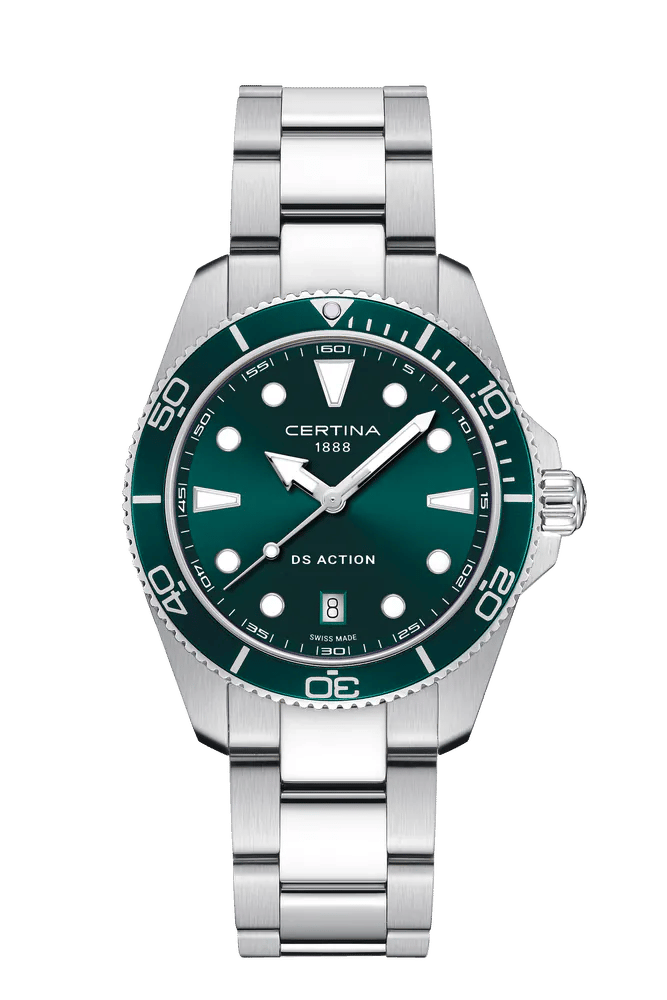
The DS-7 Chrono Auto sits at the top of the DS-7 family, above the three-hand Powermatic 80 models, and it shares the same case language and bracelet design. The blue-dial reference we tested is the most distinctive, but the black-dial version is the more conservative choice and the green adds a little more character for buyers who want something less common. Within the wider Certina range, the DS Action Diver and the DS PH200M are the obvious alternatives if you want more water-sports capability, while the DS-8 Chronograph offers a dressier take on the same idea.
Shoppers comparing the DS-7 Chrono Auto with its rivals will inevitably look at the Tissot PRS 516 Automatic Chronograph, which shares the same Swatch Group value positioning and a similarly vintage-motorsport flavour. The Hamilton Jazzmaster Auto Chrono uses the same family of movements but dresses the package up with a more formal case, and the Longines Conquest Chronograph is the step-up option if you want more finishing and brand cachet. The Seiko Prospex Speedtimer is a very different proposition in terms of movement philosophy, but it is a similarly wearable sports chronograph that deserves a look if you are not committed to Swiss automatic watchmaking.
Value, service and the long game
At around $1,100, the DS-7 Chrono Auto buys a genuine Swiss automatic chronograph, a well-made steel bracelet, a sapphire crystal and the DS construction that has underpinned Certina's reputation for decades. It is not an investment piece, and it is not going to appreciate in the way that certain hyped steel sports watches have. What it will do is hold its place on your wrist for years, and that is worth more than a speculative return. Pre-owned examples trade below retail, as you would expect for a brand in this segment, so there is no financial argument for buying new and keeping it in the box.
Servicing is handled through Swatch Group's authorised network, which is widespread and straightforward to access. As with any mechanical chronograph, it is worth confirming current service pricing and turnaround with an authorised centre rather than relying on published estimates, and it is sensible to budget for a routine overhaul every several years of regular wear. The good news is that the movement is a proven design with widely available parts, so there is no reason to expect long-term ownership to be difficult.
Verdict
The DS-7 Chrono Auto is the rare value-priced chronograph that does not feel like a compromise on the wrist. It is comfortable, legible, well built and quietly versatile, and it does the one thing a daily wearer must do: it makes you want to keep wearing it. It is not perfect, and it is not trying to be. It is a sensible, well-executed Swiss automatic chronograph that will handle a real week on the wrist without complaint, and for most buyers that is exactly the point. If you are shopping with your head as well as your heart, this is one of the most sensible Swiss automatics in its class.