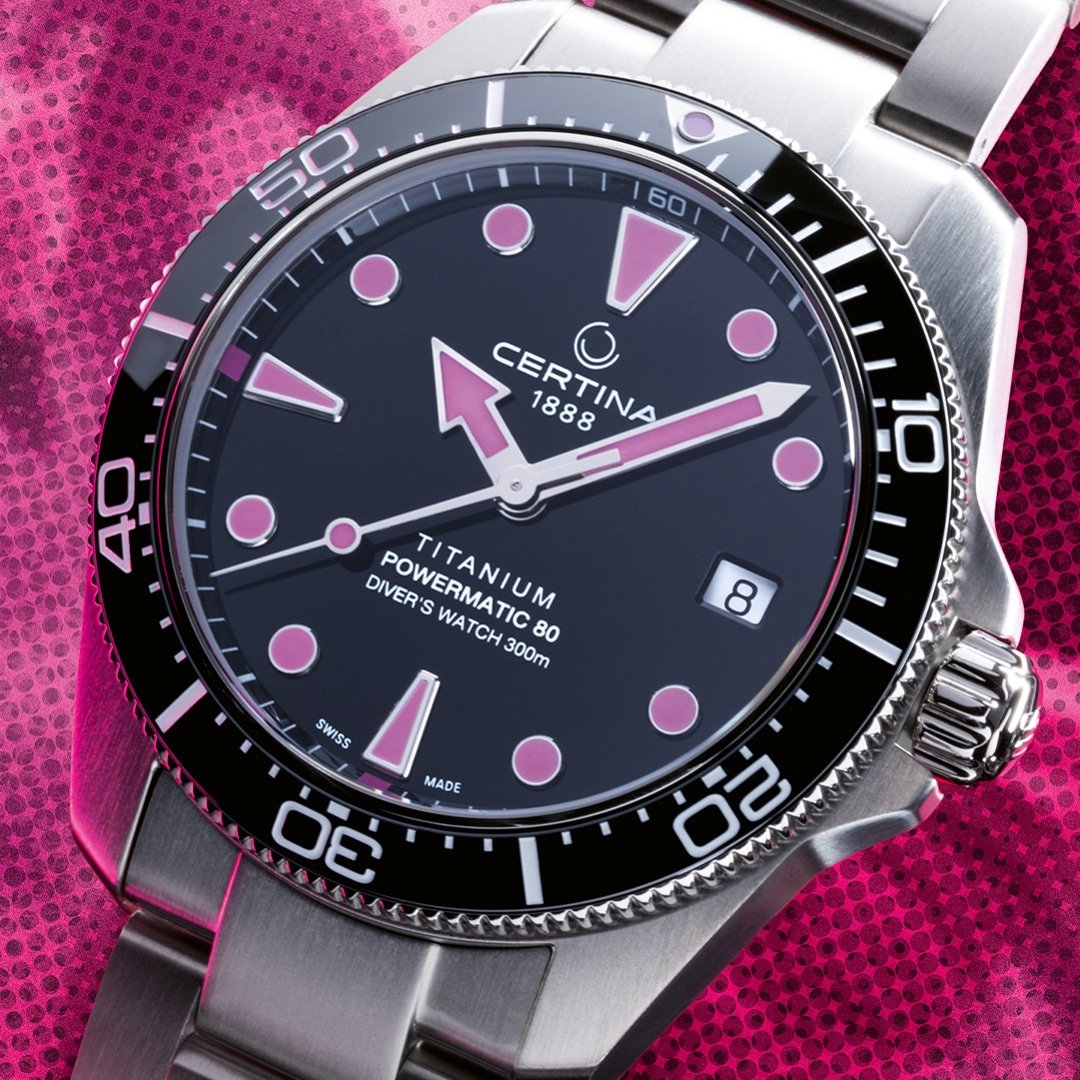
A Diver That Understands Its Own Brief
The modern dive watch has a proportion problem. Over the past two decades the category drifted steadily upward in size until a 42mm case became unremarkable and a 44mm case stopped raising eyebrows. Certina, quietly and without much fanfare, has been moving in the opposite direction. The DS Action Diver 38mm is the clearest expression of that correction: a fully specified 300-metre diver in a case that sits comfortably on a wrist that would be politely described as average.
The titanium variant adds a second argument. Titanium is not a novelty here — it is functionally appropriate. A dive watch is meant to be worn, and a lighter case means less rotational mass on the wrist, less chance of the watch catching on a cuff, and a lower probability that the wearer takes it off before doing something that might scratch it. Certina has not dressed the material up with a polished caseback or a decorative bezel; the titanium is brushed and matte, consistent with the tool-watch intent.
This review covers the watch in detail: the DS design architecture, the case and dial execution, the Powermatic 80 movement, the realities of wearing it, and whether it earns a place in a small collection.
The DS Concept, Briefly
Certina's DS designation — Double Security — dates to 1959 and describes a construction principle rather than a marketing slogan. The movement sits inside a reinforced case, suspended within an elastomer ring that absorbs shock and helps seal the assembly against moisture and dust. Over the decades the system has been refined and reapplied across the catalogue, and it remains the structural backbone of the DS Action Diver.
That heritage is worth noting because it explains why a watch at this price point can credibly claim 300 metres of water resistance. Certina is not a boutique manufacture chasing finishing benchmarks; it is a Swatch Group volume brand with a long engineering history and access to industrial capability that smaller independents cannot match. The result is a watch whose specification sheet reads more ambitiously than its price suggests.
Case, Crystal and Bezel
The case measures 38mm across, which places it firmly in the territory that was standard for dive watches in the 1960s and 1970s and which has only recently returned to fashion. The profile is clean: a brushed titanium mid-case, sharply downturned lugs, a screw-down crown at four o'clock recessed behind modest crown guards, and a caseback that is closed and screwed down. There is no exhibition window, and that is the correct decision — the movement inside is not one you need to look at.
The crystal is sapphire, flat rather than domed, with an anti-reflective coating that handles overhead light well without the blue haze that some coatings produce. The bezel is unidirectional, as it should be, with a knurled edge that offers a positive grip even with wet fingers. The action is crisp rather than silky — there is a defined click at each minute mark and virtually no backplay. It is not the equal of a Tudor or an Omega, but it is well within the standard set by other Swiss watches at this price, and it will not drift under accidental contact.
Water resistance is rated to 300 metres, which is more than almost any owner will ever test and exactly the right figure for a watch of this type. A screw-down crown, a screw-down caseback and a properly gasketed bezel assembly are the mechanical prerequisites, and Certina has ticked all three.
Dial and Legibility
The dial is where the DS Action Diver earns its keep. Applied hour markers with polished frames sit against a matte surface, with a generous fill of Super-LumiNova. The hands are broad, faceted and unmistakably diver-derived: a wide arrow-tipped hour hand, a long sword minute hand and a lollipop seconds hand that is easy to locate at a glance. The date window at three o'clock is small, framed and unobtrusive — a compromise, but a well-judged one.
Lume performance is strong. A few minutes under a lamp produces a bright, even glow across the markers and hands that remains readable for hours, and the bezel pip is treated to the same standard. This is not the blue-glowing spectacle of a Seiko diver, but it is entirely functional in the dark and consistent with the watch's understated character.
Legibility in daylight is excellent. The contrast between the matte dial and the polished marker frames is clean without being flashy, and the minute track is precise enough to be useful when timing something. There is nothing decorative here that interferes with reading the time, which is the whole point.
The Movement: Powermatic 80.611
Inside is the Powermatic 80.611, the Swatch Group's ETA C07.611 base as designated in Certina's catalogue. It is an automatic with a date, running at 21,600 vibrations per hour — three hertz rather than the more common four — with 23 jewels and a power reserve of 80 hours. The lower frequency is the mechanism behind the long reserve: fewer beats per hour means less energy consumed per day, which allows a longer mainspring without an oversized barrel.
The balance spring is Nivachron, a Swatch Group alloy developed to resist magnetic fields and temperature variation. In practical terms this means the watch is less likely to run wild near a laptop, a phone case or a magnetic clasp than an older, conventionally sprung movement would be. It is not a full anti-magnetic specification in the sense that Rolex or Omega use the term, but it is a meaningful improvement over the previous generation.
Finishing is industrial. The bridges are blasted rather than striped, the oscillating weight is simple, and there is no anglage to speak of. Since the watch has a closed caseback, none of this matters in daily use. What matters is that the movement is proven, widely serviced and inexpensive to maintain — the ETA-derived architecture has been in continuous production for years and any competent watchmaker will have seen hundreds of them.
On the Wrist
The 38mm case paired with titanium produces a watch that genuinely vanishes on the wrist. There is no perceptible top-heaviness, no tendency to rotate, and no pressure from the caseback edge after a long day. The lugs curve steeply enough that the watch hugs rather than perches, and on a wrist in the mid-six-inch range the case sits comfortably within the wrist's width without overhang.
The bracelet is a three-link design with brushed surfaces and a folding clasp. It is honest rather than refined: the links are functional, the articulation is good, and the clasp closes securely, but there is a small amount of lateral play at the end links and the finishing is straightforward. Buyers accustomed to the bracelets on a Tudor or a Grand Seiko will notice the difference immediately. Buyers accustomed to a Seiko will find it entirely acceptable.
Titanium's lower hardness means the brushed surfaces will pick up hairlines and small scuffs more readily than steel. On a matte tool watch this is largely invisible in normal light and reads as patina rather than damage. Collectors who prize crisp finishing should be aware that this is a watch that will look worn within a year of regular use — and that this is arguably the correct outcome.
Accuracy in Practice
The Powermatic 80.611 is not chronometer-certified, and Certina does not publish a factory tolerance for this reference. In real-world use, these movements typically run within roughly -5 to +12 seconds per day, with many examples settling closer to the middle of that range once they have been worn for a few weeks. The Nivachron spring keeps the rate relatively stable across positions and temperatures, which is more valuable day to day than a tight but fragile adjustment.
It is worth setting expectations honestly. This is not a watch that will keep time to a second a day, and buyers who need that should look at a COSC-certified alternative or budget for a regulation by a watchmaker after the break-in period. For everyone else, the accuracy is well within what a mechanical tool watch should deliver, and the 80-hour reserve means it will still be running on Monday morning after a weekend in a drawer.
The Lineup and Alternatives
The titanium 38mm sits alongside steel-bracelet siblings in the same DS Action Diver family, as well as larger versions in the range. The steel models offer the same dial architecture and specification at a lower price, at the cost of added weight. Buyers who prefer a lighter watch and are prepared to accept softer metal will find the titanium variant the more comfortable daily proposition.
Competition at this price is genuinely strong. The Tudor Black Bay 54 is the reference point for small-cased divers, but it costs several times as much and its finishing is in a different league. The Longines HydroConquest in a comparable case size offers a ceramic bezel and a more conventional steel case. The Oris Aquis is more sculpted and more expensive. The Seiko Prospex SPB143 competes directly on design and finishing, with a less refined movement and a heavier bracelet. The Christopher Ward C60 Trident Pro 300 in a similar case size offers a more elaborate case profile and a strong alternative for buyers who want visible finishing flourishes.
Where the Certina wins is on coherence. It does not try to be a dress watch, it does not try to be a statement, and it does not pretend to finishing it cannot deliver. It is a diver, specified as a diver, at a price that reflects industrial production rather than artisanal scarcity.
Value and Ownership
At an approximate retail of around $1,050, the DS Action Diver 38mm Titanium sits at the upper end of Certina's range but remains well below the entry point for a Tudor or an Omega. What that money buys is a titanium case, 300-metre water resistance, a sapphire crystal, a modern 80-hour automatic with a Nivachron balance spring and a bracelet — a specification that would have been unthinkable at this price fifteen years ago.
Resale is the weak point. Certina is a working brand, not a collector's brand, and the secondary market reflects that: pre-owned examples typically trade in the mid-hundreds, well below retail. This is not a watch to buy as an investment, and buyers who approach it that way will be disappointed. Approached as a durable daily wearer that will deliver years of trouble-free service, it represents excellent value.
Servicing is straightforward. The ETA-derived movement is well understood, Swatch Group service infrastructure is broad, and an independent watchmaker can handle routine maintenance without difficulty. A service interval of roughly five years and an approximate cost in the mid-hundreds is a reasonable planning assumption, though actual intervals depend heavily on wear conditions.
Verdict
The Certina DS Action Diver 38mm Titanium is the most convincing watch in the brand's current catalogue. It takes a genuinely capable dive-watch specification, reduces it to sensible proportions, houses it in a material that makes it easier to wear, and prices it without theatre. The compromises — a functional bracelet, industrial movement finishing, soft titanium surfaces — are all in places that do not affect its core competence.
It will not impress anyone at a dinner party, and it will not appreciate. What it will do is tell the time accurately, survive a swimming pool or a dive trip, disappear under a shirt cuff, and require nothing more than routine servicing for a decade. For a young collector assembling a first serious watch, that combination is difficult to argue with.