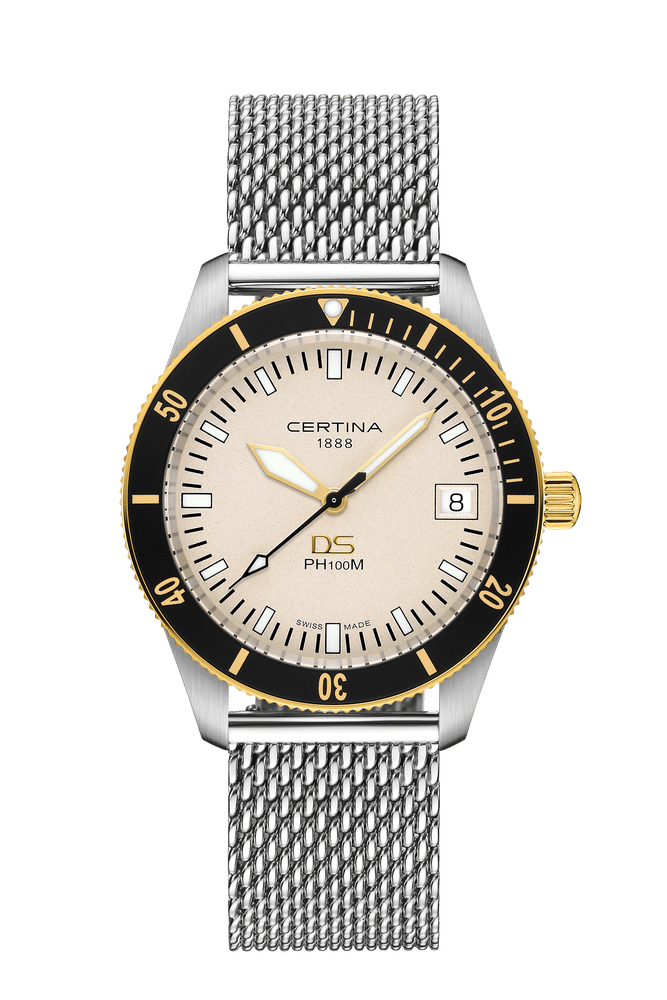
The Architecture of Resilience: A Deep Dive into the Certina DS PH200M
In the world of horology, true value is often found in the intersection of engineering excellence and historical significance. The Certina DS PH200M, reference C036.407.16.050.00, represents a rare moment where a major Swiss manufacturer has chosen to prioritize technical authenticity over modern convenience. This watch is a direct descendant of the 1967 original, a timepiece that was born during the golden era of underwater exploration. To understand the PH200M is to understand the history of the DS (Double Security) concept—a system that transformed the watch from a fragile instrument into a rugged piece of life-saving equipment.
The DS Philosophy: More Than a Marketing Acronym
To appreciate the construction of the PH200M, one must first look back to 1959. It was in this year that Certina introduced the DS concept. Unlike other watches of the era that relied solely on the case's outer shell for protection, Certina’s engineers developed a system where the entire movement was suspended inside a reinforced case. This was achieved through a thick O-ring gasket that acted as a shock absorber, allowing the movement to 'float' within the case. Furthermore, the DS system incorporated an air gap between the dial and the case, as well as reinforced case backs and specialized seals on the crown and stem.
The modern C036.407.16.050.00 maintains this structural integrity. While the modern Powermatic 80 movement has its own inherent shock resistance via the Incabloc system, the DS architecture provides an additional layer of security. This is not a watch that shyly hides under a shirt cuff; it is an industrial tool designed to withstand the hydrostatic pressure of 200 meters. The 'PH' in the name—Pression Hydrostatique—is a nod to the rigorous testing these watches underwent to ensure they could survive the crushing depths encountered by professional divers in the 1960s.
Case Geometry and Materiality
The case of the DS PH200M is a formidable piece of 316L stainless steel. At 42.8mm in diameter, it occupies a substantial footprint on the wrist. However, the technical merit lies in its finishing. The transition between the polished flanks and the brushed lug tops is executed with a precision that belies its price point. The most striking feature, however, is the bezel. Unlike the ceramic bezels found on modern luxury divers, the PH200M utilizes a graduated aluminum insert with a rounded profile. This choice is historically accurate and provides a tactile sensation that is distinctly vintage.
The bezel’s action is precise, with 60 clicks that provide a resonant, metallic feedback. There is zero back-play, a testament to the manufacturing tolerances Certina maintains within its Grenchen facility. The lugs, while long at 51.5mm, are elegantly curved, ensuring that the strap pulls the case tight against the radial bone of the wrist. This geometry is essential for a watch of this size, as it prevents the case from 'wobbling' during physical activity.
The Hesalite Factor: A Choice of Character
One of the most debated aspects of the C036.407.16.050.00 is the choice of a hesalite (acrylic) crystal. In an era where sapphire is the industry standard for 'luxury,' Certina’s decision to use hesalite is a bold statement of intent. From a technical standpoint, hesalite is more impact-resistant than sapphire; it will scratch, but it will not shatter. More importantly for the collector, the optical properties of the domed hesalite are incomparable. It creates a 'halo' effect around the edge of the dial and softens the light as it hits the hands, providing a warmth that sapphire simply cannot replicate.
Certina has treated this crystal with 'NEX Scratchguard,' a contemporary coating that increases the surface hardness of the acrylic. While it will still acquire a patina of fine scratches over years of use, these can be easily polished out with Polywatch, a ritual that many collectors find brings them closer to the mechanical nature of their timepiece. This crystal is the soul of the PH200M, bridging the gap between the 1960s and the present day.
The Powermatic 80: Industrial Efficiency
Inside the case beats the Powermatic 80.111, a caliber that has revolutionized the entry-luxury Swiss market. Based on the venerable ETA 2824-2, the Powermatic 80 represents a complete re-engineering of the movement's kinetic chain. By reducing the frequency from 4Hz (28,800 vph) to 3Hz (21,600 vph), and by utilizing a high-performance Nivaflex mainspring, the engineers at ETA have managed to extend the power reserve to a staggering 80 hours.
For the collector, this means the watch can be set aside on a Friday evening and picked up on Monday morning without the need for re-setting the time or date. The movement also features a friction-reducing escapement, which contributes to its long-term reliability and extended service intervals. While the movement is hidden behind a solid case back—embossed with the iconic Certina turtle logo—its presence is felt in the steady, reliable sweep of the seconds hand and the crisp engagement of the date change at midnight.
Dial Aesthetics and Legibility
The dial of the PH200M is a study in geometric balance. The matte black surface is punctuated by a red cross-hair, a detail that was common in mid-century divers to assist in rapid orientation of the watch face. The sword-style hour and minute hands are generously coated in Super-LumiNova, providing exceptional legibility in low-light conditions. The seconds hand, finished in a contrasting red, provides a splash of color that ties the entire aesthetic together.
The date window at 3 o'clock is discreet, featuring a black date wheel that blends seamlessly into the dial. This is a crucial detail that many manufacturers overlook, often opting for a white date wheel that disrupts the visual symmetry. On the PH200M, the date is there when you need it, but it does not demand your attention.
The Collector’s Verdict
The Certina DS PH200M is not a watch for the status-seeker. It does not carry the social weight of a Submariner or the avant-garde prestige of a Planet Ocean. Instead, it offers something increasingly rare in the modern market: an honest, technically proficient, and historically grounded timepiece that respects the intelligence of the buyer. It is a watch that rewards those who look closely at the grain of the steel, the curve of the crystal, and the heritage of the DS system. For the sophisticated young collector, it is a foundational piece—a reminder that great horology is not always about the price tag, but about the integrity of the build.