The Return of the Deep-Sea Sovereign
In the world of luxury horology, we often talk about 'tool watches' as a stylistic choice rather than a functional reality. Most modern divers will never see anything deeper than the bottom of a hotel pool in Mykonos. But every so often, a brand releases a piece that feels like it’s actually itching for a saturation tank. Enter the Certina DS PH1000M (ref. C024.907.18.051.00).
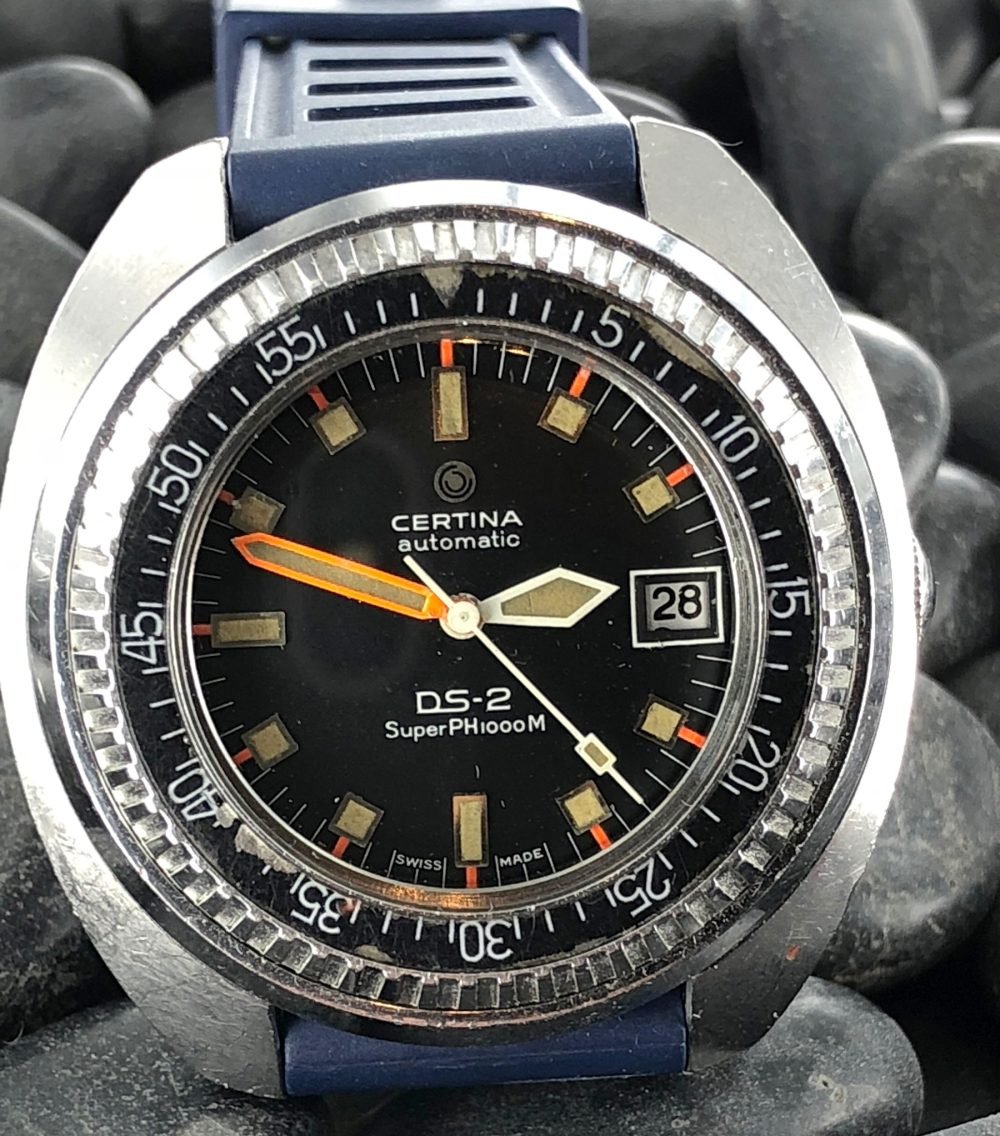
This isn't Certina playing it safe. While the brand has seen massive success with the more conventional DS Action Diver, the PH1000M is a deep dive—pun intended—into the brand's most hardcore archives. It is a faithful reimagining of the 1970 original, a watch that wasn't just 'inspired' by the sea, but was actually used by the divers of the Tektite II program, who lived and worked in an underwater habitat for weeks at a time. For the sophisticated young collector, this isn't just a watch; it’s a piece of brutalist architecture for the wrist.
The Brutalist Blueprint: Case and Design
The first thing you notice about the PH1000M is the silhouette. In an industry obsessed with the 'Submariner' shape, Certina’s barrel-shaped case is a breath of fresh, pressurized air. Measuring 43.5mm across, it sounds massive on paper. However, the lug-to-lug measurement is where the magic happens. At roughly 42mm, the watch is actually shorter than it is wide. This creates a 'puck' effect that allows it to sit remarkably well on a variety of wrist sizes.
The case finish is a tactical matte satin, which reinforces its identity as a piece of equipment. But the real star of the show is the bezel. Unlike standard dive bezels that click with a simple turn, the PH1000M features a 'push-to-rotate' system. You have to physically press the bezel down to unlock it before it will turn. It’s a tactile, mechanical interaction that feels incredibly satisfying—a reminder that this watch was designed for a world where an accidental bezel bump could be a life-or-death mistake.
1000 Meters of Credibility
Let’s talk about that '1000M' on the dial. To achieve this level of water resistance, Certina employs its legendary DS (Double Security) concept. This isn't just marketing fluff; it involves a sophisticated system of O-ring gaskets and a reinforced case back that has been the brand’s hallmark since 1959. To top it off, there is a helium escape valve at the 9 o'clock position, a feature usually reserved for watches costing five times as much.
The dial of this specific reference (C024.907.18.051.00) is a deep, matte black, accented by sharp orange hits on the minute hand and the bezel scale. It’s a high-contrast layout that prioritizes legibility above all else. The Super-LumiNova application is generous, glowing with a potent blue-green hue that makes the watch a lighthouse in low-light environments. It’s the kind of design that looks just as good with a Patagonia fleece as it does with a black oversized blazer in a Tokyo high-ball bar.
The Heartbeat: Powermatic 80 and Nivachron
Inside the steel fortress beats the Powermatic 80.611. For the uninitiated, this movement is the Swatch Group’s flex on the rest of the industry. While most movements in this price tier offer 38 to 42 hours of power reserve, the PH1000M offers a full 80 hours. You can leave it on your nightstand for three days, and it will still be keeping time when you pick it up.
More importantly, it features a Nivachron hairspring. In our modern world of MacBooks, iPhones, and magnetic iPad covers, magnetism is the silent killer of mechanical accuracy. Nivachron is an alloy that is significantly more resistant to magnetic fields than traditional steel hairsprings. It’s a 'set it and forget it' movement that brings a level of modern practicality to a vintage-inspired design.
The Cultural Context: Why It Matters Now
We are currently seeing a shift in the collector community. The 'hype' watches are becoming tired. The 'if you know, you know' (IYKYK) watches are taking over. The Certina DS PH1000M fits perfectly into this new paradigm. It’s a watch for the person who has moved past the entry-level Seiko but isn't interested in the predictable choice of a Tudor Black Bay.
It connects to a specific era of 1970s optimism—a time when we thought we’d be living in underwater cities by the year 2000. Wearing the PH1000M is a nod to that retro-futurism. It’s a conversation starter at an auction preview or a gallery opening, not because it’s expensive, but because it’s interesting. It signals that the wearer values engineering and history over brand-name clout.
The Sustainability Play
Certina has paired this reference with a strap made from #tide ocean material. This isn't just a trend-chasing move; it’s a fitting tribute to the watch’s aquatic heritage. The strap is made from upcycled plastic waste recovered from the ocean, transformed into a durable, comfortable textile. It’s a small detail, but for the younger collector who is increasingly conscious of the environmental impact of luxury goods, it’s a meaningful one. The strap is secured with a simple, robust pin buckle that matches the case finish, keeping the focus entirely on the head of the watch.
Final Verdict
The Certina DS PH1000M is a rare beast. It manages to be a faithful heritage re-issue without feeling like a costume piece. It offers specs that should cost $3,000 for just over $1,000. It wears smaller than its dimensions suggest, and it carries a historical weight that few brands can claim.
Is it a dress watch? Absolutely not. Is it a daily driver for the bold? Without question. In the sea of derivative dive watches, the PH1000M stands alone as a brutalist masterpiece. If you’re looking to add a watch to your collection that has soul, grit, and 100 bar of pressure resistance, your search ends here. Vivir’s advice? Buy it, put it on a gray NATO, and never worry about your wrist game again.