The Architecture of Resilience: Reintroducing the DS PH200M
In the high-stakes world of luxury horology, the term 'entry-level' is often used pejoratively. However, for a brand like Certina, which operates within the mid-tier of the Swatch Group, this segment is where they demonstrate their most profound engineering prowess. The Certina DS PH200M, reference C036.407.16.050.00, is a testament to the idea that technical sophistication and historical reverence need not be gated behind a five-figure price tag. When this model was unveiled, it was not merely another addition to the catalog; it was a revival of the 1967 original, a watch that participated in the SEALAB II research projects and cemented Certina’s reputation for extreme durability.
The core of the PH200M’s identity lies in the 'DS' or Double Security concept. Introduced in 1959, this was a revolutionary approach to watch construction. While other manufacturers were focused solely on the tightness of the case, Certina’s engineers realized that the movement itself needed to be isolated from external shocks. The DS system involves a floating movement mounted on an elastic shock-absorber ring, reinforced by O-ring gaskets and a thickened case back. In the PH200M, this heritage is preserved, providing a level of physical robustness that is palpable the moment you hold the piece.
Case and Materiality: A Tactile Connection to the Past
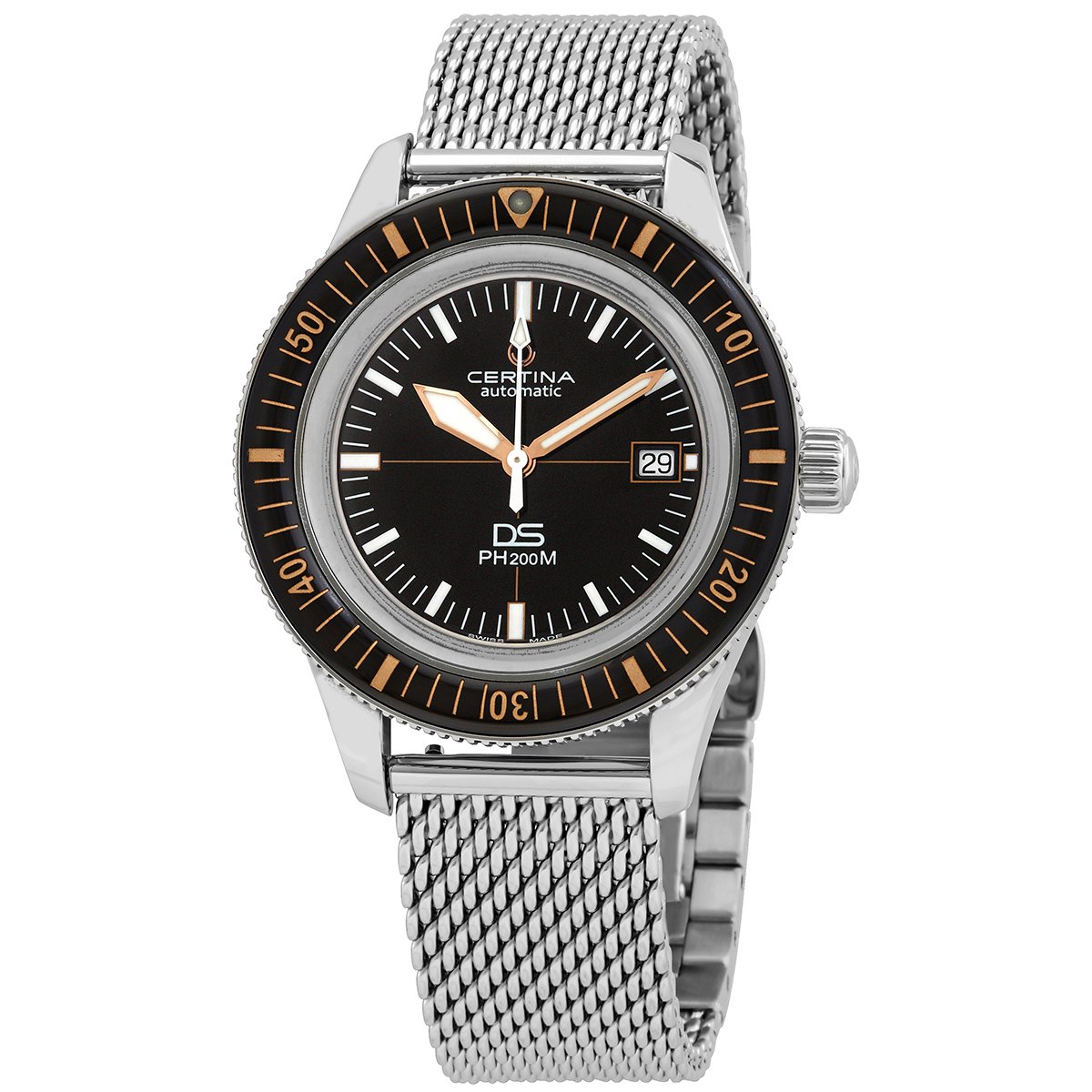
The 316L stainless steel case measures 42.8mm in diameter, a size that reflects modern tastes while remaining faithful to the oversized tool-watch ethos of the late 1960s. The finishing is predominantly polished, which may surprise those expecting a fully brushed 'tool' aesthetic, but it accurately reflects the dual-purpose nature of 60s divers which were often worn as daily timekeepers. The most controversial and yet most charming element of the reference C036.407.16.050.00 is the choice of crystal. Rather than the ubiquitous flat sapphire, Certina opted for a domed Hesalite (acrylic) crystal treated with a Nex scratch-resistant coating.
From a technical standpoint, Hesalite offers superior impact resistance compared to sapphire, as it tends to flex rather than shatter. From an aesthetic standpoint, it provides a 'warmth' and a slight distortion at the edges of the dial that sapphire simply cannot replicate. This distortion, combined with the wide, 60-click unidirectional aluminum bezel, creates a visual profile that is unmistakably mid-century. The bezel itself has a distinctively large overhang, making it exceptionally easy to grip, even with gloves—a nod to its functional diving roots.
The Dial: Geometric Precision
The dial of the PH200M is a study in legibility. The matte black surface serves as a high-contrast backdrop for the white printed indices and the bold, red crosshair that bisects the dial. This crosshair is a direct lift from the 1967 original, serving both as a visual anchor and a reminder of the watch's precision-instrument heritage. The sword-shaped hour and minute hands are generously filled with Super-LumiNova, as is the spear-tipped seconds hand.
The date window at 3 o'clock is executed with restraint. By utilizing a black date wheel with white numerals, Certina has ensured that the complication does not disrupt the visual symmetry of the dial. This is a detail often overlooked by brands at this price point, and its inclusion here demonstrates a high level of design maturity. The lume performance is commendable, providing a bright, consistent glow that ensures legibility in low-light environments, though it lacks the multi-colored 'light show' of more contemporary divers.
The Powermatic 80: A Modern Engine
Under the hood lies the Powermatic 80.111, a movement that has redefined expectations for power reserve in the sub-$1000 category. Based on the venerable ETA 2824-2, the Powermatic 80 represents a significant evolution in movement architecture. To achieve the 80-hour power reserve—nearly double that of a standard 2824—ETA engineers reduced the frequency from 28,800 vph (4Hz) to 21,600 vph (3Hz). This reduction in beat rate, combined with a more efficient mainspring and a friction-reducing synthetic escapement, allows the watch to run for over three days on a single wind.
While some purists bemoan the loss of the 'smooth sweep' associated with 4Hz movements, the practical benefits of an 80-hour reserve are undeniable. One can set the watch down on a Friday evening and pick it up on Monday morning without the need for resetting. Furthermore, the movement features a free-sprung balance, which enhances long-term rate stability and shock resistance. Although this specific reference does not include the Nivachron hairspring (which was introduced in later iterations), the 80.111 remains a robust and reliable caliber that is easily serviced by any Swatch Group technician.
The DS System: Engineering for Longevity
To understand the PH200M, one must understand the 'Double Security' architecture. Most modern divers rely on a screw-down crown and a thick gasket for water resistance. Certina goes further. The movement is essentially 'suspended' within the case, protected by a dedicated rubber ring. This provides a secondary layer of shock protection that complements the Incabloc system on the balance wheel. The case back is also notably thicker than average, featuring the iconic embossed turtle logo—a symbol of the watch's protective 'shell.'
This level of over-engineering is what allowed the original PH200M to survive the pressures of undersea research. In the modern context, it translates to a watch that can handle the rigors of an active lifestyle with ease. Whether it is the vibration from a mountain bike or the pressure of a recreational dive, the PH200M is built to endure. The 200-meter water resistance rating is conservative, given the construction methods employed.
Wrist Presence and Versatility
On the wrist, the PH200M is a commanding presence. The long, straight lugs give the watch a larger footprint than its 42.8mm diameter might suggest. However, the downward curve of the lugs helps to hug the wrist, preventing it from feeling like a 'slab' of steel. The reference C036.407.16.050.00 comes as a kit, including a high-quality brown leather strap with quick-release spring bars and a grey/blue NATO strap. This versatility is a major selling point.
On the leather strap, the watch takes on a 'skin diver' aesthetic that pairs perfectly with a casual blazer or a denim jacket. It feels sophisticated, leaning into its vintage roots. Swapping to the NATO strap transforms the piece into a rugged military instrument. The quick-release system is a thoughtful touch, acknowledging that the modern collector enjoys changing the look of their watch frequently. The pin buckle is signed and feels substantial, matching the overall quality of the case finishing.
Conclusion: The Virtues of Restraint
The Certina DS PH200M is a rare example of a watch that succeeds by knowing exactly what it is. It does not try to compete with the ceramic-laden Submariners or the high-beat Grand Seikos of the world. Instead, it offers a pure, unadulterated connection to a golden era of diving history. It prioritizes the tactile joy of Hesalite and the mechanical reliability of the DS system over the superficial flash of modern luxury materials.
For the young collector, this is an ideal acquisition. It provides a historical narrative, a high-performance Swiss movement, and a unique aesthetic identity, all for a price that remains accessible. It is a watch that rewards close inspection, from the grain of the matte dial to the relief of the turtle on the case back. In an industry often obsessed with the 'next big thing,' the PH200M proves that sometimes, the best way forward is to look back with clarity and technical precision.