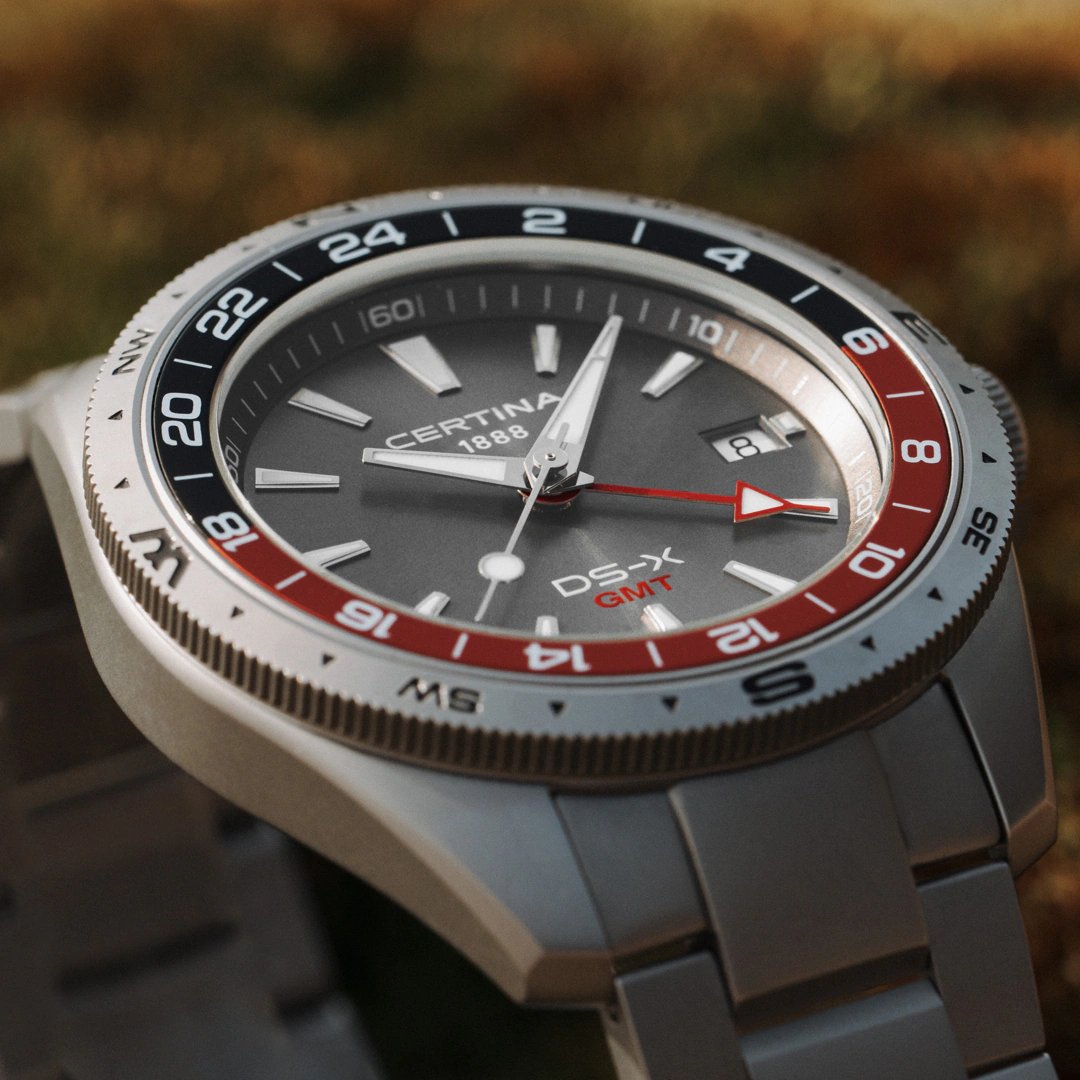
Brand context and the DS idea
Certina was founded in Grenchen in 1888 by Adolf and Alfred Kurth. The brand's modern identity is inseparable from the DS concept, introduced in 1959, which emphasised a sealed case architecture and everyday durability. That idea has survived changes in ownership and fashion because it solves a real problem: a watch should be able to absorb daily life without asking for special treatment.
Today Certina sits within the Swatch Group, which gives it access to industrial movement technology and service infrastructure that would be difficult to match independently. The DS-X GMT should be read in that context. It is not trying to be a boutique piece. It is trying to be a well-made Swiss automatic with a useful complication, a comfortable bracelet, and a price that does not require a ceremony.
The movement: Powermatic 80 GMT
The DS-X GMT uses the Powermatic 80 GMT family of automatic movements. That means an 80-hour power reserve, a frequency of 21,600 vibrations per hour, and a practical date and GMT layout. The extended reserve is the headline for many buyers, and rightly so: it allows the watch to be taken off on Friday evening and picked up on Monday morning without a reset.
This is not an in-house Certina calibre, and Certina does not present it as one. It is a Swatch Group movement, shared across several brands and tuned for value and reliability. The finishing is industrial rather than artisanal. You will not find the sort of hand-bevelled bridges that justify a display back, and the DS-X GMT does not pretend otherwise. What matters is that the architecture is sound, the GMT complication is integrated cleanly, and service support should be straightforward through authorized channels.
The GMT function is the reason to choose this reference over a standard three-hand DS model. It adds a second time-zone reading without turning the dial into a cockpit. For a traveler, that is the correct level of complexity: enough information to be useful, not so much that the watch becomes a puzzle.
Case, dial, and finishing
The case is stainless steel, and the watch is fitted with a sapphire crystal. The design language is sporty but controlled. Certina has avoided the oversized-bezel trap that makes many travel watches feel like dive tools in disguise. The DS-X GMT reads as a daily sports watch with a GMT hand and a 24-hour scale, not as a piece of expedition equipment.
The dial is legible and balanced. The GMT hand is distinct enough to be read at a glance without becoming a novelty. Super-LumiNova is applied to the markers and hands, and it performs the role expected of it: low-light visibility without neon theatrics. The stainless steel bracelet integrates cleanly with the case, and the folding clasp keeps the underside comfortable during desk work.
Finishing is where the price shows itself. The surfaces are clean and pleasant, but the transitions are not jeweller-grade. The case is brushed and polished in a way that feels durable rather than precious. That is not a criticism at this price point. It is a reminder that the DS-X GMT is built to be worn, not coddled.
On the wrist
The DS-X GMT wears like a watch designed to disappear into a routine rather than dominate the wrist. The stainless steel case has a compact, purposeful stance, and the bracelet integrates cleanly enough that the watch feels balanced rather than top-heavy. It is comfortable for a full day at a desk, and the folding clasp keeps the underside tidy.
On the wrist, the design reads sporty but not aggressive. The sapphire crystal and restrained case finishing keep it from feeling fragile, while the bracelet gives it enough presence for casual wear. It is the sort of watch you forget you are wearing until you need to read a second time zone, which is exactly the point. The GMT hand does not clutter the dial, and the date remains useful without interrupting the symmetry.
Accuracy and daily performance
Because the DS-X GMT is not chronometer-certified, owners should expect realistic mechanical performance rather than laboratory numbers. In daily use, a healthy example should hold within a few seconds to low double digits per day, depending on position and wearing habits. The Powermatic 80 GMT is generally stable once settled, and the 80-hour reserve means it can sit through a weekend without needing a reset.
It is worth setting expectations honestly. This is not a Grand Seiko or a COSC-certified Longines. It is a value-oriented Swiss automatic, and the movement's virtue is endurance rather than obsessive rate precision. If you need quartz-like timekeeping, a quartz GMT will serve you better. If you want a mechanical travel watch with a long reserve and reasonable accuracy, the DS-X GMT is entirely fit for purpose.
When to wear it
The DS-X GMT is at its best as a travel watch and daily wearer. It has enough water resistance for everyday life and enough legibility for an airport lounge, a train platform, or a rental-car counter. The stainless steel bracelet makes it easy to wear with casual clothing, and the restrained dial means it does not look out of place with a jacket.
It is not a formal dress watch. The case and bracelet are too sporty for black tie, and the GMT hand adds a utilitarian note that belongs in the day-to-day category. But for business casual, weekends, and actual travel, it hits a useful middle ground. It is the kind of watch that can be the only watch you pack for a short trip.
Reference, variants, and family
The reference shown here is C039.407.11.041.00, a steel-bracelet configuration with a blue dial. Certina's reference system can be market-specific, so buyers should confirm the exact suffix and dial colour with an authorized retailer before purchase. The DS-X GMT family sits alongside the DS Action GMT and the broader DS range, which includes the DS-1 and DS-2. Those models share the brand's practical brief but differ in case shape, bezel treatment, and movement specification.
Within Certina's catalogue, the DS Action Diver, DS-1 Powermatic 80, and DS Podium Chronograph are the obvious other ports of call. The DS Action Diver is the more overtly sporty choice. The DS-1 is the more classical daily watch. The DS Podium adds chronograph functionality. The DS-X GMT carves out a space for the traveler who wants a second time zone without a full dive watch or a chronograph.
Alternatives and cheaper homages
The most natural step-up is the Longines Spirit Zulu Time, which brings a more refined case, stronger finishing, and a more elevated brand position. The Tudor Black Bay GMT is the obvious luxury travel watch for buyers who want more wrist presence and collector recognition. The Oris Big Crown ProPilot GMT offers a pilot-inspired alternative with a distinct design language, while the Christopher Ward C63 Sealander GMT is a direct-value rival with a lighter, more modern feel.
For buyers who want the GMT experience at a lower price, the Seiko 5 Sports GMT is the obvious entry point. It is mechanical, affordable, and genuinely useful. The Tissot Seastar 1000 GMT is another Swatch Group option with a sportier, dive-adjacent stance. The Glycine Airman appeals to buyers who want a heritage 24-hour travel watch rather than a conventional GMT hand. None of these are direct substitutes for the Certina in finish or brand position, but they show how much travel-watch utility is available at different price points.
Investment and ownership
The DS-X GMT is not an investment watch. At around the retail price, it competes with other value-oriented Swiss automatics, and pre-owned examples typically trade below retail. That is normal for Certina and should not be treated as a flaw. The watch's value is in daily use, not in resale appreciation.
Buyers should focus on condition, complete paperwork, and service history if they are shopping pre-owned. A well-kept example with a healthy bracelet and clean crystal is worth more than a cosmetically tired watch with a vague history. The DS-X GMT does not have major auction history, and it is unlikely to develop a collector premium. Buy it because you want a capable travel watch, not because you want a store of value.
Service and long-term ownership
Service should be handled through Swatch Group authorized channels. Interval and cost vary by region, and Certina does not present this as a watch that should be treated as a disposable object. The Powermatic 80 GMT is a known architecture, which is an advantage: parts and trained watchmakers should be available for years to come.
The practical advice is simple. Wear it regularly, avoid unnecessary shock, and have it serviced when the rate becomes unstable or the power reserve begins to fall short. The 80-hour reserve is generous, but it is not an excuse to let the watch sit indefinitely. Mechanical watches prefer motion.
Final verdict
The Certina DS-X GMT is a sensible traveler's watch rather than a luxury statement. Its Powermatic 80 GMT movement, comfortable steel bracelet, and unpretentious design make it an easy recommendation for a first serious automatic or a no-drama second time-zone watch. It will not impress a room, but it will quietly do the job for years.
For a young collector, that is a valuable kind of honesty. The DS-X GMT does not pretend to be a precious heirloom. It offers a practical GMT, a long power reserve, and a wearable stainless steel package at a price that leaves room for the rest of life. If you want a watch that earns its place through use rather than hype, it deserves a serious look.