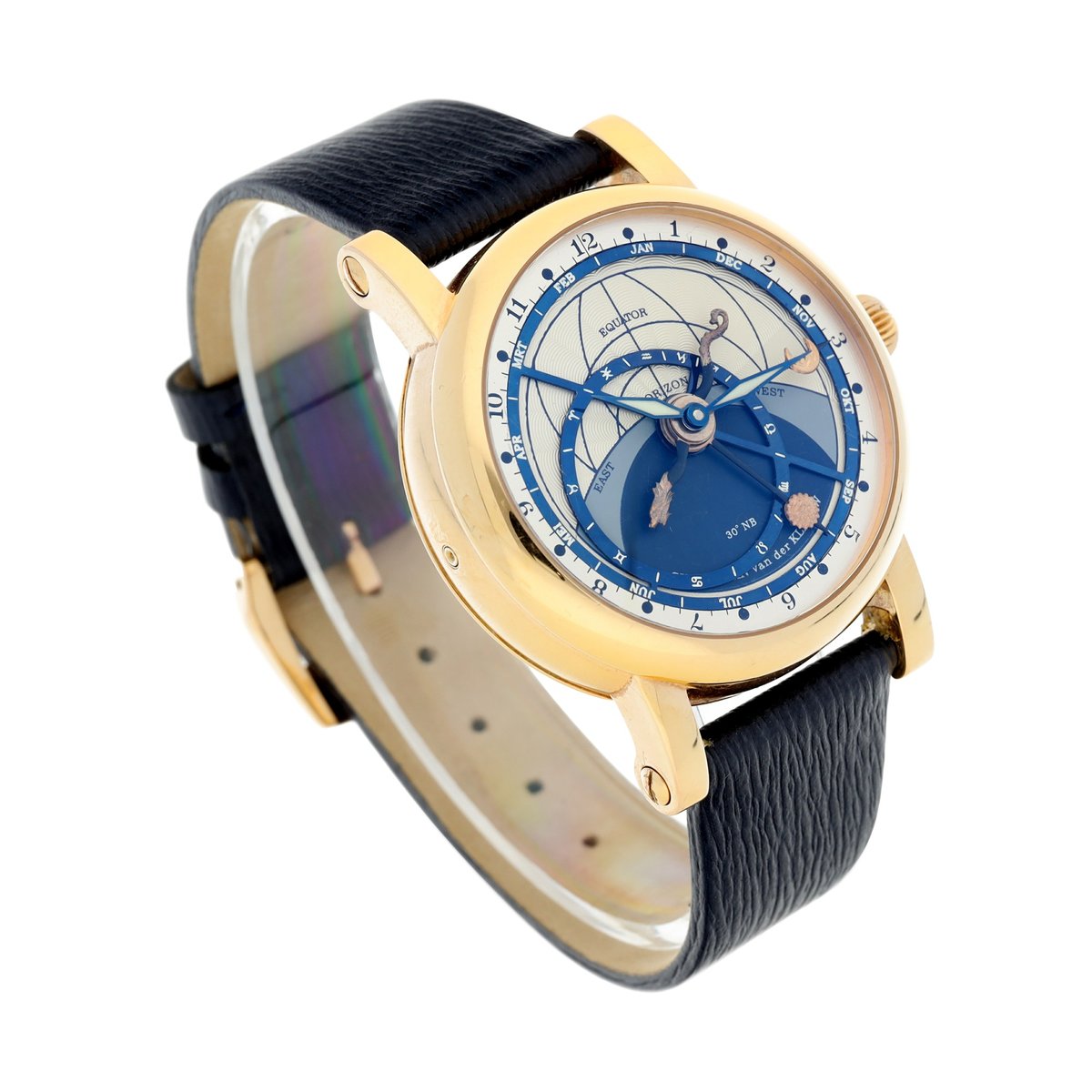
The Dutch independent that looks up
Christiaan van der Klaauw founded the brand in 1974 in the Netherlands, building a reputation around astronomical complications rather than generic luxury. That origin matters. This is not a fashion house that added a moonphase because the mood board said celestial; CVDK's identity was built on the night sky, and the Astrolabium is one of the purest expressions of that brief.
The Astrolabium sits in a family that includes the Real Moon Joure, the Planetarium, and the Eclips, but it has its own personality. Where the Real Moon Joure is a more accessible moon-phase flex, the Astrolabium is the instrument for the collector who wants the dial to feel like a piece of antique science. The reference is simply Astrolabium, and that simplicity is part of the charm. There is no need for a coded sub-reference to explain what you are looking at.
Movement: an astronomical engine, not a chronometer flex
The Astrolabium runs on an automatic caliber with CVDK's astronomical module. It is not COSC-certified, and CVDK does not pretend it is a daily chronometer in the Rolex sense. The movement exists to drive a layered celestial display, and that is the correct way to judge it. The base automatic provides regular drive; the module turns the dial into an astrolabe, with zodiac and star-chart information layered into the watch face.
The architecture matters less than the translation. A watch like this lives or dies on whether the display feels coherent, and CVDK's long experience with astronomical complications shows. The finishing is oriented toward reliable daily drive rather than chronometric paperwork, and the result is a mechanical object that feels closer to a scientific instrument than a luxury badge. You do not buy this for the movement's certificate; you buy it for what the movement animates.
Design and specs
The case is offered in stainless steel and precious-metal variants, with sapphire crystal, no lume, and a leather strap. That combination tells you almost everything about the wearing experience: this is a dress-watch posture with a celestial complication, not a tool watch. The absence of lume is not an oversight; it is a signal that the Astrolabium belongs to candlelight and restaurant lighting, not a night dive.
The dial is the main event. The astrolabe display creates depth and a sense of layered information that rewards close looking. It is not a watch for quick glances in a meeting; it is a watch for the moment someone at dinner asks what all those rings and markers mean. CVDK has built a design that feels Dutch in its precision and old-world in its references, which is a difficult balance to pull off without looking like a museum replica.
On the wrist
On the wrist, the Astrolabium behaves like a small planetarium with a strap. The case is polished and jewelry-adjacent rather than tool-watch chunky, and the leather strap keeps the whole thing close to the wrist without turning it into a slab. It is the kind of watch you notice because the dial pulls people in, not because the case clanks against a laptop.
The balance is more dress watch than daily beater: the sapphire crystal and layered celestial display create depth, while the case sits politely under a cuff. It does not disappear on the wrist, but it also does not demand gym-watch energy. Think of it as a collector's evening piece that can survive a normal office day if you are careful with it.
Accuracy and daily life
CVDK does not position the Astrolabium as a COSC-chasing daily chronometer. Expect normal automatic-watch real-world variance, and remember that the astronomical display is meant to be set and enjoyed rather than timed against a quartz clock. If you need seconds-level obsession, buy a sports chronometer; if you want a sky on your wrist, you learn to live with mechanical character.
Daily life with the Astrolabium is about ritual. You set it, you wear it, and you occasionally catch someone staring at the dial trying to decode it. It is not the watch you grab for a gym session or a beach trip. It is the watch you wear when the evening has a little ceremony to it, when the restaurant is dim and the conversation is good.
Occasions and wrist presence
The Astrolabium works best for formal and dress occasions, but it can handle a daily office environment if you are not rough on your watches. It also travels well as a conversation piece, though it is not a travel watch in the GMT sense. The wrist presence is strong without being loud: 4/5. It is not a hype-brick, but the dial stops conversations and the case reads as jewelry.
This is a watch for the collector who already has the steel sports watch and the dive watch and wants something that says something different. It pairs with tailoring better than with athleisure, and it rewards the wearer who enjoys explaining a complication without turning into a lecture. The Astrolabium is culture-forward because it is unapologetically specific: it is for people who like science, craft, and a little bit of theatre on the wrist.
Variants, family, and alternatives
The Astrolabium is available in a steel execution that is the most approachable entry into the astrolabe display, and in precious-metal variants that warm up the celestial dial. The steel version is the one to look for if you want the complication without the full jewelry flex. The rose-gold variant is for the collector who wants the Astrolabium to read as an evening piece first and a mechanical instrument second.
Within the CVDK family, the Real Moon Joure, Planetarium, and Eclips are the closest siblings. The Real Moon Joure is the more familiar moon-phase play; the Planetarium is the bigger astronomical statement; the Eclips is the eclipse-focused alternative. Other notable models from the brand include the Venus, which shows the same commitment to celestial storytelling in a different register.
If you are looking at alternatives, the Patek Philippe Celestial is the blue-chip celestial grand complication, while Van Cleef & Arpels Poetic Astronomy offers a more decorative jewelry-house take. The Bovet Récital 22 Grand Récital is a more ornate, less Dutch interpretation of astronomical complications. None of them are direct substitutes for the Astrolabium's specific astrolabe proposition, which is exactly why the CVDK has a collector base.
If you want the celestial mood without the astrolabe price, the Orient Sun and Moon and the Sugess Moonphase are budget stand-ins. They do not deliver the same complication or the same independent-watch credibility, but they show how far the celestial aesthetic has traveled into accessible watchmaking.
Investment and service
The Astrolabium is a niche independent, and that shapes its investment profile. Pricing sits in the $40,000-$55,000 range depending on case metal, dealer, and availability, and the pre-owned market is thin enough that you should not treat it like a liquid asset. The trend is stable rather than explosive: the watch holds value because it is rare and specific, not because it trades like a hyped steel sports watch. There is no major auction history to point to, which is normal for a small Dutch independent with a specialized complication.
Hold if you bought it for the complication and the Dutch independent story. This is a long-term collector piece, not a quick flip. Service should go through CVDK or an authorized specialist because the astronomical module is not a generic watchmaker job. That service path is part of the ownership cost of a small independent, and it is worth factoring in before you buy.
Pros and cons
- Pros: genuine astrolabe complication on the wrist; deep, conversation-starting dial; Dutch independent rarity.
- Cons: limited everyday legibility; complex service path; niche resale market.
Final verdict
The Astrolabium is not the watch you buy because a celebrity wore it, or because a resale chart told you to. It is the watch you buy because you want a Dutch independent's celestial instrument on your wrist and you are comfortable with a niche, service-sensitive object. For the right collector, that is more valuable than another steel sports watch with a waiting list.