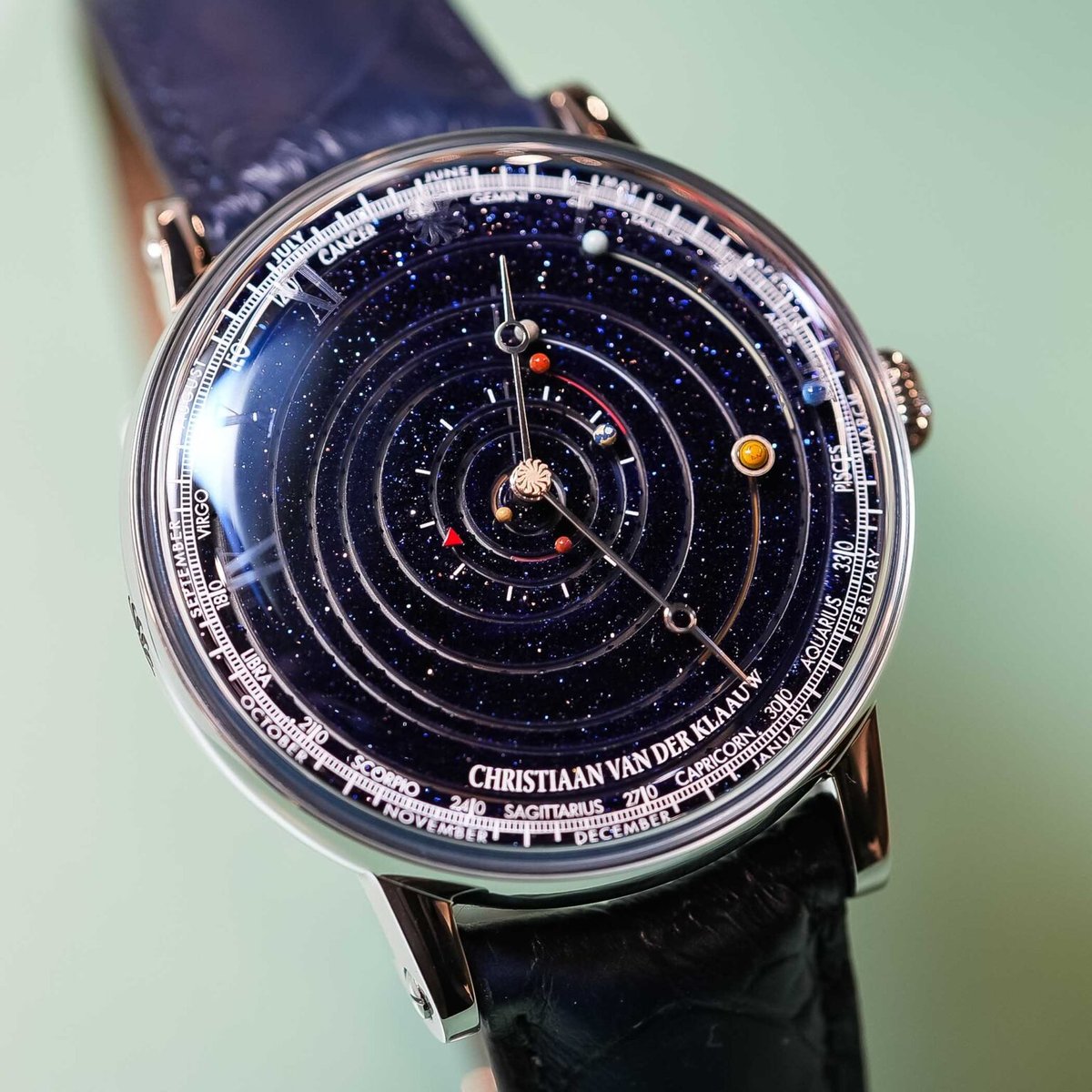
There are watches that tell you the time, and there are watches that tell you where you are. The Christiaan van der Klaauw Grand Planetarium Eccentric is unapologetically the second kind. On a dial you could cover with a thumb, a small Dutch atelier has installed a working model of the solar system: Mercury, Venus, Earth, Mars, Jupiter, Saturn, Uranus and Neptune, each on its own track, each moving at its own true relative speed.
It is the sort of object that once lived only behind glass at Baselworld and now fits neatly into the way young collectors actually buy. Van Cleef & Arpels took the astronomical dial to the red carpet. Jacob & Co. put it on the wrists of rappers and racing drivers and made it a music-video prop. And in Friesland, quietly, Christiaan van der Klaauw has been doing the harder, smaller, more mechanical version of the same idea since 1974.
The CKGP1104 is where that lineage lands right now: a grand planetarium, laid out off-centre, cased in gold, strapped in leather, and produced in numbers small enough that most collectors will never see one outside a photograph. Here is what it is, how it wears, and whether it earns its keep.
The house that maps the sky
Christiaan van der Klaauw founded his workshop in 1974 in the Frisian north of the Netherlands — a region better known for ice skating and stubbornness than for haute horlogerie. He began with clocks, moved into watches, and built the house's reputation on a single obsession: the night sky rendered in gear teeth.
The geography is not incidental. Franeker, a short drive away, is home to Eise Eisinga's planetarium — a ceiling-mounted model of the solar system built between 1774 and 1781 that still runs today, the oldest working planetarium on earth. A Dutch watchmaker growing up in that shadow does not need to be told twice what a complication ought to look like. The sky, in that part of the world, is a piece of local infrastructure.
Van der Klaauw's Planetarium put a heliocentric display on a wrist and was recognised by Guinness World Records as the smallest mechanical planetarium of its kind — a detail that sounds like marketing until you consider what it takes to shrink orbital periods into a case. The atelier is now led by Daniël and Maria Reintjes, who have kept the astronomical core intact while sharpening the dials, the finishing and the overall presentation. It is the classic small-house arc: heritage, then refinement, then a new generation of collectors discovering it just as the auction market starts paying attention to independent European names.
Reading the Grand Planetarium Eccentric
The dial is the argument. Where most astronomical watches give you a moonphase aperture and call it a day, this one gives you the whole system. Each planet sits on its own track, and each track is geared to the planet's real orbital period rather than a convenient approximation. Mercury completes its circuit in roughly 88 days. Neptune takes about 165 years.
Sit with that for a second. On your wrist, the outermost planet will complete a single lap roughly five generations from now. The indicator may as well be a fixed point, and that is precisely the romance of it — most of the motion on this dial is happening at a pace human beings cannot perceive, which is what separates an astronomical complication from a decorative one.
The "Eccentric" in the name does double duty. On the layout side, the time display is deliberately pushed off centre rather than planted in the middle, which frees up the real estate the planetary tracks need and breaks the concentric-circle convention that makes so many complication dials look like targets. On the astronomical side, the orbits are drawn as the elliptical paths the planets actually follow rather than tidy rings. Every square millimetre goes to the sky; there is no date window elbowing in for space.
In person the effect is closer to a scientific instrument than a piece of jewellery. The deep blue dial, the fine printed tracks and the small planetary markers reward a loupe and punish a dim restaurant. That is the trade: you do not buy this for legibility at 11pm. You buy it because at 2pm, in good light, it does something no chronograph can.
Inside the eccentric
The movement is where the money goes, and where the atelier gets coy. CVDK builds the astronomical module in-house, and stacks it on a self-winding base the brand does not shout about. What matters is the reduction train: to make Neptune crawl while Mercury sprints, you need enormous gear ratios, and enormous ratios mean friction, backlash and torque loss. Get it wrong and the display stutters, stalls or drifts. Get it right — as this house has been doing for decades — and the whole system runs off one mainspring with the calm of a clock in a church tower.
Finishing is appropriately old-school for the bracket. Bridges are bevelled, the module is assembled and adjusted by hand, and the engineering is legible in the way serious collectors want: not decorated for a photograph, but finished because the parts need to survive decades of continuous, glacial rotation.
Is it in-house in the purest sense? The astronomical brain is, and that is the part you are paying for. Small European ateliers of this size almost always build on a supplied base movement, and CVDK's discretion about it is part of the house's character rather than a flaw.
On the wrist
In the metal, the Grand Planetarium Eccentric behaves like a dress watch with a secret. The gold case carries real heft without feeling top-heavy, the lugs curve away cleanly so the leather sits flush against the wrist, and the whole thing slides under a shirt cuff without a fight. There is no lume and no concession to the dark, so this is a daytime and dinner object, not a tool.
The sensation that stays with you is density. The dial is a diagram, and diagrams reward attention: for the first week you will catch yourself tilting your wrist toward a window to check whether the inner track has budged. Then you will stop checking, because Neptune has not moved and will not move, and you will settle into the pleasure of owning something that keeps time on a scale larger than your own.
It does not announce itself across a room. It waits to be asked. In a market where astronomical watches have become associated with maximalism — spinning tourbillons, gem-set constellations, cases the size of a saucer — that restraint reads as confidence. This is the version of the genre that a collector wears, not the version a publicist stages.
Accuracy and daily life
This is not a chronometer-certified piece and nobody at the atelier pretends otherwise. Expect a well-regulated automatic that holds a stable rate under normal wear, with the ordinary positional variation that comes with small-series independent watchmaking. Keep it wound, wear it regularly, and have it regulated at service rather than chasing seconds with an app.
The astronomical display is a separate question. Its accuracy is a function of gear ratios and correct setting — and because the outer planet's lap takes generations, a small offset is genuinely invisible within a human lifetime. What matters more is the setting ritual: this is not a watch you adjust in a car park, and the atelier will walk you through it. Treat that as part of the ownership experience rather than an inconvenience.
Water resistance is not the point of this watch and CVDK does not position it as one; if you plan to wear it hard, that is a conversation to have with the atelier directly. Servicing should go back to Friesland or to an approved specialist, because a generalist watchmaker should not be opening a gear train tuned for a 165-year lap. That is the real cost of small-house ownership: a smaller network, a slower turnaround, and a relationship rather than a service counter.
The money question
Pricing sits in the region of the high five figures in US dollars, and it varies by market, edition size and specification — confirm with the atelier rather than a grey-market listing. What that money buys is a hand-assembled astronomical complication from a European house with real history, produced in numbers that make it genuinely uncommon.
What it does not buy is liquidity. There is no major auction history for the CKGP1104, and CVDK pieces surface at public sale rarely; they move privately, through specialist dealers and through collectors who already know each other. When they do come up, they hold their ground rather than spike. The trend line is stable — a soft floor, not a rocket.
The honest read: if you are buying this for appreciation, you are buying the wrong watch. If you are buying it because you want a planetarium on your wrist that no one else at the meetup owns, you are buying exactly the right one, and the resale question will feel academic for a decade.
What it competes with
The obvious rival is the Van Cleef & Arpels Midnight Planétarium — more jewellery, more visibility, more money, and a fraction of the mechanical intimacy. Jacob & Co.'s Astronomia is the maximalist reading of the same brief, built for people who wear watches on camera. Patek's Celestial maps the sky rather than the orbits: quieter, more institutional, and a different intellectual pleasure entirely.
None of them is trying to do what CVDK does. The Frisian house is the only one of the group offering a true planetarium at a scale that behaves like a dress watch, from an atelier small enough that the watchmaker knows your name. If the idea appeals but the budget does not, orbital-themed dials from studios such as Xeric and Mr Jones Watches scratch the same visual itch for a few hundred dollars — with none of the mechanical honesty, but plenty of charm.
Verdict
The Grand Planetarium Eccentric is the connoisseur's answer to the astronomical-watch boom: less jewellery than Van Cleef, less theatre than Jacob & Co., and far more actual sky per square millimetre than either. It is not a watch you buy for resale charts or for the approval of a room. It is a watch you buy because you want to look down at your wrist and see the solar system quietly doing its thing.
For the collector who already owns the obvious pieces — the steel sports watch, the dive watch, the chronograph — and wants something nobody else at the table has, this is a genuinely special object. Buy it to keep. It will outlast the trend cycle by roughly 165 years.