Ref. C60-42ADC31B0KK0-HK
Bronze is not a neutral choice. On the Christopher Ward C60 Pro 300 Bronze, the case, bezel and crown begin warm and bright, then take on the marks of every desk edge, swim and sweaty commute. That is the point. This is a 300m diver that invites daily wear rather than safe-queen treatment, and the reference C60-42ADC31B0KK0-HK arrived on a hybrid strap that makes the proposition even more casual.
I wore it for a full week as my only watch: office days, school runs, a pool session and a weekend of errands. The question was not whether bronze looks good in photographs. It was whether the watch remains comfortable, legible and accurate once the novelty fades. The answer is mostly yes, with a few bronze-owner caveats.
Christopher Ward was founded in 2004 as a direct-to-consumer British brand, and the C60 Trident line has become its core dive-watch family. The Pro 300 Bronze extends that line with a bronze case that develops patina. The brand's model is to sell online and keep costs down, which is why the spec sheet reads stronger than the price suggests.
The bronze proposition
Christopher Ward has built its reputation on direct-to-consumer value, and the C60 Trident line is the clearest expression of that idea. The Pro 300 Bronze takes the familiar dive-watch formula and shifts the material from steel to bronze, which changes the ownership experience more than the spec sheet suggests. Bronze is softer than steel, warmer in tone and reactive to air, moisture and skin. A new watch looks almost golden; a worn one looks like a tool with a history. That is either the reason to buy it or the reason to avoid it.
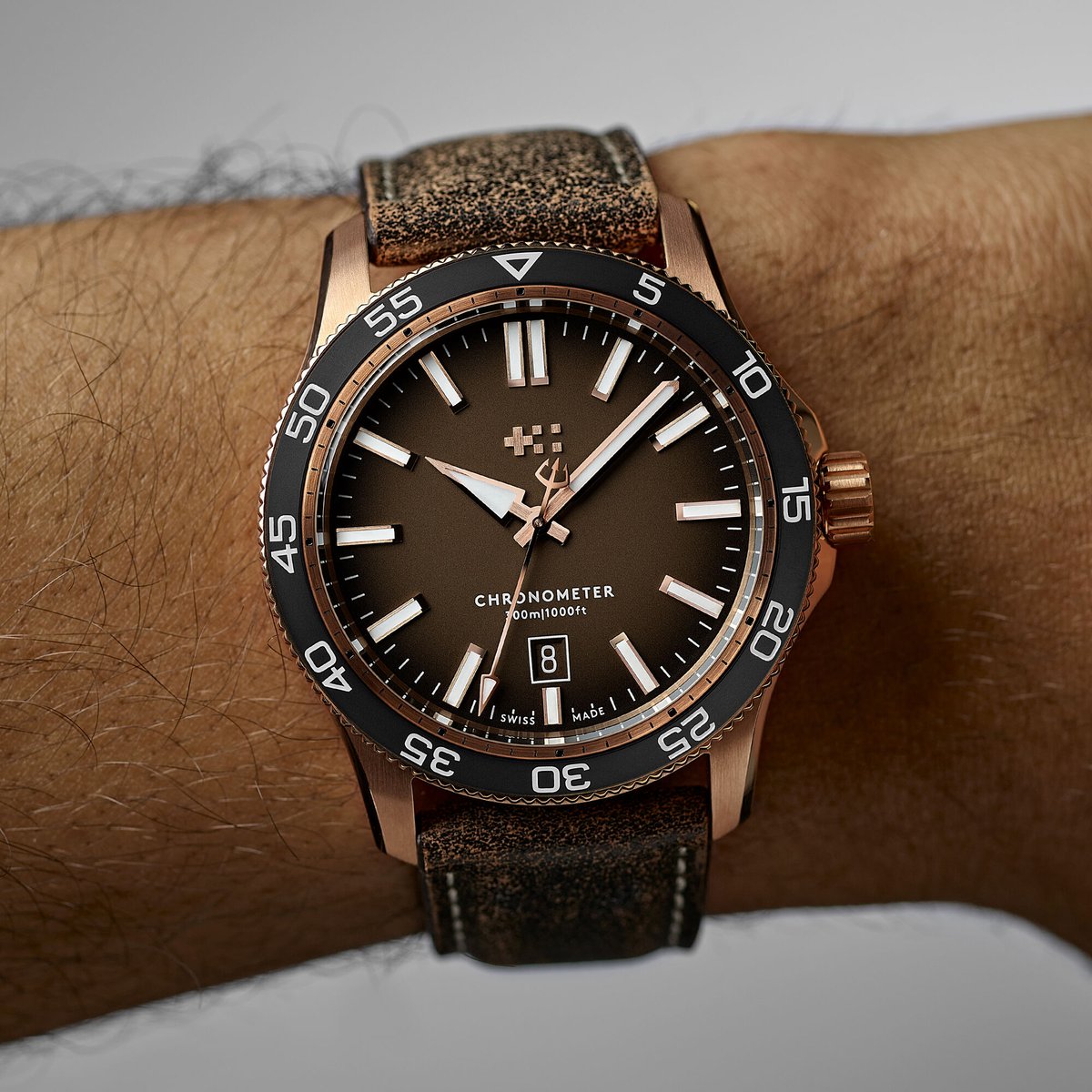
At 42mm, the case has enough presence to read as a proper diver without becoming a caricature. The bronze bezel, crown and case share the same warm tone, and the brown dial keeps the overall look cohesive. The crystal is sapphire, the water resistance is 300m and the lume is Super-LumiNova X1. Those are serious dive-watch numbers, but the watch is not dressed like a piece of survival equipment. It is casual, slightly vintage and easy to pair with denim, chinos or a wet suit.
The first impression is warmer than a steel diver and less aggressive than a tactical watch. The bronze case catchlight is soft rather than bright, and the brown dial keeps the watch from looking like a gimmick. It reads as a tool that has been left out in the sun, not as a costume piece. That matters because bronze can look forced when the rest of the design is too polished. Here, the hybrid strap and simple dial keep the package coherent.
Case, strap and wrist feel
On the wrist, the C60 Pro 300 Bronze feels like a tool watch with manners. The bronze case has real mass, but the caseback is flat, the lugs curve down and the hybrid strap is supple from the first wear. It sits securely without needing to be strapped down hard. The crown is big enough to grip but does not dig into the back of the hand. The bronze has a warm, almost brass-like tone that reads casual; this is not a watch that disappears under a cuff. It is balanced on the strap, though the head is heavy enough that I noticed it during the first hour and then stopped noticing it entirely. That is the test.
The hybrid strap is the right call for this reference. It is comfortable in heat, dries quickly and does not make the watch feel top-heavy. The pin buckle is simple and easy to adjust, and the strap has enough flexibility that the watch stays put during a swim. If you prefer a bracelet, the bronze option will add weight and change the balance, but on the hybrid setup the watch is an easy daily wear. The only real comfort caveat is psychological: bronze can leave a dark mark on skin or a shirt cuff if it is new and damp. That fades as the patina settles, but it is worth knowing before you wear it with a white linen shirt.
The case finishing is honest rather than luxurious. The bronze surfaces are brushed and polished in the right places, and the edges are soft enough to avoid snagging on a sleeve. The bezel grip is good even with wet fingers, and the crown guards do their job without making the case look bulky. This is not a watch that feels fragile. It feels like something you can take to the beach and then wear to dinner without changing straps.
Dial, bezel and legibility
The brown dial is the quiet hero. It has enough warmth to match the bronze without becoming a monochrome exercise, and the applied markers and hands are easy to read in both daylight and low light. The date at 3 is small but useful, and it does not upset the symmetry too badly. The bezel action is positive, with little backplay, and the bronze edge gives you something to grip. The sapphire crystal has a clear anti-reflective treatment that keeps reflections under control in bright conditions.
Lume is strong. Super-LumiNova X1 charges quickly under a lamp and remains readable through the night. The hands and hour markers glow evenly, and the bezel pip is easy to find. This is not a lume monster in the style of a Seiko diver, but it is entirely adequate for a 300m watch. Legibility on the move is excellent: the broad hands, high-contrast dial and simple chapter ring mean you can read the time at a glance, even with wet hands or in a dark car park.
The dial is also restrained in a way that suits long-term wear. There is no oversized logo, no unnecessary text and no faux-vintage clutter. The date window is not perfectly integrated, but it is practical. At night, the lume is bright enough to read without straining, and the bezel pip is easy to locate. For a watch that is meant to be worn every day, that matters more than a dramatic dial texture.
Movement and accuracy
The movement is the Sellita SW200-1, a known quantity in the sub-$2,000 dive-watch market. It is automatic, hacks, hand-winds and runs at 28,800 vph with 26 jewels. Power reserve is 38 hours, which is modest by current standards but entirely normal for this movement. The date changes cleanly and the crown action is positive. There is no COSC certification here, so do not expect chronometer numbers on the box.
Over seven days, worn during the day and rested crown-up at night, my sample averaged about +6 seconds per day. That is well within the movement's normal range and good enough that I stopped resetting it after the first few days. Expect variation with position and activity; a regulated example can do better, but a non-certified workhorse should be judged on consistency, not brochure numbers. The 38-hour reserve means it will be dead after a weekend off the wrist unless you wind it. That is the main practical compromise of this price point.
The movement is not the reason to buy this watch, but it is not a reason to avoid it. The SW200-1 is easy to service, parts are widely available and most watchmakers know it well. If you want an in-house calibre or a long power reserve, you will need to spend more. If you want a reliable daily automatic with a date, this is a sensible choice.
Living with it for a week
I wore the C60 Pro 300 Bronze for a week that included desk work, a school run, a pool session and a Saturday of errands. It handled all of it without fuss. The bronze picked up a few small marks and a slightly darker tone around the bezel edge, which is exactly what buyers of bronze watches want. The strap dried quickly after the pool, and the watch never felt insecure on the wrist. The 300m water resistance is more than most people need, but it means you do not have to think about rain, washing your hands or a sudden downpour.
The watch is at its best with casual clothes. It looks right with a T-shirt, a field jacket or a sweater. It is less at home with a suit, not because it is too big, but because the bronze and hybrid strap make it read as a weekend piece. That is not a criticism; it is a clarity of purpose. If you want one watch for everything, a steel C60 Pro 300 will be more versatile. If you want a daily diver with a bit of character and a visible record of wear, the bronze version makes more sense.
The strap is a big part of that versatility. A hybrid strap is more comfortable than a stiff leather strap in summer and less formal than a bracelet. It also makes the watch easier to size and adjust. The pin buckle is not as secure as a deployant clasp, but it is simple and reliable. If you plan to swim often, check the strap regularly and rinse it after salt water. The watch itself will handle the water without drama.
Patina and ownership
Bronze is a living material. The watch will not stay the same colour as the day you bought it, and that is the point. Some owners speed up the process with a saltwater dip; others wipe the case with a cloth to keep it brighter. I did neither. I let it age naturally, and the result was a warmer, slightly uneven finish that made the watch feel more personal. The caseback is bronze too, which means the patina continues on the back, though the skin contact is less visible than on the case sides.
The trade-off is maintenance. Bronze can mark skin and cuffs, and it will never look as crisp as steel. If you like your watches to stay factory-fresh, this is not the reference for you. If you like the idea of a watch that records its own history, it is a compelling proposition. The C60 Pro 300 Bronze is not a limited edition or a safe-queen object; it is a watch designed to be worn.
There is also a practical side to patina. The darker areas around the bezel and crown can make the watch look older than it is, which some people love and others do not. A quick wipe with a soft cloth will even out the tone, but it will not remove the marks entirely. If you wear a lot of light-coloured shirts, consider a leather or rubber strap to keep the bronze away from fabric. The watch head itself is the part that changes, so the strap choice is part of managing the ownership experience.
Service, value and alternatives
Routine service is straightforward through Christopher Ward or a competent independent, and the Sellita SW200-1 is widely supported. Christopher Ward does not publish a fixed service interval for every model, so follow the brand's guidance and your watchmaker's advice. The movement is not expensive to service compared with in-house calibres, which is part of the value story.
At its retail price, the C60 Pro 300 Bronze sits in a crowded but sensible part of the market. It offers a bronze case, 300m water resistance, sapphire crystal, strong lume and a reliable Swiss movement. The price is fair for what you get, though it is not an investment. Pre-owned examples trade below retail, and the bronze finish narrows the buyer pool. Buy it because you want to wear it, not because you expect it to appreciate.
Alternatives include the Tudor Black Bay 58 Bronze, which is more refined and much more expensive; the Oris Divers Sixty-Five Bronze, which is smaller and more vintage in feel; and the Longines Legend Diver Bronze, which has a dressier, heritage-led character. Cheaper homages exist, but they rarely match the case finishing or the comfort of the hybrid strap.
Reference variants and family
The reference reviewed here is C60-42ADC31B0KK0-HK, with a brown dial and a khaki hybrid strap. Christopher Ward's C60 family also includes the steel C60 Trident Pro 300 and the higher-spec C60 Trident Pro 600, along with other C60 models such as the Bronze and Lympstone. Other notable Christopher Ward models include the C63 Sealander, the C1 Bel Canto, The Twelve and the C65 Dune. Each has a different personality, but the C60 Pro 300 Bronze is the most overtly casual of the core divers.
What I would change
The obvious criticism is the power reserve. Thirty-eight hours is enough for daily wear but not for a weekend off the wrist. A longer reserve would make the watch easier to live with, though it would also raise the price. The second criticism is the lack of COSC certification. At this price, that is not a dealbreaker, but it is worth knowing that accuracy will vary from sample to sample. The third is the bronze itself. It is a feature, not a bug, but it limits the watch to casual wear for many people.
I would also like to see a quick-release bronze bracelet offered as a package option. The hybrid strap is comfortable, but a bronze bracelet would complete the vintage-diver look. Christopher Ward does offer bracelet options on other C60 models, so this is more of a packaging wish than a design flaw. The watch itself does not need more features; it needs the right strap for the owner.
Who it is for
This watch is for the person who wants a dive watch with a difference but does not want to baby it. It suits someone who works in casual clothes, spends weekends outdoors and likes the idea of a watch that changes over time. It is not for the collector who needs every watch to look new, or for the person who wants one watch for a wedding and a swim. The C60 Pro 300 Bronze is a specialist daily wearer, and it is very good at that job.
Verdict
The Christopher Ward C60 Pro 300 Bronze is a convincing daily diver for people who like objects that show their age. It is comfortable, legible and water-resistant enough for real life, and the Sellita movement is a known quantity. The caveats are real: bronze can stain, the power reserve is modest, and there is no chronometer certification. None of those stopped me from enjoying it. If you want a bronze watch you will actually wear, put this one on your shortlist.