The Architectural Paradigm of the C60 Trident GMT 300
In the hierarchy of modern horology, the GMT-diver occupies a unique and often contested space. It must satisfy the rigorous ISO 6425-adjacent demands of a submersible tool while providing the multi-timezone functionality required by the global traveler. Christopher Ward’s C60 Trident GMT 300, specifically reference C60-44AGM31S0KK0-B0, approaches this dual-identity not through brute force, but through surgical precision and architectural refinement.
The 'Light-catcher' Case: A Study in Geometry
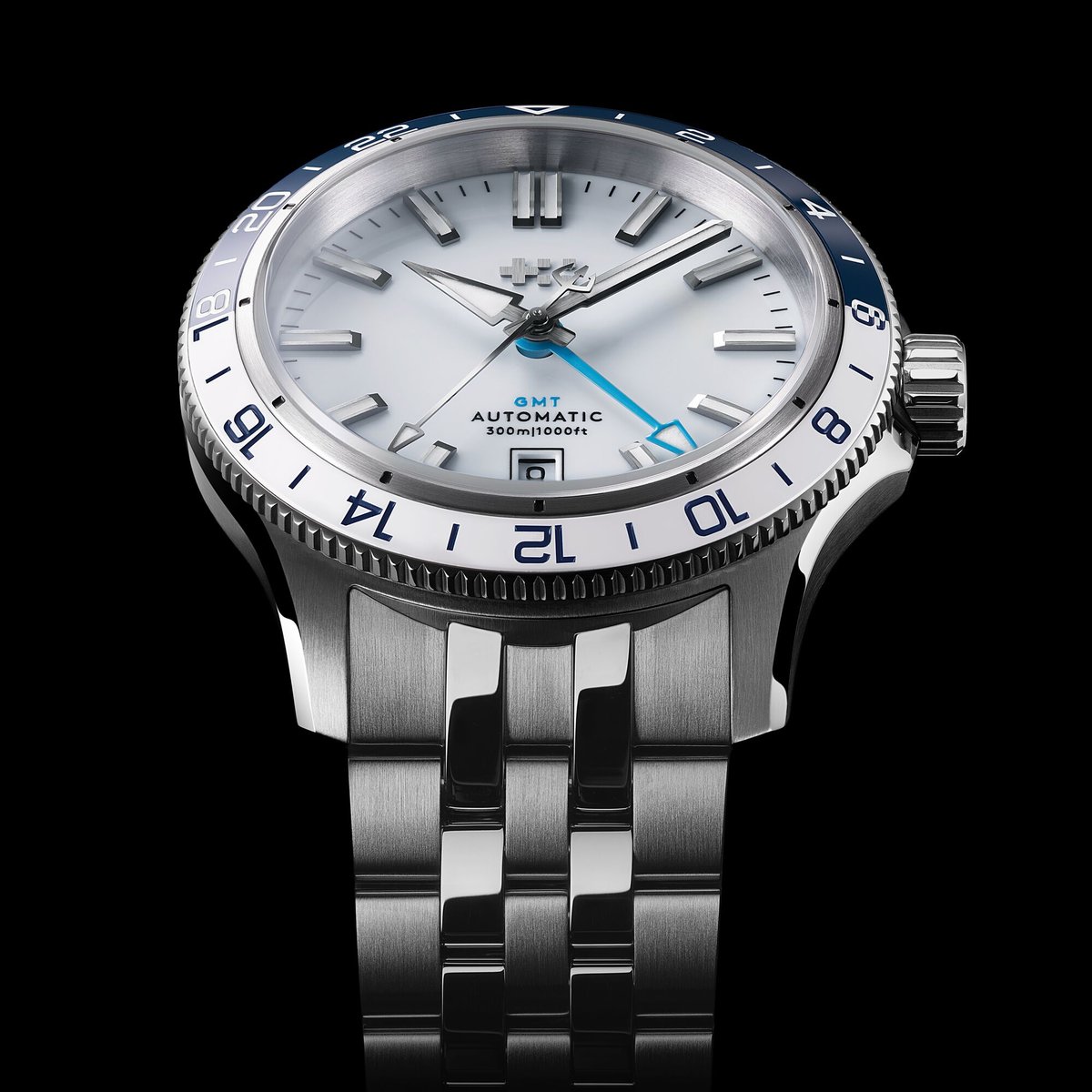
The hallmark of any modern Christopher Ward timepiece is the 'Light-catcher' case. This is not merely a marketing colloquialism but a technical description of the case’s complex surfacing. At 40mm in diameter, the case utilizes a series of alternating brushed and polished facets that curve inward toward the wrist. This geometry serves two purposes: it visually reduces the thickness of the mid-case and creates a dynamic interplay with ambient light. When one examines the transition from the brushed top of the lugs to the polished undercut that runs the length of the case, the level of finishing is staggering. The tolerances are tight, the transitions are crisp, and the lack of any sharp or unfinished edges speaks to a manufacturing process that has been refined over nearly two decades.
The Bezel and Dial: Functional Elegance
The C60 Trident GMT 300 features a bi-directional 24-hour bezel with a ceramic insert. Unlike the unidirectional 120-click bezels found on pure divers, this bi-directional movement allows for the rapid adjustment of a third time zone. The ceramic material ensures scratch resistance, while the numerals are deeply engraved and filled with Super-LumiNova. The dial itself is a glossy, deep black that provides a high-contrast backdrop for the applied indices. Each index is diamond-polished and faceted, catching the light in a manner that ensures legibility even in low-light environments. The GMT hand, finished in a striking orange, provides a necessary pop of color and immediate orientation for the secondary time zone. The use of Super-LumiNova Grade X1 BL C1 represents the highest tier of luminous material, ensuring that the watch remains functional in the depths of a cockpit or the hull of a ship.
The Sellita SW330-2: The Heart of the Traveler
Inside the C60 Trident GMT 300 beats the Sellita SW330-2. For the technically minded collector, the distinction between the SW330 and the SW330-2 is vital. The '-2' iteration represents a significant mechanical overhaul. Sellita’s engineers modified the gear train to increase the power reserve to 56 hours, up from the standard 42. This movement is a 'caller' GMT, meaning the GMT hand is adjusted independently in the second crown position. While 'flyer' GMTs (where the local hour hand jumps) are often preferred by pilots, the 'caller' GMT is arguably more useful for the office-based collector who needs to track a remote office or a loved one abroad without stopping the movement. The movement is visible through a sapphire exhibition caseback, revealing a custom rotor with the Christopher Ward twin-flag engraving and a level of perlage and snailing that is rare at this price point.
Ergonomics and the Bader Bracelet
A watch is only as good as its connection to the wearer. The Bader bracelet provided with this reference is a three-link oyster-style construction that emphasizes durability and comfort. The links are secured with screws rather than pins, a detail that facilitates easier resizing and offers greater security. The standout feature, however, is the clasp. Christopher Ward has pioneered a tool-less micro-adjustment system that allows for approximately 10mm of expansion or contraction. This is essential for maintaining comfort during temperature fluctuations or long flights. The integration of the bracelet into the lugs is seamless, with end-links that show zero play, reflecting the high-precision CNC machining used in the component's creation.
Conclusion: The Value Proposition
The Christopher Ward C60 Trident GMT 300 is a testament to what can be achieved when a brand focuses on engineering over artifice. It does not rely on a storied history of military contracts or Hollywood endorsements; instead, it relies on the quality of its steel, the precision of its movement, and the intelligence of its design. For the sophisticated young collector, it represents a bridge between entry-level luxury and the high-horology stratosphere. It is a watch that demands to be worn, analyzed under a loupe, and appreciated for its technical honesty.