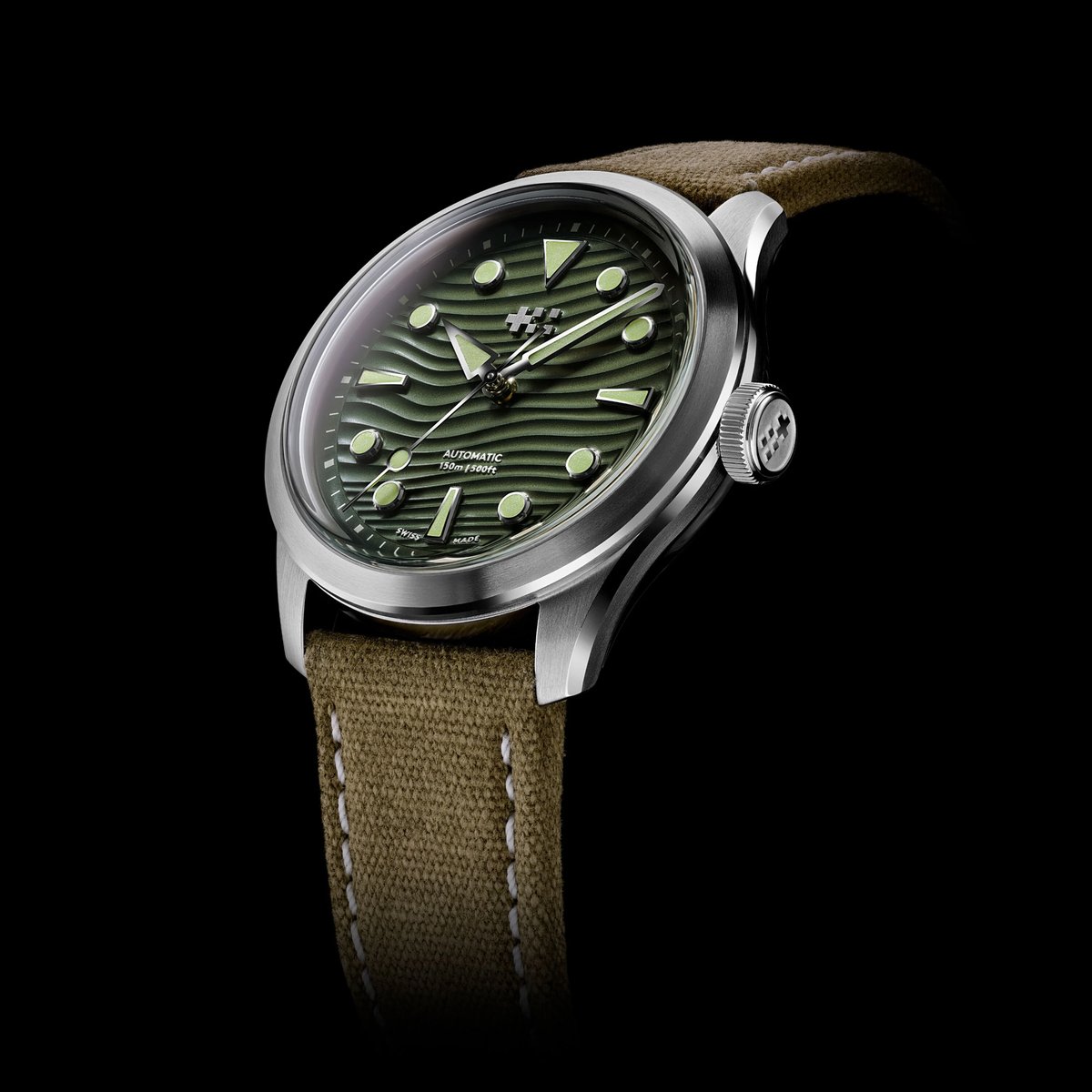
A field watch with a city accent
The C65 family is Christopher Ward's vintage-leaning line, and the Dune applies that DNA to the field-watch brief rather than the diver one. That means a slim steel case, a dial that prioritises reading the time over decoration, and a specification list that is sensible rather than theatrical.
The design language is restrained almost to a fault. There is no rotating bezel, no oversized crown guards, no compass scale or stencilled faux-military type. What you get is a clean dial with applied indices, a straightforward handset and a date window that is present but not shouting. It is the sort of watch that looks unremarkable in photos and considerably better on the wrist, because the thing photographs cannot capture is how well the whole package is proportioned.
Christopher Ward has spent two decades arguing that Swiss-made watches do not need Swiss retail margins, and the Dune is a good illustration of where that money goes: into case finishing, a sapphire crystal and a movement you will actually be able to service in ten years, rather than into a glossy brand campaign.
Case, crystal and the business of legibility
The case is stainless steel, and at 38mm it sits in the size band that most people should be buying but relatively few are. Christopher Ward has not chased the oversized trend here, and the watch is better for it. Finishing is a sensible mix of brushed surfaces with polished accents on the flanks, the sort of detailing that survives daily knocks without turning into a scratch magnet.
The crystal is sapphire with an anti-reflective coating, and it does its job: on a bright morning the dial reads cleanly from arm's length with no glare washing out the hands. Water resistance is rated to 150m, which is more than a field watch strictly needs and exactly the sort of headroom that makes a watch genuinely carefree. You can swim in it, wear it in the rain, wash it under a tap after a hike. Nothing about the Dune makes you handle it carefully.
Legibility is where the watch quietly excels. The dial layout is uncluttered, the hands are the right length and the indices are applied rather than printed, which gives them a slight dimensional lift that catches light at odd angles. The date window is small, framed and placed where it does not interrupt the symmetry of the dial. It is not a watch that shows off, but it is a watch you can read in half a second — and that is what a field watch is for. The lume is Super-LumiNova X1, which is competent rather than spectacular; it glows well for the first few hours of darkness and fades to a faint marker by early morning. If you need a torch-bright dial at 4am this is not it, but for finding the time when you wake up it is perfectly adequate.
The movement: a workhorse, and that is a compliment
Inside is a Sellita SW200-1, an automatic with a 38-hour power reserve, a frequency of 28,800 vibrations per hour and 26 jewels. It is the modern evolution of the ETA 2824 architecture, which means it is proven, well understood and — crucially — serviceable almost anywhere in the world.
Christopher Ward has not attempted to dress it up with an exhibition caseback, and that is a decision I respect. The SW200-1 is an industrial movement: reliable, accurate enough, and cheap to maintain. Putting a sapphire window on it would add cost and thickness for the sake of a rotor you would look at twice. The solid caseback is the honest choice, and it keeps the watch slim against the wrist.
This is not an in-house calibre and it is not COSC-certified, and neither of those facts matters at this price. What matters is that the movement hacks, has a quick-set date, and will still be repairable in fifteen years — which is more than can be said for some far more expensive watches.
How it actually wears
The 38mm case is the headline, and it is a smart one. On a 6.75-inch wrist the Dune sits squarely inside the sweet spot — big enough to read at a glance, small enough that a shirt cuff closes over it without a fight. The case profile is slim and flat against the arm, and because the lugs curve down rather than jut out, the watch perches on the wrist instead of overhanging it. I never once caught a lug on a jacket sleeve or felt the case roll when I turned my wrist.
Weight is another quiet win. On the leather strap the whole thing is light enough to forget by mid-morning, yet the solid steel case gives it just enough heft that it does not feel like a toy. The crown is small but well-knurled and easy to grip for a quick wind or a date change, and the strap itself is supple from day one — no break-in period, no awkward creasing near the buckle.
If there is a weak point in the wearing experience, it is the pin buckle. It works, it is secure, and it is entirely inoffensive — but on a watch where the case finishing is this good, the hardware feels like the one place Christopher Ward saved a few pounds. It is a small thing, and easily fixed with an aftermarket strap, but it is worth knowing before you buy.
A week in the real world
This is the section that matters, because a field watch lives or dies by its ability to be boring. Over seven days the Dune did not once demand attention. It survived a desk, a keyboard, a gym bag and a kitchen sink. It read clearly in a car at dusk and in a badly lit restaurant. It slipped under a shirt cuff at dinner without catching, and it looked appropriately understated rather than out of place.
The leather strap is the right pairing for this watch. Swap it for a NATO and the Dune becomes a proper weekend tool; keep it on leather and it passes at the office. The quick-release style of strap changing that Christopher Ward favours makes the swap painless, and the watch has enough of a neutral design that almost any strap colour works. That versatility is a real part of the value here — one watch, several moods.
The one place it gave ground was lume. After a long evening it was legible but dim, and if you are the sort who genuinely needs to read a dial in pitch darkness this is not the tool for the job. For everyone else, it is fine.
Accuracy you can live with
The SW200-1 is a known quantity, and Christopher Ward regulates it reasonably well. Over the test week, worn daily and rested crown-up overnight, the watch ran a little fast — roughly five to eight seconds a day, which is comfortably inside what you should expect from a non-COSC Sellita at this tier. That is a watch you set once at the start of the month and forget, and it will drift less than a minute across thirty days. If you are the sort who times it against a reference clock every morning you may notice small positional variation, but for real life it is a non-issue.
Where it fits in a collection
The Dune works best as a one-watch solution or as the sensible member of a small rotation. It covers daily wear, travel and casual sport without complaint, and it dresses up further than its field-watch brief suggests — a clean dial and a slim case go a long way under a cuff. It is not a formal watch, and it is not pretending to be, but it will not embarrass you at a dinner either.
Against its obvious rivals the argument is straightforward. A Rolex Explorer or a Tudor Ranger does the same job with more brand prestige and a much larger bill. A Hamilton Khaki Field or a Seiko Alpinist does it for less money with less refinement. The Dune sits in the middle and makes a credible case for itself by being better finished than the entry-level options without asking anything like the premium of the luxury names.
Value, resale and the long game
At retail the C65 Dune Automatic sits in the low four figures depending on strap or bracelet configuration, and at that money it is a genuinely strong proposition. You are paying for a well-made Swiss-assembled case, a sapphire crystal, a proven automatic movement and a design that will not date.
What you are not paying for is resale. Christopher Ward's direct-to-consumer model means the secondary market sits well below retail, and the Dune is not an exception. Buy it to wear, keep it, service it when it needs it, and pass it on to someone who will do the same. Treating it as an investment would be a mistake — but treating it as a five-figure watch you happen to have bought for four figures is exactly right.
Service and ownership
The SW200-1 is one of the most widely serviced movements in the industry, which means you are not locked into a single service centre. Any competent independent watchmaker can handle it, and Christopher Ward also offers factory service directly. That matters more than most buyers realise at the point of purchase and considerably more five years later.
The verdict
The C65 Dune Automatic is one of the more honest watches in its price bracket: a properly sized, properly specified field watch with no gimmicks and no borrowed mythology. It wears beautifully, tells the time clearly and asks nothing of you beyond the occasional wind down. It will not impress a room, but after a week on the wrist it is genuinely hard to take off — and for a daily driver, that is the only review that counts.