By Dr. Hélène Rousseau, Daily-Wear Watch Reviewer
Most GMT watches ask you to make a deal: accept a little more bulk, a little more polish, or a little more brand tax in exchange for a second time zone. The Christopher Ward C65 Dune GMT, reference C65-38AGM3-S00E0-VC, proposes a different bargain. It keeps the case modest, the dial textured and readable, and the travel complication useful without turning the watch into a paperweight. I wore this one for a full week, through commutes, desk work, a school run, a dinner, and a weekend bag, to find out whether the Dune GMT is a travel watch you actually wear or a spec sheet you admire from a distance.
The answer sits somewhere between practical and pleasant. The Dune GMT is not trying to be a luxury statement piece. It is trying to be the watch you grab when you have a flight, a meeting, and a dinner in the same day. That is a narrower brief than it sounds, and Christopher Ward has been refining this kind of daily-wear watch for years. The question is not whether it looks good in a photograph. It is whether it survives a real week on the wrist without asking for attention.
The brand behind the Dune
Christopher Ward was founded in 2004 in the United Kingdom by Mike France, Chris Ward, and Peter Ellis. The brand built its reputation on a direct-to-consumer model, Swiss manufacturing, and a stubborn focus on specification per dollar. It has grown from an internet-curious upstart into a serious player in the sub-$3,000 segment, with a catalog that ranges from dive watches to dress pieces and, more recently, a genuinely ambitious chiming watch.
The C65 line is the vintage-leaning branch of the family. It draws on mid-century sports-watch proportions rather than modern dive-watch bulk, and the Dune is its softer, more everyday expression. The Dune GMT adds a second time zone to that formula without turning the watch into a tool-heavy travel clock. In brand terms, it is Christopher Ward doing what Christopher Ward does best: taking a familiar category, trimming the excess, and pricing it where a young collector can actually say yes.
Movement and specifications
The C65 Dune GMT uses the Sellita SW330-2, a proven Swiss automatic GMT movement. It is not an in-house caliber, and Christopher Ward does not certify this reference to COSC. What you get instead is a known quantity: a caller-style GMT hand, a date, a 56-hour power reserve, and a service network that understands the movement. For a daily-wear travel watch, that is a sensible trade.
- Movement: Sellita SW330-2 automatic GMT
- Power reserve: 56 hours
- Frequency: 28,800 vph
- Jewels: 25
- Complications: hours, minutes, seconds, date, GMT
- Case: 38mm stainless steel
- Water resistance: 150m
- Crystal: sapphire
- Lume: Super-LumiNova X1
- Bracelet: stainless steel bracelet with deployant clasp
The 56-hour reserve is the practical detail that matters most. It means you can take the watch off on Friday evening and pick it up on Monday morning without a full reset. The GMT hand is set independently, so you can track a second time zone without stopping the watch. The date is there, small but useful, and the movement is thin enough to keep the case from feeling slab-like on the wrist. Christopher Ward regulates the SW330-2, but it is not a chronometer-certified movement. That is not a flaw at this price. It is simply a reminder that sample-to-sample accuracy will vary.
How it wears
On the wrist, the 38mm case is the headline. It is a size that works on a wide range of wrists without looking undersized on a 7-inch wrist or oversized on a 6-inch wrist. The lugs are short and curve downward, so the watch sits close to the arm rather than floating above it. The case is brushed and polished in the right places, with enough definition to catch light without becoming a scratch magnet. The crown is easy to grip, does not dig into the back of the hand, and stays out of the way during desk work.
The bracelet is the other half of the comfort story. It tapers sensibly, articulates well, and does not pull hair the way some cheaper steel bracelets do. The deployant clasp feels secure and sits flat enough that I forgot about it by the second day. In a week of wear, the watch never felt top-heavy or prone to rotating around the wrist. It slipped under a shirt cuff, sat comfortably under a jumper, and stayed put during a rainy walk. That is not a dramatic achievement, but it is exactly what a daily-wear GMT should do.
Dial, legibility, and the GMT hand
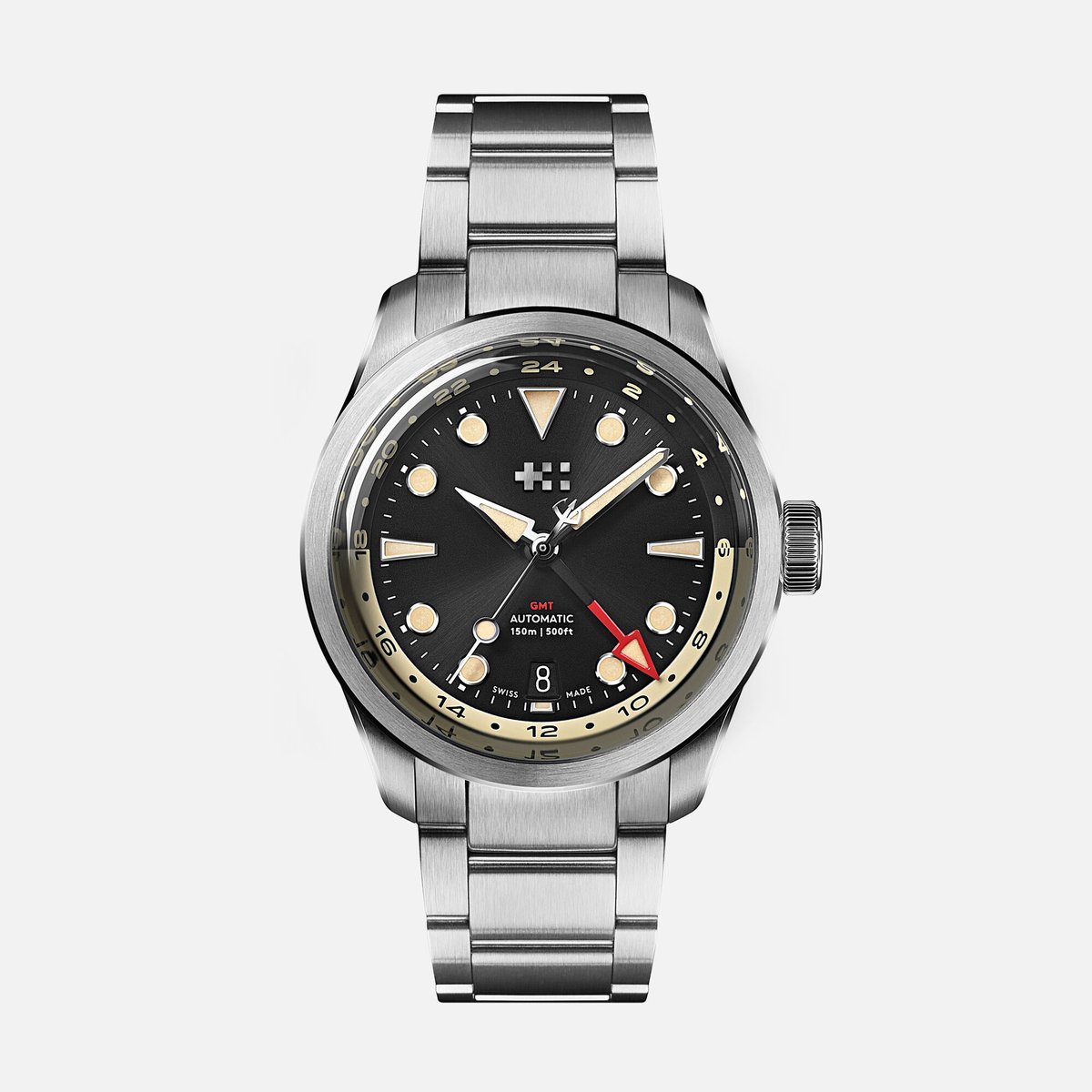
The Dune dial is the part that makes the watch feel less like a spec sheet and more like an object with a point of view. The sand-toned surface has a subtle texture that catches light without becoming noisy. The applied markers are faceted and legible, and the hands are simple enough to read at a glance. The GMT hand is distinct without shouting, which is a harder balance than it sounds. In low light, the Super-LumiNova X1 does its job on the markers and hands, though it is not a dive-watch torch.
Legibility is strong in office light, outdoor light, and the dim light of a restaurant. The date window is small, but it does not interrupt the dial the way some oversized date apertures do. The 24-hour scale is easy to parse once you have set the GMT hand, and the watch does not require a manual to use. That matters. A travel watch should not make you feel like you need a training course before a red-eye flight.
Accuracy over a week
The SW330-2 is not COSC-certified, so the honest expectation is a watch that runs within roughly -10 to +15 seconds per day. My sample averaged about +6 seconds per day over the week, which is entirely acceptable for a non-chronometer GMT at this price. It was consistent enough that I did not need to reset it midweek. If you are the kind of owner who checks a reference clock every morning, you will notice the drift. If you wear the watch and live your life, you will not.
The GMT function is easy to set and easy to read. The date changed cleanly, the crown had a positive feel in each position, and the watch did not exhibit any ghost-position quirks. The power reserve held up over a weekend off the wrist, which is the real test for a daily-wear automatic. This is not a movement that invites poetry. It is a movement that invites you to stop thinking about it and wear the watch.
Occasions and versatility
The Dune GMT is at its best as a daily wearer and a travel watch. It has enough water resistance for swimming and rain, enough legibility for a workday, and enough restraint to wear with a jacket. It is not a formal dress watch, but it can pass at a smart-casual dinner without looking out of place. It is not a dedicated sports watch, but the steel bracelet and 150m water resistance mean you do not have to baby it. That versatility is the point.
If you want one watch for a week-long trip, this is a strong candidate. You can wear it on the plane, at a meeting, at dinner, and on a walk without changing straps. The GMT hand earns its keep when you are crossing time zones, and the date is useful when you are living out of a suitcase. It is not the most rugged travel watch on the market, and it is not the dressiest. It is the one that sits comfortably in the middle.
Reference variants and family context
The reference reviewed here is C65-38AGM3-S00E0-VC, a 38mm stainless steel Dune GMT on a steel bracelet with a sand-toned dial. Christopher Ward has offered other dial and strap combinations in the Dune GMT line, and the reference codes change accordingly. The core recipe stays the same: 38mm case, Sellita GMT movement, sapphire crystal, 150m water resistance, and a vintage-inspired dial.
Within the C65 family, the Dune GMT sits alongside the C65 Dune Automatic, the C65 Trident Diver, the C65 Sandhurst, and the C65 Dartmouth. The Dune Automatic is the three-hand sibling, while the Trident and Sandhurst lean more heavily into sports and military cues. The Dune GMT is the travel-focused middle child. It is not the most capable tool watch in the line, but it may be the most wearable one for someone who wants a single watch to do most things.
Similar watches and homages
The obvious comparison is the Tudor Black Bay GMT. It has more mass, more brand recognition, and a higher price. It also has a jumping local hour hand and a rotating bezel, which makes it a more capable traveler. The Christopher Ward is smaller, lighter on the wallet, and easier to wear with a cuff. If you want the Tudor, you know why. If you want a GMT that disappears on the wrist, the Dune GMT makes a strong case.
The Longines Spirit Zulu Time 39 is another natural rival. It brings a more traditional aviation look and a strong movement, but it also costs more and wears larger than its dimensions suggest. The Grand Seiko SBGM221 is the dressier option, with superior finishing and an in-house movement, but it is a different price bracket entirely. The Dune GMT does not try to beat those watches at their own game. It tries to be the one you actually wear.
On the homage side, the San Martin SN0109-G GMT offers a similar steel-sports-GMT formula for around $250. It is a budget interpretation, not a substitute. The finishing, bracelet, and movement are a step down, but it shows how closely the industry has converged on this look. The Pagani Design PD-1758 GMT is another sub-$200 option for someone who wants the silhouette without the price. Neither will match the Christopher Ward on feel, but they are useful context for how much value the Dune GMT packs.
Investment and ownership
The Dune GMT is not an investment piece. The current retail is around $1,295, and the secondary market typically trades in the $850 to $1,050 range. That is a normal depreciation curve for a direct-to-consumer brand with strong value and a thinner collector base. The trend is stable rather than appreciating. You buy this watch because you want to wear it, not because you expect it to fund a future purchase.
There is no meaningful auction history for this reference. That is not a criticism. Most watches at this price are not auction watches. The ownership case is straightforward: you get a Swiss-made GMT with a comfortable case, a useful complication, and a bracelet that feels better than the price suggests. If you keep the box and papers and buy used, you can soften the depreciation. If you buy new and wear it every day, you will get your money's worth in wrist time.
Service
Christopher Ward does not publish a single fixed service interval that applies to every owner, and the SW330-2 can be serviced by Christopher Ward or a competent independent watchmaker. The practical advice is to service the watch when accuracy or power reserve drifts, not on a calendar. A routine service is not cheap, but it is not exotic either. The movement is common enough that you are not locked into a single service center, which is a real advantage for a daily wearer.
Pros and cons
- Pros: 38mm case and short lug stance make it easy on smaller and average wrists.
- Pros: GMT, date, 150m water resistance, and sapphire crystal cover daily life without fuss.
- Pros: Textured dial and clear hands keep legibility strong in office and outdoor light.
- Pros: Bracelet is comfortable and the clasp feels secure for the price.
- Pros: Strong value for a Swiss-made GMT from a direct-to-consumer brand.
- Cons: Sellita SW330-2 is not COSC-certified, so accuracy varies sample to sample.
- Cons: Resale is softer than established Swiss brands.
- Cons: The date window is small and not everyone will love its position.
- Cons: No major auction history, so collectibility is limited.
Final verdict
The Christopher Ward C65 Dune GMT is a travel watch for people who do not want to wear a travel watch. It is comfortable, legible, and versatile, with a movement that is proven rather than precious. The lack of COSC certification and the modest resale are real trade-offs, but they are the right trade-offs for a watch at this price.
If you want a single watch that can handle a flight, a workweek, and a dinner without changing character, the Dune GMT deserves a place on your shortlist. It is not the most exciting watch in the room. It is the one you will reach for most often.