Christopher Ward Twelve X Review: Skeletonised SH21 in Titanium
In the last few years, the integrated-bracelet sports watch has become the default uniform of young collectors. Most of them are safe, steel, and date-window predictable. The Christopher Ward Twelve X, reference C12-41A5D1-T00K0-B0, is not that. It takes the Twelve family's sharp bracelet and titanium case and opens the dial to an in-house SH21 movement. The result feels less like a catalogue exercise and more like a statement of intent from a brand that has spent two decades arguing that accessible does not have to mean anonymous.
The Twelve X is aimed at the collector who has already owned the obvious steel sports watch and wants something with more visual and mechanical texture. It is not subtle. The skeletonised dial exposes bridges, wheels, and the architecture of the movement, and the titanium case keeps the whole thing from feeling heavy or self-important. At its price, it sits in a narrow lane: below the European skeleton sports watches, above the mass-market openworked alternatives. That lane is exactly where Christopher Ward has become dangerous.
Brand context: Christopher Ward's in-house argument
Christopher Ward was founded in 2004 in England, and its early reputation was built on direct-to-consumer pricing and Swiss-made value. The brand's more interesting chapter began with the SH21, its in-house automatic calibre with a five-day power reserve. That movement changed the conversation: Christopher Ward was no longer just a value proposition, but a company with mechanical ambition. The Bel Canto and other recent releases have reinforced that shift.
The Twelve X makes sense in that context. It takes the Twelve, the brand's integrated-bracelet sports watch, and gives it the movement the family always deserved. It is not a heritage reissue or a vanity project. It is a production statement: Christopher Ward can put an in-house, chronometer-certified, skeletonised movement into a titanium sports watch and still undercut the established names.
Design and build: the skeleton is the point
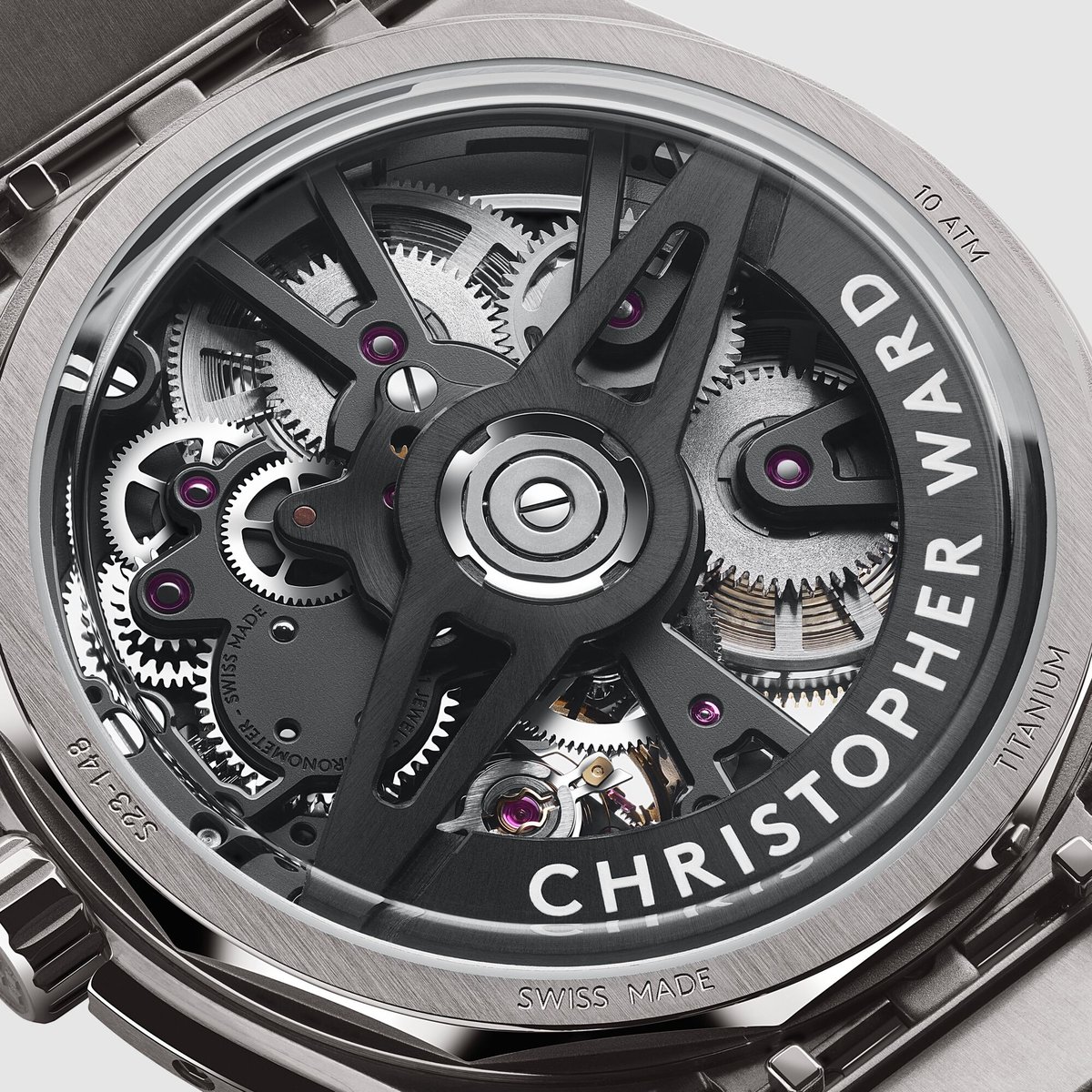
The first thing to understand about the Twelve X is that the dial is not decorative openworking. The movement is the dial. Christopher Ward has skeletonised the SH21's bridges and left enough structure to read the watch as a machine rather than a pattern. The effect is darker and more architectural than most skeleton dials at this price. It has depth, and it changes character as the light moves across the titanium case and sapphire crystal.
The 41mm titanium case is the right shell for this idea. Titanium gives the Twelve X a muted, technical look that suits the openworked movement, and it keeps the watch comfortable for daily wear. The integrated bracelet is central to the design. It flows into the case without conventional lugs, and it gives the watch the sharp, sport-luxury silhouette that has made the Twelve family so popular. The bracelet is not an afterthought; it is half the reason the watch works.
Legibility is the trade-off. The Twelve X has hands and indexes with Super-LumiNova X1, but the openworked background means the time does not pop the way it does on a solid dial. This is a watch you read with a little more patience. In return, you get a view of the movement that most watches at this price hide behind a caseback. The Twelve X is not for someone who wants a one-glance tool watch. It is for someone who wants to look down and see engineering.
The details that matter
The Twelve X is not simply a Twelve with the dial removed. The case and bracelet have to carry more visual weight because the dial is busier, and Christopher Ward has kept the finishing clean enough to stop the watch from feeling overwrought. The titanium case has a muted sheen that plays well against the openworked movement. The sapphire crystal is clear enough to let the skeletonised bridges read without glare dominating the view.
The bracelet is the other half of the story. Integrated bracelets live or die by their articulation and taper, and the Twelve's bracelet is one of the reasons the family has been so well received. On the Twelve X, it gives the watch a jewellery-like quality without turning it into a dress watch. The deployant clasp keeps the underside clean and makes the watch feel more expensive than its price suggests. These are the details that separate a good value watch from a genuinely desirable one.
Movement: Calibre SH21
The Twelve X runs the in-house Calibre SH21, an automatic movement with a 120-hour power reserve, a frequency of 28,800 vph, and 25 jewels. It is COSC-certified, which means it is tested to chronometer standards rather than merely described as accurate. The SH21 is a twin-barrel design, and that five-day reserve is one of the most useful complications a daily watch can have. You can take it off on Friday and pick it up on Wednesday without resetting it.
In the Twelve X, the SH21 is not just visible through an exhibition caseback. It is the face of the watch. The skeletonised bridges and openworked structure turn the movement into a landscape. The finishing is industrial in the best sense: modern, precise, and consistent with the titanium case. It does not pretend to be hand-engraved haute horlogerie, and it does not need to. The point is architecture, not ornament.
The COSC certification matters because skeleton watches can be treated as display objects. The Twelve X is still a sports watch with a chronometer-rated movement. That combination is the heart of its value proposition: mechanical theatre on the front, daily-wear discipline underneath.
On the wrist
Titanium changes the experience of a 41mm sports watch. The Twelve X feels light and balanced on the wrist, and the integrated bracelet distributes that lightness cleanly. It does not flop or feel hollow. The case sits close to the wrist, and the bracelet's articulation makes it easy to wear for long stretches. This is not a watch that demands a special occasion.
The wrist presence is more about texture than size. The openworked dial catches light and shadows, and the titanium case has a softer, more utilitarian sheen than steel. It reads as modern rather than vintage-inspired. On a suit, it is sharp enough to work because the bracelet and case are so clean. On a T-shirt, it looks technical and purposeful. The Twelve X is at its best when you stop treating skeleton watches as fragile dress pieces and wear them the way you would wear a sports watch.
Accuracy and daily wear
With COSC certification, the expectation is -4 to +6 seconds per day. In real-world use, SH21 examples often settle within that range, though owner reports vary with wear patterns and temperature. The important point is that the Twelve X is not a delicate showpiece that loses time because it is openworked. It is a modern automatic with a five-day reserve and chronometer testing.
Daily wear is straightforward. The titanium case and bracelet are comfortable, the sapphire crystal is appropriate for a watch at this level, and the Super-LumiNova X1 gives the hands and indexes a usable glow when the light drops. The lack of a date keeps the skeleton dial cleaner, though buyers who use a date every day should note that this is a time-only presentation. The Twelve X rewards a wearer who values the movement over the calendar.
Occasions and presence
The Twelve X is a daily watch with a formal edge. It works with a button-down and trousers, it works with denim, and it works as a travel watch because the five-day reserve means it can sit in a bag or on a bedside table without stopping. It is not a gym watch in the way a rubber-strap diver is, but it is robust enough for normal sport and casual use. The titanium finish and integrated bracelet make it feel more versatile than a traditional skeleton dress watch.
Wrist presence is 4/5. It is not a loud watch in the way a gold chronograph is loud, but the openworked dial gives it a lot of visual information. People notice it because it looks different from the usual steel sports watch. It has enough restraint to avoid looking gimmicky, which is the harder trick.
Who it is for
The Twelve X is for the collector who wants mechanical content on the wrist, not just a familiar logo. It suits someone who already has a dive watch and a dress watch and wants a sports watch with a difference. It also suits the first-time high-end buyer who wants to feel like the money went into engineering rather than marketing. What it does not suit is the buyer who needs instant legibility or a date at a glance.
It is also a strong option for someone comparing European integrated-bracelet watches and wondering whether the premium is worth it. The Twelve X does not match the finishing of a Laurent Ferrier or the brand cachet of a Royal Oak, but it delivers a comparable idea at a fraction of the cost. That is the Christopher Ward argument in one watch.
Collector context
Christopher Ward has become a serious brand for young collectors because it understands the current market: people want design, movement credibility, and a story they can explain to a friend. The Twelve X has all three. The SH21 gives it in-house status, the titanium case gives it a modern material story, and the skeleton dial gives it visual drama. It is the kind of watch that starts conversations in a way a standard steel sports watch does not.
The collector risk is that skeleton dials are a taste. They can feel busy in a way that solid dials do not, and they do not hide scratches or dust as well as a plain surface. The Twelve X mitigates this with a dark, architectural skeleton rather than a fussy jewelled display. It still asks you to enjoy looking at it. If you do, it rewards ownership.
Value, investment, and service
The Twelve X sits around the $4,250 mark at retail, which is a serious number for Christopher Ward but still modest for an in-house, COSC-certified, skeletonised titanium sports watch. Pre-owned examples have traded in the rough $3,200 to $4,000 range, depending on condition and completeness. The trend is stable rather than appreciating. Christopher Ward's direct-to-consumer model and the niche appeal of skeleton dials keep resale close to retail, but they do not turn the watch into a speculative asset.
That is not a criticism. The Twelve X is a wearer's watch. It offers an in-house five-day movement, a titanium case, an integrated bracelet, and a skeletonised dial for less than many European brands charge for a time-only steel sports watch. The value is in the engineering and the daily experience, not in auction performance. There is no major auction history for this reference; it trades mainly through owner forums and pre-owned dealers.
Service should be handled through Christopher Ward or an approved watchmaker. The SH21 is an in-house movement, and the skeletonised finishing makes independent servicing less straightforward than a generic ETA-based watch. That is the price of admission for an in-house skeleton, and buyers should factor it into ownership.
Alternatives and homages
The closest European alternative is the Zenith Defy Skyline Skeleton, which brings a more aggressive integrated-bracelet design and a high-frequency movement. The Girard-Perregaux Laureato Skeleton is the blue-chip benchmark for an integrated skeleton sports watch, but it costs many times more. The Tissot PRX Powermatic 80 Skeleton is the accessible alternative: it has the integrated bracelet and openworked dial, but it does not have the in-house movement or the titanium case.
For buyers who want the look at a lower price, the Tissot PRX Skeleton is the obvious entry point. The Casio Edifice EFR-S108D offers an integrated-bracelet sports watch feel for a few hundred dollars, though it is not a skeleton. The Orient Maestro Skeleton is a traditional openworked automatic for entry-level buyers. None of these watches replaces the Twelve X's combination of in-house movement, titanium, and integrated bracelet, but they show how far the style has spread.
Final verdict
The Christopher Ward Twelve X is one of the most convincing arguments for accessible sports-luxury on the market. It pairs an in-house, COSC-certified SH21 with a titanium integrated bracelet and a skeletonised dial that has real mechanical depth. It is not the easiest watch to read, and it is not an investment piece, but it is a watch you wear for the pleasure of looking at it. At its price, that is a rare and valuable combination.