The Alpha’s Entry into Independent Horology
Let’s be candid: the current state of the watch market is exhausting. We’ve spent the last half-decade watching the same five stainless steel sports watches oscillate in price like a volatile crypto-asset. For the collector who actually understands the mechanics of horology—and more importantly, the mechanics of value—the real play is elsewhere. It’s in the 'neo-vintage' era of the 1990s and early 2000s, specifically within the houses of independent visionaries who didn’t have a LVMH or Richemont marketing budget to hide behind. Enter the Chronoswiss Chronoscope (ref. CH 1523).
This isn't just another chronograph. It is a piece of history that you can actually wear without the fear of a mugging or a 50% overnight market correction. When Gerd-Rüdiger Lang launched the Chronoscope, he wasn't trying to compete with the Daytona; he was trying to out-engineer the entire industry. By creating the world’s first automatic regulator chronograph, he carved out a niche that remains unchallenged in its price bracket today.
The Gerd-Rüdiger Lang Legacy: A Study in Defiance
To understand the CH 1523, you must understand the man. Lang was a veteran of Heuer during the golden age of mechanical stopwatches. When the Quartz Crisis hit and the world turned to battery-powered circuits, Lang did the unthinkable: he doubled down on gears and springs. He founded Chronoswiss in 1983, a time when most people thought mechanical watches were as obsolete as the horse and carriage.
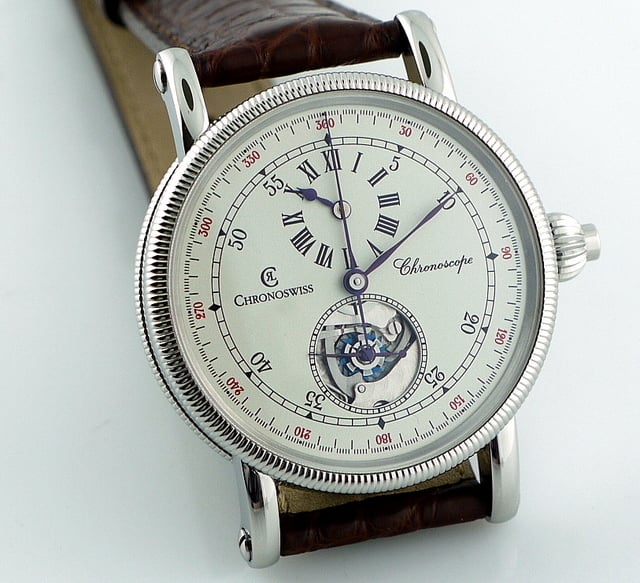
Lang’s obsession was the 'Regulateur'—a dial layout where the hours, minutes, and seconds are separated into different registers to ensure maximum precision for the person setting the time. It was a tool for the observatory, not the racetrack. The Chronoscope took this high-brow aesthetic and integrated a monopusher chronograph. The result is a dial that looks like a scientific instrument from the 19th century, yet functions with the convenience of a modern automatic movement.
Technical Mastery: The C.125 Caliber
From a market perspective, the movement is where the 'alpha' lies. The Caliber C.125 is a fascinating hybrid. It utilizes a vintage Enicar 165 base movement—a choice that shows Lang’s deep respect for historical calibers. To this, Chronoswiss added a complex monopusher chronograph module developed by Dubois-Dépraz. Unlike a standard chronograph with two pushers, the monopusher handles start, stop, and reset through a single button integrated into the crown.
This isn't just a gimmick; it's a simplification of the user interface that requires significantly more complex internal geometry. The 'slow-beat' 21,600 vph frequency gives the watch a soulful, rhythmic tick that high-beat modern movements lack. This is the equivalent of driving a vintage Porsche with a manual gearbox—it requires a bit more engagement, but the payoff is pure mechanical purity.
Aesthetic Analysis: The Coin-Edge and the Onion
The design language of the CH 1523 is unmistakable. The coin-edge bezel and the oversized onion crown are the brand’s DNA. In a world of polished surfaces and ceramic bezels, the knurled texture of the Chronoscope feels tactile and expensive. The dial is a solid sterling silver plate (on many variants), finished with a fine graining that catches the light without the gaudy sparkle of modern sunray finishes.
The regulator layout is the star of the show. The large central hand tracks the minutes, while the hours are relegated to a sub-dial at 12 o'clock, and the running seconds are at 6 o'clock. The chronograph seconds are also handled by the central hand, creating a beautiful dance of steel when the pusher is engaged. It is a layout that demands you slow down and actually *look* at the time, rather than just glancing at it.
Investment Thesis: The Neo-Vintage Arbitrage
Why buy now? Because the 'independent' boom has already swept through F.P. Journe and De Bethune, and it is currently trickling down to the 'second tier' of 90s greats. Chronoswiss, specifically the models produced under Lang’s direct supervision, are the next logical step. The CH 1523 currently trades in the $4,000 to $5,500 range. Compare that to a modern Patek Philippe 5235G, which offers a similar regulator layout for ten times the price.
Liquidity for these pieces is surprisingly high. Collectors are actively hunting for clean examples of the CH 1523 because they represent the pinnacle of the brand’s output. We are seeing a 'flight to quality' where buyers are ditching entry-level luxury brands (like Longines or TAG Heuer) for pieces with genuine horological significance. The Chronoscope is a 'hold' for the next five years. As the story of Gerd-Rüdiger Lang becomes more widely known among younger collectors, expect these prices to push toward the $8,000 mark.
Wrist Feel and Real-World Use
On the wrist, the 38mm case is a revelation. We are currently seeing a massive shift away from the 44mm 'dinner plate' watches of the 2010s. The CH 1523 fits perfectly on a 6.5 to 7.5-inch wrist, offering a profile that is both elegant and technically impressive. It doesn't have the heft of a gold watch, but the complexity of the dial gives it a 'visual weight' that makes it feel like a much more expensive piece.
Is it a daily driver? If your daily life involves an office, high-end dining, and the occasional gallery opening, then yes. If you’re planning on jumping off a yacht in Saint-Tropez, leave it in the safe. With 30 meters of water resistance, this is a 'dry' watch. It’s built for intellectual pursuits, not athletic ones.
Final Verdict: Portfolio Diversification
The Chronoswiss Chronoscope CH 1523 is a mandatory inclusion for any collector looking to diversify away from the 'Hype Cycle.' It offers a rare combination of historical 'firsts,' independent pedigree, and a design language that is entirely its own. In the world of watch investing, you don't make money by following the crowd; you make money by being where the crowd is going to be in two years. Right now, the crowd is waking up to the genius of Gerd-Rüdiger Lang. My advice? Get in before the gates close.