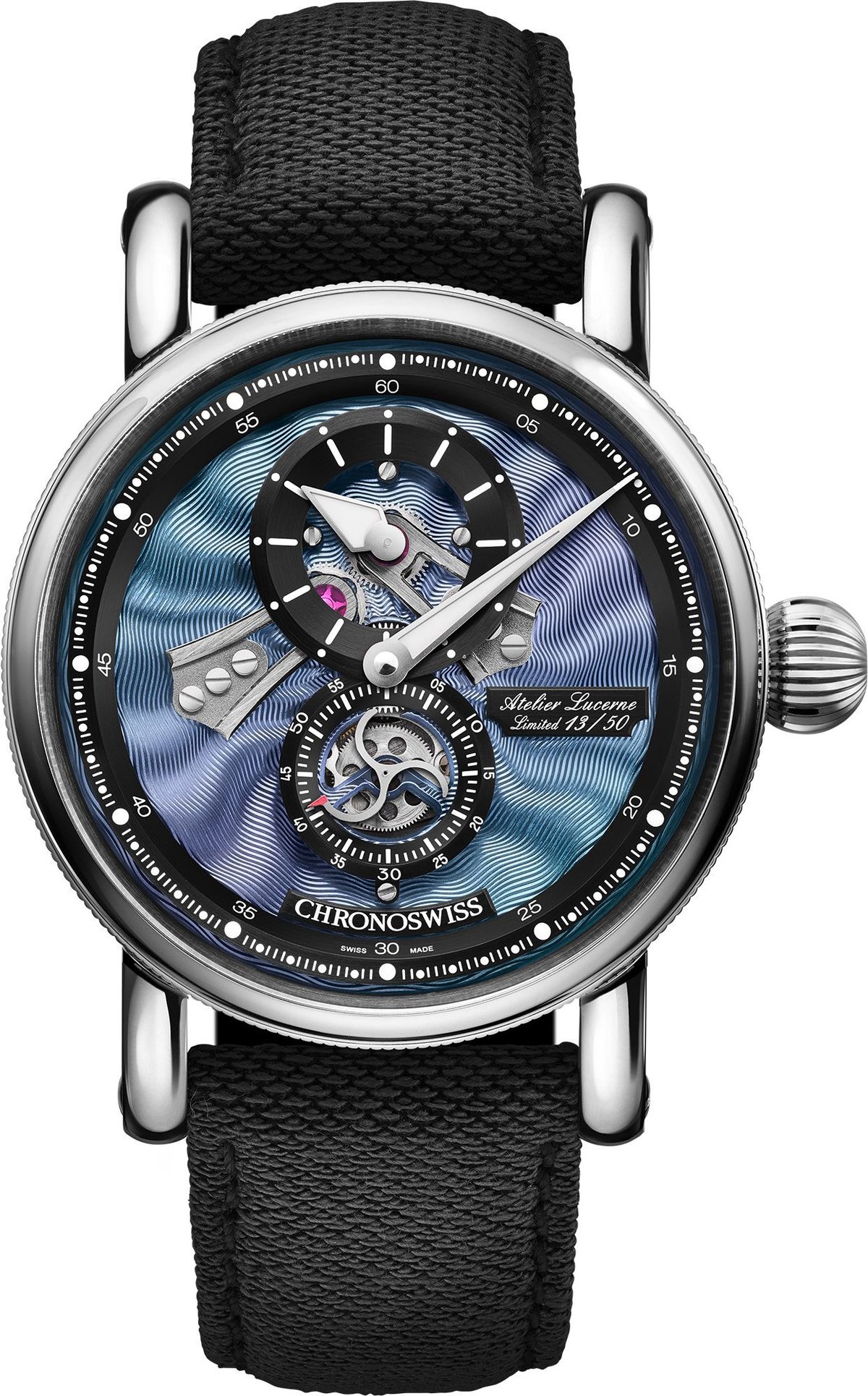
The Renaissance of the Regulator: Chronoswiss CH-8753
In the world of watchmaking, the 'regulator' is a term that evokes images of 18th-century observatories and master clockmakers. Originally, regulator clocks were the most accurate timekeepers in a workshop, used as a reference to set all other timepieces. They featured a large central minute hand and separate sub-dials for hours and seconds to prevent the hands from overlapping and obscuring the view at critical moments. Chronoswiss, under the visionary Gerd-R. Lang, was the first brand to shrink this concept into a wristwatch in 1987. Fast forward to today, and the Flying Regulator Open Gear (Ref. CH-8753) represents the ultimate evolution of that legacy.
The Architecture of the Dial: A 42-Part Symphony
The 'Open Gear' in the name refers to the fact that the wheels which drive the regulator display are moved to the dial side. This isn't just a cosmetic choice; it requires a complete redesign of the movement's top plate. The dial of the CH-8753 is composed of two levels. The bottom level features a stunning hand-guilloché pattern—a rarity in this price bracket—which is then treated with a galvanic coating to achieve its deep, lustrous blue. The top level consists of 'flying' sub-dials and bridges that appear to float above the base.
When you look at this watch under a loupe, the depth is staggering. The hour display at 12 o'clock is housed in a funnel-like sub-dial, which is sandblasted to provide a matte contrast to the polished hands. The minute track sits on a raised ring around the periphery, creating a bowl-like effect that draws the eye toward the center of the mechanical action. For the daily wearer, this means the watch changes character depending on the light. In direct sun, the guilloché dances; in low light, the Super-LumiNova X1 on the hands and indices provides a neon-like glow that is surprisingly legible for such a complex layout.
On the Wrist: Lug-to-Lug and the 'Onion' Factor
Let's talk about the wearability. As Dr. Hélène Rousseau, I have worn everything from 34mm vintage dress watches to 47mm divers, and I can tell you that numbers on a spec sheet rarely tell the whole story. The CH-8753 has a 41mm diameter, which is the 'sweet spot' for most modern collectors. However, the Chronoswiss case is distinctive. It features a knurled bezel and a knurled case back, a nod to the brand's early aesthetic. The lugs are straight and utilize screw-in bars rather than spring bars. This makes the watch feel incredibly robust, but at 50mm lug-to-lug, it requires a wrist of at least 16.5cm (6.5 inches) to sit flat.
The signature 'onion' crown is another point of contention. It is a joy to wind—the grip is unparalleled—but if you wear your watch low on the wrist, near the hand, it will leave a mark by 5:00 PM. I found that wearing the CH-8753 slightly higher on the arm, behind the ulna bone, solved this issue and allowed the folding clasp to balance the weight of the case perfectly. The 13.85mm thickness is the real hurdle. This is a tall watch. It will bump into door frames, and it will struggle with tight shirt cuffs. It is a watch that demands to be seen, not tucked away.
The Caliber C. 299: Reliable Theater
Inside the CH-8753 beats the Caliber C. 299. While Chronoswiss is an independent brand, they are transparent about their use of high-grade Swiss bases. The C. 299 uses an ETA-style architecture but is modified so extensively with the Open Gear module that it feels like a bespoke creation. The movement is visible through the sapphire case back, featuring a skeletonized rotor and perlage finishing. While it lacks the haute horlogerie hand-finishing of a Greubel Forsey, it is executed with a clean, industrial precision that matches the technical vibe of the dial.
The 42-hour power reserve is perhaps the only area where the watch shows its age. In a world where 70-hour 'weekend-proof' movements are becoming the standard, you will need to reset this watch if you leave it off from Friday night to Monday morning. However, given the tactile pleasure of using the onion crown, I found myself looking forward to the ritual of winding it.
Daily Survival: The Seven-Day Test
On Monday, the watch felt like a statement piece for the office. It paired beautifully with a navy blazer. On Wednesday, during a rainy commute, the 100m water resistance provided peace of mind—something you don't always get with regulator watches, which are often treated as delicate dress pieces. By Saturday, I had swapped the alligator strap for a custom blue rubber strap, and the watch transformed into a sporty, avant-garde companion for a casual gallery opening.
The legibility is surprisingly good once your brain adjusts to the regulator layout. We are conditioned to look for two hands meeting in the center; here, you learn to look at the top for the hour and the center for the minute. Within 48 hours, it becomes second nature. The small seconds at 6 o'clock provides just enough movement to let you know the watch is alive without cluttering the visual field.
The Verdict for the Sophisticated Collector
The Chronoswiss Flying Regulator Open Gear CH-8753 is not for the collector who wants to blend in. It is for the person who appreciates the 'New School' of watchmaking—where the movement is the dial and the case is a piece of industrial design. At an MSRP of $9,400, it sits in a competitive space, facing off against the likes of IWC, Zenith, and Panerai. What Chronoswiss offers that those brands don't is a sense of genuine independence and a dial depth that is usually reserved for watches costing three times as much.
If you have the wrist size to pull it off and the confidence to wear a watch that people will constantly ask about, the CH-8753 is a stellar addition to a rotating collection. It survives the week by being more than just a tool; it is a constant reminder of why we love mechanical watches in the first place: the sheer, visible joy of gears in motion.