Chronoswiss: A Small House With a Very Specific Obsession
Chronoswiss was founded in 1983 by Gerd-Rüdiger Lang, a former Heuer chronograph specialist who set up shop in Munich before the manufacture ultimately settled in Lucerne, Switzerland. Lang's bet was unusual for the era: rather than chase the quartz crisis with cheap volume, he went the other way, reviving classical complications and hand-finishing them at a scale the big houses had abandoned.
The defining move came with the regulator. In a traditional regulator clock — the kind a watchmaker used as a reference instrument in the workshop — the hours, minutes and seconds are separated onto their own axes so that the minute hand, the one that matters for precision, gets the full dial. Lang put that layout on a wristwatch at a time when nobody else was doing it serially. That single decision gave Chronoswiss an identity that has survived every ownership change since, including the 2012 handover to the Ebstein family.
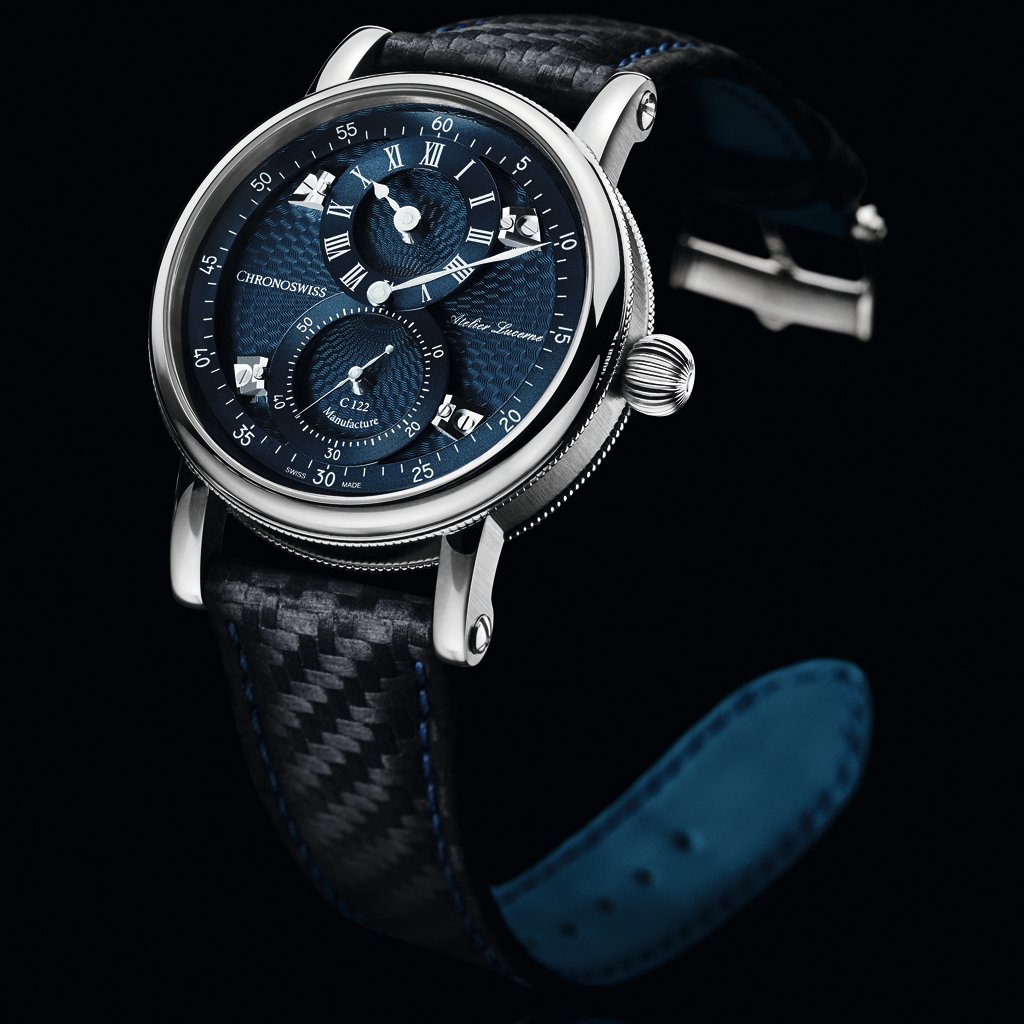
Two other house signatures matter here. The first is the coined, or knurled, bezel — a fine fluted ring that has become the brand's most recognisable case cue. The second is the onion crown, a deliberately oversized, grippy winding crown that gives Chronoswiss cases a slightly antique, instrument-like feel. Both are present in the Heritage line, and both are part of why these watches photograph as something other than generic Swiss steel.
The Heritage designation itself is the brand reaching back into its own archive — the 1980s and 1990s regulator designs that built the house — and reissuing that thinking with contemporary construction and finishing. It is not a re-edition of a specific vintage reference so much as a restatement of a house idea.
The Flying Regulator Dial: Architecture Over Legibility
Most regulator watches are flat. The hands sit on one plane, the sub-dials are printed or applied, and the whole thing reads as a graphic exercise. The Flying Regulator does something else: the hour and small-seconds indications are mounted on raised bridges that stand proud of the base dial, so the watch face has genuine three-dimensional depth. Depending on the light, the sub-dials cast small shadows onto the plate beneath them. It is a detail that does not show up in press images and shows up immediately on the wrist.
In the grey-on-grey execution, the effect is deliberately restrained. There is no colour to distract from the geometry — just tonal variation between the base plate, the raised elements and the hands. That is a confident choice. A regulator dial is already asking the wearer to relearn how to read a watch; adding a loud colour scheme on top of that would be asking too much. The grey version says: look at the structure, not the palette.
There is also a technical story underneath the aesthetics. Floating the sub-dials means the hands for the hours and seconds have to be driven up and out to a different plane than the central minute hand, which is exactly the kind of problem a regulator module is designed to solve. Chronoswiss did not add depth for its own sake; the depth is a by-product of the way the movement delivers the display.
Practical consequences follow. Reading the time at a glance is genuinely slower than on a conventional three-hander, because your eye has to travel to the correct sub-dial for the hours. That is not a flaw, it is the point, but it is worth being honest about. If you want a watch you can read in half a second while driving, this is not it. If you want a watch that rewards a second look every time you check the time, this is exactly it.
Movement: A Modified Swiss Automatic Built Around the Regulator Layout
Chronoswiss builds its regulator calibres on Swiss ébauche foundations, then reworks them — a proprietary regulator module, in-house finishing, and adjustment — rather than engineering a movement from a blank sheet. This is the honest description, and it is also the correct one commercially: it keeps the price in the range where a small independent can actually sell watches, and it means parts and service knowledge exist well beyond the brand's own atelier.
In practical terms you are getting an automatic regulator movement with a modern beat rate, a power reserve in the low-forties range, and the kind of finishing — Geneva stripes, blued screws, perlage on the plates — that you can enjoy through a sapphire caseback. It is not a COSC-certified chronometer, and Chronoswiss does not market it as one. What the brand does do is regulate and adjust each movement before it leaves the workshop, which matters more day to day than a certificate.
If you are the sort of buyer who needs the movement to be fully in-house and vertically integrated, this is not your watch, and no amount of dial architecture will change that. If you care about how the movement performs, how easy it is to service and what it costs to keep running, the modified-Swiss approach is arguably the more sensible engineering decision. It is also the reason the watch can be priced where it is — a fully in-house regulator from a house this size would cost multiples of what this reference does.
On the Wrist
The Flying Regulator wears larger than a conventional watch of the same footprint, and that is a function of the dial rather than the case. The raised sub-dial bridges push the visual centre of gravity outward, and the coined bezel catches light all the way around its circumference, so the watch announces itself from across a table. On a smaller wrist this reads as presence; on a larger wrist it reads as appropriately scaled. Either way, it is not a shrinking-violet piece.
Comfort is where the design pays you back. Chronoswiss ships this on a hand-stitched leather strap, and the case is built with the kind of softly curved lugs that let the watch settle onto the wrist instead of perching on top of it. The onion crown is genuinely usable — you can wind and set the watch without pinching — which sounds like a small thing until you have owned a watch where it is not true. The overall weight sits in the comfortable middle: substantial enough to feel like a mechanical object, light enough that you forget about it by mid-afternoon.
One caveat: the raised dial elements and the domed crystal mean this is a watch that collects reflections. In bright, overhead light the dial can go slightly washy, and the grey-on-grey palette does not fight back the way a high-contrast black dial would. It is at its best in indoor and evening light, which is, conveniently, where most collectors actually wear their watches.
Accuracy and Daily Ownership
Expect a well-adjusted example to run within roughly minus five to plus eight seconds a day, which is normal territory for a Swiss automatic at this level and entirely acceptable for a watch with no date and no hacking-second obsession attached to it. Individual examples vary, and a fresh service will usually tighten things up noticeably. If you buy pre-owned, ask for a timegrapher reading — amplitude and beat error tell you far more about a movement's health than a seller's description of how it keeps time.
Day-to-day, the ownership experience is straightforward. There is no date to set, no GMT hand to chase, no chronograph to reset. You pick it up, wind it if it has been sitting, set the minute hand, and go. The regulator layout means setting the watch is actually a slightly different ritual than usual — you set the minutes centrally and then bring the hour sub-dial around — which owners tend to either love or find mildly irritating. There is no middle ground.
When to Wear It
This is a dress-adjacent watch with a design-forward streak, which puts it in a narrower lane than a generic steel sports watch.
- Formal and business: Excellent. The grey dial, the leather strap and the restrained palette slide under a cuff and look considered rather than flashy. This is the watch's natural habitat.
- Daily wear: Good, with caveats. It is comfortable and legible enough for office life, but the dial depth and crystal reflections make it less than ideal in harsh outdoor light.
- Evening and social: Very strong. The raised sub-dials are a conversation starter, and the coined bezel reads as jewellery without being ostentatious.
- Sport and travel: Not its brief. There is no lume to speak of and no second time zone, and the leather strap is not built for water or sweat.
The Market: What It Costs and What It Is Worth
Here is the part most reviews skip. Chronoswiss is a small-volume independent with a thin secondary market, and that has a direct effect on how you should buy one.
At retail, the Heritage Flying Regulator sits in the mid four figures in US dollars — roughly the same territory as a nicely specified Omega or a mid-range Grand Seiko. On the pre-owned market, examples typically trade somewhere in the high three thousands to low five thousands, which means the first owner absorbs a meaningful haircut. That is not a knock on the watch; it is simply the reality of buying any independent where the brand's collector base is measured in thousands rather than millions.
The trend line is flat-to-soft rather than collapsing. Chronoswiss does not have a hype cycle, so it also does not have a hype crash. What it has is a slow, steady used market where well-kept examples with full boxes and papers hold their value considerably better than loose ones. If you are buying, that is your leverage: buy the complete set, buy from a seller who will provide a timegrapher reading, and negotiate.
Demand cycles matter here too, and the honest read is that this reference is not cyclical in the way a steel sports Rolex is. It does not spike when the market heats up and it does not crater when the market cools. It simply trades in a narrow band, driven almost entirely by how many enthusiasts happen to be looking for an unusual regulator dial in any given month. That is a very different risk profile from a hype watch — lower upside, but also far less downside volatility.
Auction history is essentially nil. The model does not appear with any regularity at the major watch sales, and there is no recorded result that would justify calling this an investment. Treat it as a wearer, not a store of value.
Hold or Sell?
If you already own one, hold — but hold it as a watch, not as an asset. There is no catalyst on the horizon that will re-rate this reference, and selling into a thin market usually means accepting a wider spread than you would on a mainstream brand. If you are buying, buy pre-owned and buy the best example you can find. The depreciation has already happened; you are capturing it rather than paying for it.
Service and Long-Term Ownership
Chronoswiss maintains an authorised service network, and because the base calibres are Swiss ébauche-derived, an experienced independent watchmaker can handle routine work. That said, for anything involving the regulator module or case refinishing, authorised service is the safer route — the coined bezel in particular is easy to ruin if someone polishes it carelessly, and once the crisp edges are gone they do not come back.
Budget for a full service at some point in the ownership cycle, and factor it into your purchase price if you are buying a used example with unknown service history. The good news is that this is not a watch with exotic materials or a movement that requires a factory return; the long-term ownership cost is predictable, which is more than can be said for a lot of small-brand mechanical watches.
Alternatives Worth Cross-Shopping
Louis Erard Le Régulateur. The obvious regulator alternative at a lower price point, with a more graphic, less architectural dial. If you want the layout without the depth, this is the value play.
Nomos Glashütte Lambda. A German regulator-influenced design with genuinely in-house engineering and a very different, more austere aesthetic. Stronger brand recognition in enthusiast circles, and a more liquid used market.
Meistersinger. Not a regulator in the strict sense, but the same philosophical territory — a watch that asks you to read time differently. Considerably cheaper, and a low-risk way to test whether the single-axis reading experience suits you.
Speake-Marin or Habring². If you want to stay in the independent space but step up in finishing and exclusivity, these are the natural next rungs. Expect to pay materially more, and expect an even thinner resale market.
Verdict
The Chronoswiss Heritage Flying Regulator in grey-on-grey is a specialist's watch, and it should be bought with specialist reasoning. It offers a genuinely unusual dial architecture, a well-executed modified Swiss automatic, and the kind of small-house character that mainstream brands cannot manufacture on purpose — all at a price that the used market has already discounted for you.
What it does not offer is liquidity, brand heat or a credible appreciation story. If those are your criteria, walk away. If your criteria are a watch that looks like nothing else on the table, wears comfortably, and can be bought at a meaningful discount to retail by anyone patient enough to shop properly — this reference deserves a serious look.
Buy it pre-owned, buy it complete, and wear it. That is the whole thesis.