Manufacture History: Chronoswiss and the Regulator Tradition
Chronoswiss was founded in 1983 by Gerd-Rüdiger Lang, a watchmaker who sensed that the quartz crisis had not extinguished the desire for mechanical watches. Operating first from Munich and later from Lucerne, Switzerland, the brand built its reputation on classical complications and uncompromising finishing. Lang was particularly drawn to the regulator, a layout that had been largely forgotten by the mainstream industry. Chronoswiss did not simply revive it; the brand made it a signature, producing a series of regulator watches that appealed to collectors who valued legibility, history, and mechanical integrity.
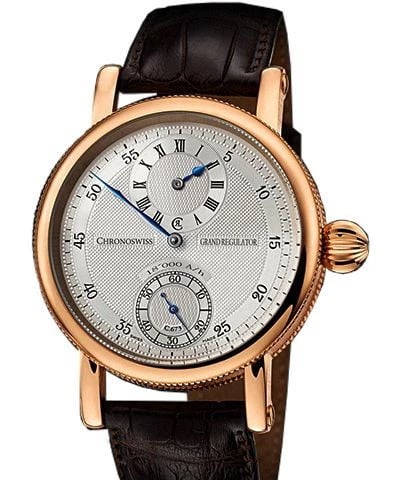
The Heritage Regulator continues that lineage. It is part of the Heritage collection, which draws on historical references while employing modern manufacturing standards. The CH-6723 is a stainless steel model with a silver guilloché dial, a combination that feels both archival and contemporary. Chronoswiss has always been a small, independent-minded house, and the Heritage Regulator reflects that ethos: it is not designed to compete with mass-market luxury watches but to satisfy a specific, knowledgeable clientele.
Movement: Calibre C.281
At the heart of the Heritage Regulator CH-6723 is the Chronoswiss Calibre C.281. This is an automatic movement based on the venerable ETA 2892-A2, a workhorse calibre known for its slim profile and reliability. Chronoswiss modifies the base movement with its own regulator module, which rearranges the hands to the classical regulator configuration. The result is a movement that offers the convenience of automatic winding with the visual and mechanical interest of a regulator display.
The C.281 operates at a frequency of 28,800 vibrations per hour, or 4 Hz, and delivers a power reserve of approximately 42 hours. These are not extraordinary figures by modern standards, but they are entirely appropriate for a watch of this nature. The ETA 2892-A2 is a proven architecture, and Chronoswiss's modifications are executed with care. The movement is rhodium-plated and decorated with circular graining, and the blued screws add a touch of traditional color. Through the sapphire display back, the wearer can see the skeletonized rotor and the regulator module, though the view is more about mechanical honesty than spectacle.
It is worth noting that the C.281 is not an in-house movement. Chronoswiss, like many independent brands, relies on a supplied base calibre. This is not a drawback; the ETA 2892-A2 is one of the finest automatic movements ever produced, and its widespread use means that service is straightforward. However, collectors who insist on in-house manufacture should look elsewhere. The Heritage Regulator is not COSC-certified, so accuracy is not guaranteed to chronometer standards, but the movement can be regulated to perform well within everyday expectations.
Case and Dial: A Study in Traditional Finishing
The case of the Heritage Regulator is crafted from stainless steel. It features Chronoswiss's signature onion crown, a detail that is both tactile and historically resonant. The crown is easy to grip, and its fluted shape adds a subtle decorative element without overwhelming the profile. The lugs are elegantly curved, and the overall case finishing alternates between polished and brushed surfaces. This is a watch that looks more expensive than its price suggests, particularly when the light catches the guilloché dial.
Speaking of the dial, it is here that the Heritage Regulator truly shines. The silver-plated surface is decorated with a hand-guilloché pattern, a technique that involves cutting intricate geometric lines into the metal. The result is a dial that changes character depending on the angle of light, sometimes appearing almost white, sometimes revealing a deeper, textured silver. The regulator layout is clean and balanced: the central minute hand is the longest, the hour subdial sits at twelve o'clock, and the small seconds subdial is at six o'clock. The hands are blued steel, a traditional choice that contrasts beautifully with the silver dial. There is no date window, no lume, and no unnecessary text. The dial bears only the Chronoswiss name and the words 'Swiss Made'.
The sapphire crystal is slightly domed, which adds a vintage feel without distorting the dial. The caseback is also sapphire, allowing a view of the movement. The watch is paired with a hand-sewn leather strap, which complements the formal character of the piece. The strap is secured by a pin buckle, a simple and reliable choice. While some might prefer a deployant clasp, the pin buckle keeps the package lightweight and traditional.
Wrist Feel: Comfort and Balance
On the wrist, the Heritage Regulator is a pleasure. The case is neither oversized nor undersized; it sits comfortably on medium to large wrists, with a profile that slips easily under a shirt cuff. The onion crown does not dig into the wrist, and the curved lugs ensure that the watch hugs the arm without excessive overhang. The leather strap is supple from the start, and the pin buckle allows for fine adjustment. The watch feels substantial but not heavy, thanks to the stainless steel case and the relatively slim automatic movement.
One of the most appealing aspects of the Heritage Regulator is its balance. The regulator layout means that the minute hand is the most prominent, which is exactly as it should be. When you glance at the watch, your eye is drawn to the central minute hand, and the hour and seconds are there when you need them. This is a watch that encourages a different kind of time reading, one that is more deliberate and less hurried. It is also a watch that feels at home on a variety of straps, from the original leather to a more casual suede or even a steel bracelet, though the latter would change its character significantly.
Accuracy: What to Expect
Because the C.281 is based on the ETA 2892-A2, real-world accuracy is generally good. A well-regulated example should run within -5 to +10 seconds per day, which is acceptable for a non-chronometer mechanical watch. Some examples may perform even better, while others might be slightly outside that range. The movement is not COSC-certified, so there is no guarantee, but Chronoswiss does regulate its movements before they leave the factory. If you are particular about accuracy, a watchmaker can easily adjust the regulator to bring it within tighter tolerances.
It is worth remembering that mechanical watches are affected by temperature, position, and activity. The Heritage Regulator is no different. If you wear it daily, you may notice slight variations depending on how you store it at night. A watch winder can help maintain consistency, but it is not necessary. The 42-hour power reserve means that the watch will keep running if you take it off for a day, but it will stop if left unused for longer. For a dress watch, this is perfectly adequate.
Occasions and Wrist Presence
The Heritage Regulator is primarily a formal and dress watch. Its elegant dial, leather strap, and lack of lume make it ideal for business meetings, dinners, and cultural events. However, it is also versatile enough for daily wear in an office environment. The stainless steel case and sapphire crystal are durable enough to withstand the rigors of everyday life, though the leather strap will show wear over time. It is not a sports watch, and it should not be worn for swimming or strenuous activities. For travel, it is a fine companion, as the regulator layout is easy to read once you are accustomed to it.
In terms of wrist presence, I would rate it a 4 out of 5. It is not a flashy watch, but it attracts attention from those who know watches. The guilloché dial catches the light, and the blued hands provide a subtle pop of color. It is the kind of watch that rewards close inspection rather than shouting across the room. On the wrist, it feels refined and intentional, a piece that suggests its owner values substance over show.
Reference Variants and Family
The CH-6723 is the core stainless steel Heritage Regulator with a silver guilloché dial. Chronoswiss has produced other variants in the Heritage Regulator line, including models with different dial colors and case materials, but the CH-6723 remains the most classic expression. The Heritage Regulator family sits alongside other Chronoswiss regulator models, such as the Regulator Classic, the Flying Regulator, and the Regulator Automatique. Each offers a different take on the regulator theme, from sportier designs to more complicated versions.
Other notable Chronoswiss models include the Delphis, with its jumping hour and retrograde minutes; the Flying Regulator Open Gear, which exposes the movement's gear train; the Orea, an elegant round watch; the Sirius, a classic three-hander; the Timemaster, a chronograph; and the Kairos, a sophisticated dress watch. Chronoswiss has always been a niche brand, and its catalog reflects a commitment to mechanical variety rather than mass appeal.
Similar Watches and Homages
If you are drawn to the regulator layout, there are several alternatives to consider. The Nomos Glashütte Lambda is a German regulator-style watch with an in-house calibre and a clean, minimalist dial. The Habring² Regulator is an independent Austrian offering with a modular movement and excellent finishing. The Louis Erard Excellence Regulator is a more accessible Swiss option with a distinctive dial. The Stowa Regulator Classic is a German watch that offers a traditional regulator layout at a lower price point. Each of these has its own character, but the Chronoswiss Heritage Regulator stands out for its guilloché dial and onion crown.
For those on a budget, there are homage watches that mimic the regulator layout. The Parnis Regulator and the Tisell Regulator are two examples, both priced around $250. These watches use inexpensive movements and materials, and they do not offer the same level of finishing or brand heritage. However, they can be a fun way to experiment with the regulator style before committing to a more expensive piece.
Investment Value and Service
The Chronoswiss Heritage Regulator CH-6723 had an original MSRP of approximately $5,900. Current retail prices for new examples are around $6,200, depending on the dealer. On the pre-owned market, prices range from $2,800 to $3,800, making it a depreciating asset from a pure investment standpoint. This is not a watch that will likely appreciate in value, but it was never intended to be. It is a watch to be worn and enjoyed. For collectors, the pre-owned market offers excellent value, as you can acquire a well-made Swiss regulator for a fraction of its original price.
There is no major auction history for this reference. It is not a limited edition, and it does not have the kind of cult following that drives prices up at auction. If you are looking for an investment, this is not the watch for you. If you are looking for a beautifully finished, mechanically interesting watch that you can wear without fear, the Heritage Regulator is a strong candidate.
Service for the C.281 movement is available through Chronoswiss authorized service centers. Because the base movement is an ETA 2892-A2, many independent watchmakers can also service it, though the regulator module may require specialist attention. Service intervals vary with use, and your watchmaker can advise on the appropriate schedule. The cost of service will vary, but you should expect a few hundred dollars for a standard overhaul. Authorized service is recommended to ensure that genuine parts are used and that the watch retains its value.
Pros and Cons
Pros:
- Distinctive regulator dial with central minute hand, hour at twelve, and seconds at six.
- High-quality guilloché dial and elegant case finishing.
- Reliable ETA-based automatic movement with 42-hour power reserve.
- Comfortable on the wrist and versatile for formal and daily wear.
- Excellent value on the pre-owned market.
Cons:
- No date or lume, which limits its practicality for some.
- Not intended for water sports.
- Depreciates from retail, so not an investment piece.
- Not an in-house movement, which may matter to some collectors.
Final Verdict
The Chronoswiss Heritage Regulator CH-6723 is a thoughtful modern take on a watchmaker's tool. It offers a genuine regulator display, solid movement architecture, and elegant finishing at a price that makes pre-owned examples especially attractive. For collectors who value traditional layout over trendy complications, it remains a compelling choice. It is not a watch for everyone, but for those who appreciate the history and purity of the regulator, it is a quiet triumph.