Why the Heritage Sirius matters right now
There is a moment in every collector's arc when the loud stuff stops working. You have done the steel sports chronograph. You have refreshed the drop page. You have watched a piece you bought at retail trade at a premium for six weeks and then come all the way back. And then you start noticing the houses that never had a waitlist — the ones that built their reputation on dial architecture, hand-finishing, and the stubborn belief that a watch should be legible before it is photogenic.
Chronoswiss is one of those houses. The Heritage Sirius, reference CH-8023, is one of those watches.
It is not a hype piece. It will not double. What it delivers is something the current market has almost stopped making: a properly finished, mechanically serious dress watch from a brand with a genuine point of view, at a price a young collector can actually reach. That combination — real watchmaking, no queue, no premium — is the most interesting corner of the market right now, and the Sirius sits squarely in it.
One note on sourcing before we go further. Chronoswiss has never maintained the kind of exhaustive public reference database that Rolex or Omega do, and archive material for the Heritage-era Sirius is thin. Where a figure is not documented for this specific reference, this review says so rather than filling the gap with a plausible-sounding number. If you are buying, confirm details with a Chronoswiss specialist or the brand's service department before you wire money.
The house: Munich, 1983
Chronoswiss was founded in 1983 by Gerd-Rüdiger Lang, a German watchmaker who had spent years in the movement business before deciding to build watches his own way. Lang set up in Munich, and his timing was close to perfect. The quartz crisis had hollowed out the Swiss industry, and the mechanical ébauches that had once been the backbone of European watchmaking were sitting in drawers, unwanted and cheap. Lang bought them, rebuilt them, and finished them to a standard the big houses had largely abandoned.
His signature move came in 1987: the Régulateur, a wristwatch with the regulator-style dial layout — central minute hand, off-centre hours, small seconds — that had previously existed almost exclusively on clock faces and in watchmakers' workshops. It was a strange idea for a wristwatch and it became the brand's identity. Chronoswiss has been the regulator house ever since.
The other thing Lang established was a visual language the brand still speaks. Knurled, coin-edge bezels. Onion crowns. Sapphire crystals front and back. Skeletonised rotors and hand-engraved bridges visible through the caseback. Dials engineered for reading rather than for rendering. If you have handled a Chronoswiss from any era, you know the feel — dense, deliberate, slightly over-built in the way German watchmaking often is.
Lang sold the company in 2012. The Ebstein family took over, relocated the operation to Lucerne, and spent the following decade reworking the collection — leaning harder into the regulator concept, adding the Delphis and Open Gear lines, and eventually introducing manufacture calibers. The Heritage-era pieces, including the Sirius, come from the transitional period when Chronoswiss was still building on modified Swiss ébauches but finishing them to a very high standard. That is the context you need to understand this watch.
Design: a dial that behaves
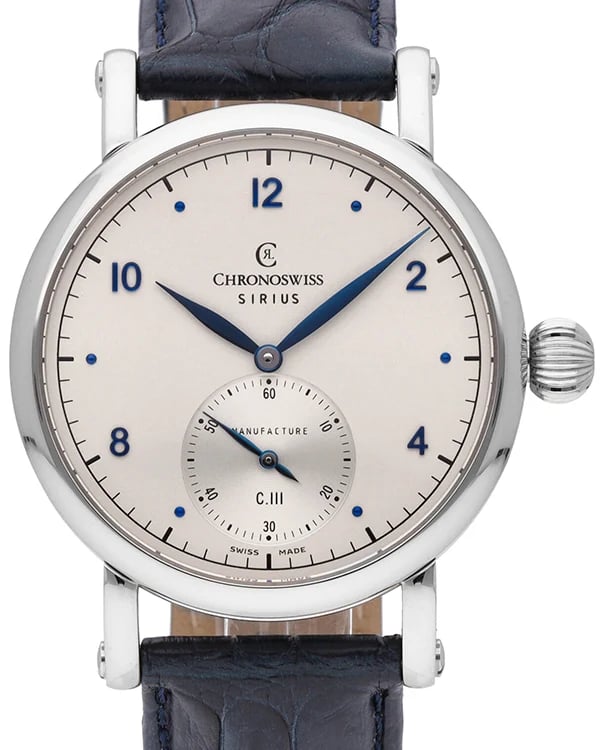
The Heritage Sirius is a round, classical dress watch, and its design brief is legibility. The dial is silvered and textured, with applied indices that catch light at the edges and a handset that is long enough to actually point at something. Nothing on this dial is decorative for its own sake. There is no oversized logo, no faux-patina lume plot, no subdial you will never read. It is a dial built by people who think a watch is a tool for telling time, even when it is a tool you wear with a suit.
What makes it recognisably Chronoswiss is the case. The brand has always had a thing for machined, tactile casework — fluted or knurled surfaces, stepped bezels, crowns you can actually grip — and the Sirius carries that DNA in a restrained form. It is a dress watch with a machined edge, which is a rare combination. Most dress watches are smooth and slightly anonymous. This one has a spine.
The crystal is sapphire, front and (as is standard for the house) back. That caseback matters more than it does on most watches, because Chronoswiss finishing is genuinely worth looking at: the bridges are decorated, the screws are blued, and the rotor is skeletonised and engraved rather than left as a plain slab of tungsten. In an era where entry-level luxury watches increasingly hide stamped movements behind solid casebacks, this is a meaningful statement.
The movement: honest, if under-documented
Here is where we have to be straight with you. Chronoswiss does not publish a caliber designation for the Heritage Sirius CH-8023, and we are not going to invent one. What is well established is the house method: take a Swiss ébauche, strip it, rebuild it, and finish it by hand to a level the base movement never received. That is the Lang formula, and it is what made Chronoswiss interesting in the first place.
Practically, that means a few things for a buyer. First, the movement is automatic and it is not COSC-certified — Chronoswiss did not submit this generation for chronometer certification. Second, the power reserve is not published for this reference, so plan on wearing the watch regularly or keeping it on a winder rather than trusting a specific hour figure. Third, and most usefully, because the base is a widely known Swiss ébauche rather than a proprietary in-house caliber, a competent independent watchmaker can service it. On a niche brand, that is a significant advantage — you are not hostage to one service centre.
The finishing is the point. Skeletonised rotor, engraved bridges, blued screws, perlage on the plates. At this price point, most of what you can buy has a closed caseback and a movement that was assembled, not finished. The Sirius is from the other tradition.
Specifications
Chronoswiss does not publish a complete specification sheet for this reference, so here is what we can state with confidence — and what we cannot.
| Attribute | Detail |
|---|---|
| Reference | CH-8023 |
| Movement | Automatic, Chronoswiss-modified Swiss ébauche |
| Complications | Date |
| Case material | Stainless steel |
| Crystal | Sapphire, front and caseback |
| Strap | Leather, pin buckle |
| Lume | None |
| Case diameter | Not published for this reference |
| Case thickness | Not published for this reference |
| Lug-to-lug | Not published for this reference |
| Water resistance | Not published for this reference |
| Jewel count | Not published for this reference |
| Power reserve | Not published for this reference |
| Frequency | Not published for this reference |
| COSC certified | No |
We have deliberately left those fields blank rather than quoting figures from a different Sirius variant or a different era. If a seller quotes you a dimension, ask them where it came from.
On the wrist
The Heritage Sirius is a dress watch that behaves like a dress watch. It sits close to the wrist rather than perching on top of it, and because the case is compact and the lugs curve down rather than out, it disappears under a shirt cuff without a fight. That is not a small thing. A lot of contemporary dress watches have grown into small sports watches — heavy, top-heavy, always catching on a sleeve. The Sirius does not do that. On the wrist it reads as furniture, not equipment.
The other thing you notice is the finishing density. Chronoswiss cases have always felt slightly over-built for their size, and this one is no exception: the case flanks and bezel have a machined crispness that photographs poorly and feels excellent in the hand. The leather strap is the correct pairing — a bracelet would fight the dial — and the pin buckle keeps the whole thing slim and unobtrusive. If you are used to a heavy steel bracelet watch, the first hour will feel almost alarmingly light. By day three, everything else feels clumsy.
Presence is the trade-off. This is a three-out-of-five watch. The dial has real depth and the case finishing rewards a close look, but nobody across the table will clock it. That is the deal you make with a watch like this: you buy it for yourself, not for the room.
Accuracy and day-to-day behaviour
With no published rate specification and no COSC certification, there is no factory number to hold this watch to. In practice, a well-maintained Swiss automatic of this generation typically settles within a handful of seconds per day in either direction, and that is the realistic expectation. What matters more than the number is service history. A freshly serviced example will hold a steady rate; an unserviced one may drift and show inconsistent amplitude on a timing machine.
Ask for a timegrapher printout before you buy. If the seller cannot provide one, price the cost of a full service into your offer — it is the single most common surprise on any pre-owned mechanical watch, and on a niche brand it is worth budgeting for rather than assuming.
On water resistance, be conservative. Chronoswiss does not publish a figure for this reference that we can verify, and a leather-strapped dress watch with no screw-down crown should be treated as splash-resistant at best. Wash your hands with it on. Do not swim in it. Do not wear it in the shower. This is a dry-land watch and it is happier that way.
The family, and what else to look at
The Sirius name covers more than one watch. Over its production run, Chronoswiss offered the Sirius as a straightforward automatic, as a chronograph, and with calendar complications including a triple date and a day-date. Because the brand does not publish a full reference table for this generation, the practical advice is simple: if you want a chronograph, buy a Sirius chronograph; if you want the pure dress-watch experience, buy the time-and-date. Do not assume a reference number tells you the configuration — verify it.
Elsewhere in the Chronoswiss catalogue, the Régulateur remains the definitive model and the one that holds the most cultural weight. The Delphis, with its jumping hours and retrograde minutes, is the brand's most technically ambitious contemporary piece. The Opus, with its exposed movement architecture, is the one that made collectors pay attention in the 1990s. Any of these will tell you more about the house than a spec sheet will.
If the Sirius is on your shortlist, it is worth cross-shopping a few things. The Nomos Tangente is the other great German dress watch of the modern era — cleaner, more minimal, and with a fully in-house movement at a comparable price. The Jaeger-LeCoultre Master Control Date is the grown-up alternative: more prestige, more money, and a dial playing a similar game of restraint. The Glashütte Original Senator Excellence brings Saxon finishing and a hand-engraved balance cock. And the IWC Portofino Automatic is the Schaffhausen entry-level dress watch — more brand recognition, less mechanical character.
If you want the look for less
There is no direct homage to the Heritage Sirius, and that is partly because the brand's design language is hard to copy cheaply. But if you are testing whether you actually wear a dress watch before committing, the Orient Bambino remains the default entry-level dress automatic at around $250 — same restrained proportions, none of the finishing. The Seiko Presage Cocktail Time at roughly $425 brings genuine Japanese dial craft. The Tissot Le Locle Automatic at around $400 is Swiss-made with a classical layout and is a useful benchmark for how much more the Chronoswiss actually delivers.
None of them will feel like the Chronoswiss in the hand. That is the honest answer. But they will tell you whether a dress watch belongs in your rotation at all.
Market and value
Chronoswiss is a niche house with a thin secondary market, and that cuts both ways. On the downside, liquidity is poor: if you need to sell quickly, you will take a haircut, and you should not expect to recover retail. On the upside, that same indifference is exactly why a watch this well finished can be had for a fraction of what an equivalent JLC or Glashütte Original costs.
Street pricing on a stainless-steel Heritage Sirius generally clusters in the region of $1,500 to $3,500 depending on condition, completeness, dial variant, and service history. Precious-metal examples sit higher. The trend is best described as stable rather than appreciating — the market is not chasing these watches, but it is also not abandoning them, and well-preserved examples with boxes and papers have firmed up modestly as collectors rediscover the Lang-era design language.
There is essentially no auction history to speak of. Chronoswiss does not appear regularly in the headline watch auctions, and there are no notable recorded results for the Heritage Sirius CH-8023. Pricing is set by specialist dealers and private listings, which means you have more negotiating room than you would on a Rolex — and also less certainty about where the floor is.
The recommendation is straightforward: buy it to wear. If you are looking for a store of value, this is not it. If you are looking for a genuinely well-finished watch that almost nobody else at the table will be wearing, it is one of the better buys in Swiss horology right now.
Servicing
Because the movement is built on a widely serviced Swiss ébauche rather than a proprietary in-house caliber, a competent independent watchmaker can handle routine servicing. That is a real advantage on a small brand, and it means you are not locked into a single service centre or a long queue. For anything involving case refinishing, dial work, or parts sourcing, Chronoswiss's own service department remains the safest route — the brand still supports its older references, though turnaround times on Heritage-era pieces can be longer than on current production.
Chronoswiss does not publish a recommended service interval or a standard service cost for this reference, so we are not going to quote a number. The sensible approach is the standard one: service when the rate drifts or the amplitude drops, not on a calendar.
Verdict
The Chronoswiss Heritage Sirius CH-8023 is the kind of watch the modern market has largely stopped producing: a quietly excellent, hand-finished dress watch from a house with an actual point of view, sold without a queue or a markup. It is not an investment, and it will not impress anyone who only reads hype lists.
But if you have already done the hype list and found it hollow, this is where the interesting stuff starts. A German-Swiss house that reinvented the regulator dial, a movement finished by hand rather than assembled by machine, a case with a machined edge instead of a smooth shrug, and a price that a young collector can actually reach without a financing plan. At used prices, it is one of the better-kept secrets in Swiss watchmaking — and secrets like that do not stay secret forever.