The Munich Maverick: A Contextual Prelude
To understand the Chronoswiss Kairos CH2823, one must first understand the climate of the 1980s. The watch industry was in shambles. The 'Quartz Crisis' had decimated traditional Swiss houses, and the future of mechanical horology looked bleak. Enter Gerd-Rüdiger Lang, a man with a mustache as formidable as his ambition. In 1983, he founded Chronoswiss in Munich, not Switzerland. It was a punk-rock move in a velvet-lined industry. Lang wasn't just making watches; he was preserving a dying art form. The Kairos was one of the pillars of this movement, a watch that didn't just tell time—it screamed 'Mechanical Forever.'
The CH2823 represents the zenith of this era. It arrived at a time when the world was beginning to rediscover the charm of a ticking balance wheel. In the culture of the late 80s and early 90s, where excess was the norm, the Kairos was a restrained, intellectual alternative. It was the watch for the person who preferred a Leica to a camcorder, a fountain pen to a ballpoint. Today, that same energy is being rediscovered by a new generation of collectors who find the current 'hype-watch' culture vapid and exhausting.
The Dial: A Symphony in Solid Silver
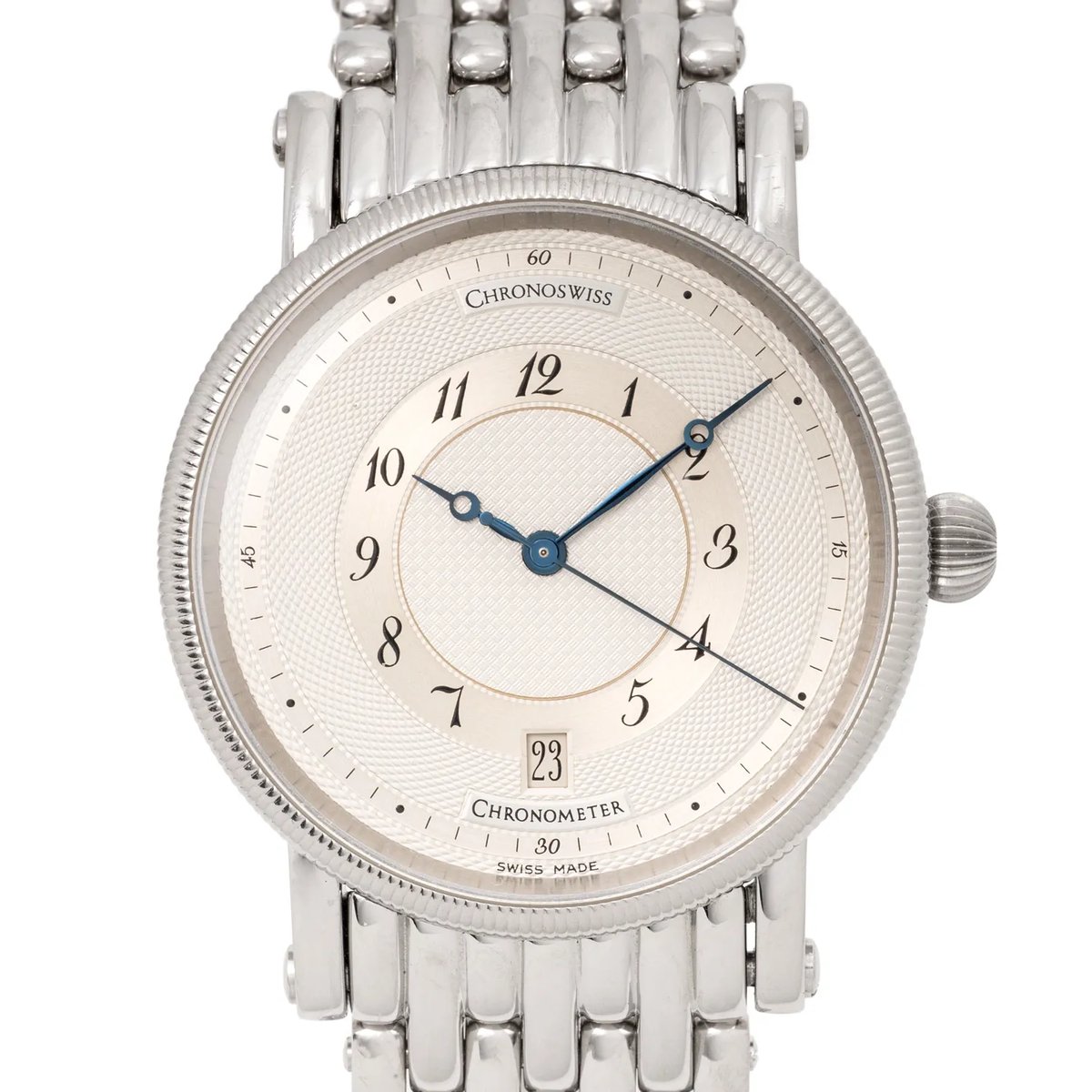
The centerpiece of the Kairos is, without question, the dial. In an era where most dials are stamped brass with a layer of paint, the CH2823 features a dial made of solid .925 sterling silver. But it’s the finishing that stops you in your tracks. The guilloché—a pattern of intricate, engine-turned engravings—is executed with a precision that mimics the high-end work of Breguet. This isn't just for show; the way the light dances across the 'grain d'orge' (barleycorn) pattern creates a depth that is impossible to replicate with modern laser etching.
Complementing the silver canvas are the hands. These aren't just blue; they are thermally blued steel. This involves heating the steel to precisely 300 degrees Celsius until it reaches that iconic cornflower blue. At various angles, they can appear almost black, only to flash a vibrant electric blue when they catch the sun. The use of Breguet-style 'pomme' hands adds a layer of historical romanticism that grounds the watch in the traditions of the 18th century, despite its 20th-century origins.
The Case: Architecture on the Wrist
The case of the CH2823 is equally distinctive. Chronoswiss established a design language that is instantly recognizable: the coin-edge bezel and the onion crown. The coin-edge detailing on the top and bottom of the case midsection serves two purposes. Aesthetically, it breaks up the polished surfaces and adds a tactile, industrial feel. Functionally, it harks back to an era when bezels were screwed down to ensure water resistance.
Then there is the crown. The 'onion' crown is a Chronoswiss signature. Originally designed for pilots who needed to adjust their watches while wearing thick gloves, on the Kairos, it becomes a piece of wearable sculpture. It is oversized, yes, but it is perfectly proportioned to the 38mm case. It invites interaction. Every time you set the date or time, you are reminded of the mechanical nature of the object on your wrist. The lugs are straight and protruding, featuring functional screws that hold the strap in place—a much more secure and premium solution than the ubiquitous spring bar.
The Movement: The Reliable Heart
Under the hood of the CH2823 beats the Caliber C.282. While Chronoswiss is now moving toward more in-house production, during the era of the CH2823, they relied on the ETA 2892-A2 as a base. But don't let the 'ETA' label fool you. This was the top-grade version of the movement, stripped down and refinished by Chronoswiss to meet their exacting standards. Through the sapphire caseback, you can see the results: perlage on the plates, Côtes de Genève on the rotor, and blued screws throughout.
The choice of the 2892-A2 was a strategic one. It is a notoriously thin movement, which allowed the Kairos to maintain its slim 10.5mm profile. It is also one of the most reliable automatic calibers ever made. For the modern collector, this is a massive advantage. You get the beauty of a high-end German watch with the serviceability of a movement that any master watchmaker can fix. It’s the best of both worlds: artisanal on the outside, bulletproof on the inside.
Wrist Feel and Cultural Styling
How does it wear? In a word: elegantly. The 38mm diameter is the sweet spot for the modern 'Quiet Luxury' trend. It doesn't shout for attention from across the room, but it rewards the close observer. On a matte alligator strap, it’s a formal powerhouse. Swap that out for a grey suede or a tan Epsom leather strap, and suddenly the Kairos becomes a sophisticated daily driver that looks just as good with a cashmere hoodie as it does with a charcoal suit.
We are seeing a shift in the 'Watch World' zeitgeist. The heavy, 44mm divers that dominated the 2010s are giving way to smaller, more textured pieces. The Kairos fits this new mood perfectly. It’s a watch for the person who values the 'maker's mark.' It’s for the collector who spends their weekends at estate sales or hunting for first-edition books. It suggests a life lived with intention.
Investment Potential: The Sleeper Is Waking Up
From a value perspective, the Chronoswiss Kairos CH2823 is currently in a 'buy' window that won't stay open forever. For years, Chronoswiss was overlooked as the market obsessed over Rolex and Patek Philippe. However, as those prices have reached the stratosphere, collectors are looking for 'value plays' in the neo-vintage market (watches from the 1980s to the early 2000s). The Kairos is a prime candidate for appreciation.
Currently, you can find well-maintained examples of the CH2823 for under $3,000. When you consider that you are getting a solid silver, engine-turned dial and hand-blued hands—features usually reserved for watches costing $10,000 or more—the value proposition is staggering. As more collectors realize the importance of Gerd-Rüdiger Lang in the history of the mechanical revival, these early Munich-era pieces will likely see a steady climb in desirability and price.
Final Thoughts
The Chronoswiss Kairos CH2823 is more than just a timepiece; it’s a bridge between the classical past and the mechanical future. It’s a testament to the fact that great watchmaking doesn't always have to come from a giant conglomerate or a valley in the Jura mountains. Sometimes, it comes from a passionate man in Munich who refused to let the ticking of a mechanical watch become a sound of the past. If you’re looking for a watch that offers genuine horological depth, impeccable style, and a connection to a pivotal moment in watch history, the Kairos is waiting. Just don't wait too long—the secret is getting out.