The Philosophy of Pure Horology
When Gerd-R. Lang founded Chronoswiss in 1983, the industry was in a state of existential dread. Quartz was the king, and mechanical watches were viewed as archaic relics. Lang’s response was not to compete with technology, but to lean into the romance of the mechanical. The Orea is perhaps the most romantic of his creations. It does not rely on the complexity of a chronograph or the novelty of a regulator; instead, it relies on the purity of the 'Grand Feu' enamel dial.
In the context of a daily-wear watch, the Orea offers a refreshing clarity. In a week of testing, I found that the Orea doesn't just tell the time—it presents it. The stark, milky white of the enamel provides a level of contrast that modern lacquered or painted dials simply cannot match. This is the watch for the person who values the 'slow' movement in all aspects of life—slow food, slow fashion, and the slow, painstaking process of firing a dial in a kiln.
Case Architecture and Ergonomics
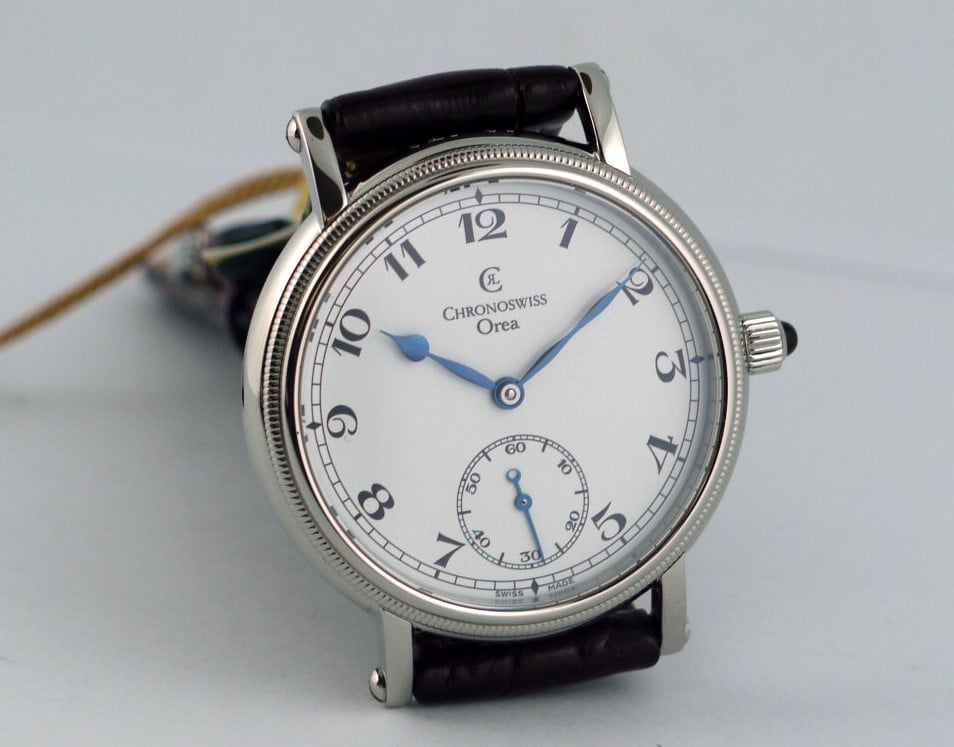
The case of the Orea is a masterclass in the Chronoswiss DNA. It features the signature fluted or 'coin-edge' bezel and caseback, which serves a dual purpose. Aesthetically, it breaks up the polished surfaces and gives the watch a vintage, almost pocket-watch-like feel. Functionally, it provides a grip that makes handling the watch feel secure. The 36.5mm diameter is the 'sweet spot' for a dress-leaning daily wearer, but as I often remind my readers at Vivir, diameter is only half the story.
The lug-to-lug measurement of 46mm is where the Orea finds its modern relevance. The lugs are straight and thin, protruding boldly from the case. On my 6.5-inch wrist, these lugs ensure the watch doesn't get lost. They create a rectangular 'footprint' on the wrist that provides stability. Unlike curved lugs that hug the wrist, these straight lugs allow the watch to 'float' slightly, which I found surprisingly comfortable during long days at the office. The strap is held in place by visible screws rather than spring bars—a nod to the robustness Lang insisted upon.
The Dial: A Sea of White Enamel
One cannot discuss the Orea without obsessing over the dial. 'Grand Feu' (Great Fire) enamel is a technique where glass powder is dusted onto a metal plate and fired at temperatures exceeding 800 degrees Celsius. The result is a surface that is virtually immune to UV degradation. It will be as white in 200 years as it is today. The depth of the enamel is visible around the center hole where the hands are mounted; there is a slight, soft 'sink' that gives the dial a three-dimensional quality.
The Roman numerals are printed with a thickness that suggests they are floating on top of the glass-like surface. Combined with the heat-blued Breguet-style hands, the legibility is peerless. In low-light conditions (though there is no lume), the slightest bit of ambient light reflects off the blued steel, allowing you to read the time with ease. This is a watch designed for the eye first.
The Movement: A Forgotten Treasure
Inside the automatic Orea beats the Caliber C.121. For the movement nerds, this is a treat. It is based on the Enicar 165, an ebauche that Chronoswiss acquired in significant quantities. It is a thin, reliable movement that allows the Orea to maintain its svelte profile. Through the sapphire caseback, you can see the gold-plated rotor, which has been skeletonized to reveal the perlage and circular graining beneath. While it doesn't have the 70-hour power reserve of a modern Tudor or Rolex, its 38 hours are more than enough for a daily wearer that stays on the wrist.
The Real-World Week
I wore the Orea for seven days straight, transitioning from board meetings to weekend gallery openings. The watch is a chameleon. On a black alligator strap, it is a formal powerhouse. Switch it to a tan calfskin or even a grey suede, and the 'neo-classical' elements feel suddenly modern and architectural. The onion crown, which looks large in photos, never once dug into the back of my hand. This is due to the height of the lugs, which keeps the crown slightly elevated from the skin.
The only caveat is the water resistance. At 30 meters, this is strictly a 'dry' watch. It will survive a rainstorm or a hand-washing, but it should never see the inside of a pool. For the young collector, this is the trade-off for such a refined aesthetic.
Final Verdict
The Chronoswiss Orea is a bridge between the old world and the new. It offers a level of artisanal craft—specifically the enamel dial—that is usually reserved for watches costing five times as much. For the Vivir reader who wants a watch with a story, a soul, and a face that will never age, the Orea is a superlative choice. It is a reminder that sometimes, the most beautiful things are the ones that don't try too hard.