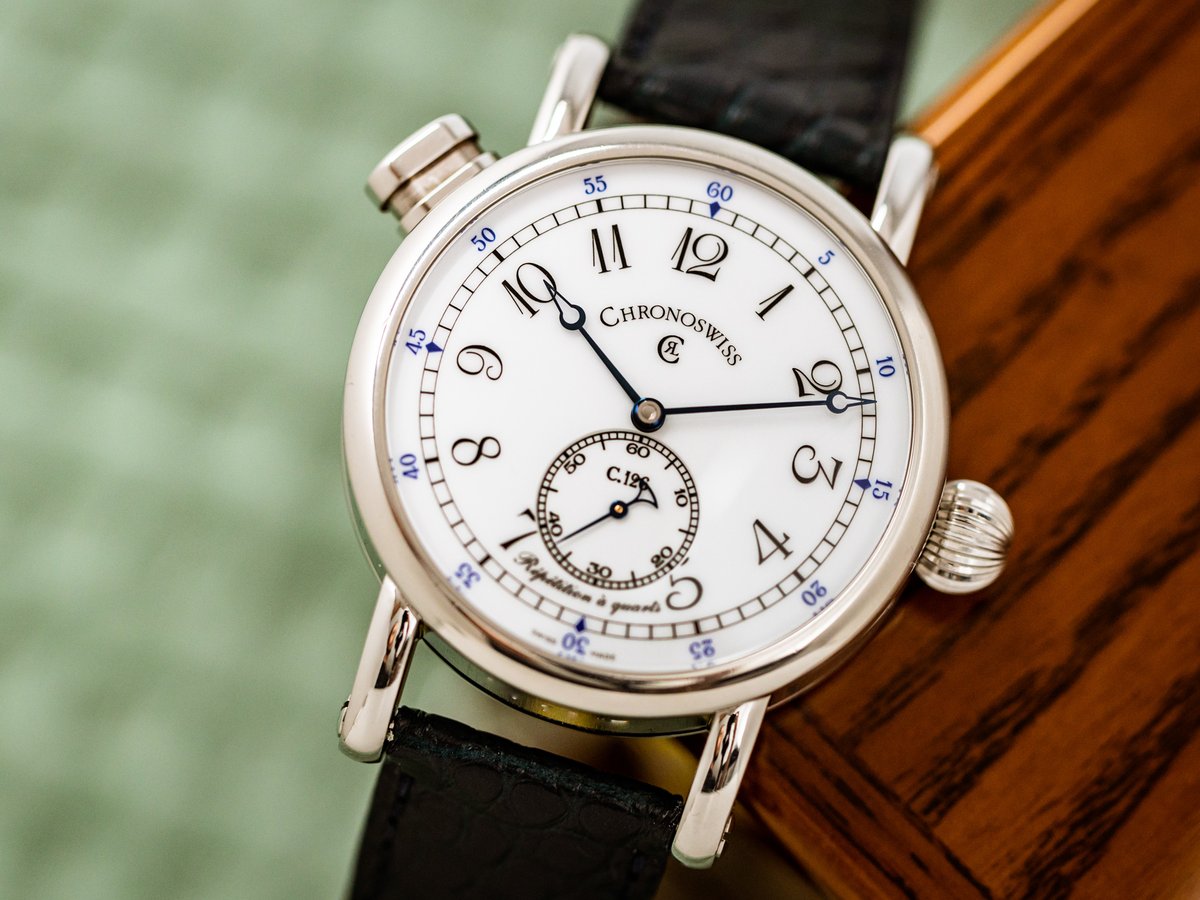
Chronoswiss Répétition à Quarts (Ref. CH.1641R) Review
There is a particular kind of collector who stops caring about the dial and starts caring about what the watch can do to a quiet room. The Chronoswiss Répétition à Quarts is built for that person. It is a quarter repeater — a watch that, on demand, strikes the hour on one gong and the elapsed quarter-hours on a second, lower tone — from a brand that has never been fashionable enough to be expensive and never been dull enough to be forgotten.
Reference CH.1641R is the version most often encountered on the secondary market, and it remains a genuinely strange proposition: a Swiss striking watch from the 1990s, cased in gold, built by an independent at the height of its creative confidence, priced at a small fraction of what a comparable repeater from the grandes maisons commands. It is not a watch you buy for liquidity. It is a watch you buy because you want to hear your wristwatch.
This review is written for the collector who already knows what a repeater is and wants to know whether this one is worth owning, what it costs to keep running, and what happens when the day comes to sell it.
Chronoswiss: The Brand Behind the Chime
Chronoswiss was founded in 1983 by Gerd-Rüdiger Lang, a German watchmaker who had spent years at Heuer before setting up on his own in Munich and later relocating the operation to Lucerne. Lang's premise was contrarian and, for a while, extremely effective: take the classical vocabulary of horology — the regulator dial, Breguet hands, guilloché and skeletonised plates, hand-finished bridges — and put it in a modern wristwatch at a price a working collector could reach.
That positioning matters enormously when you are trying to understand the Répétition à Quarts. Chronoswiss was never a manufacture in the modern sense. It bought ébauches from established suppliers and did the interesting work itself: finishing, skeletonising, engraving, and — in this case — housing a striking mechanism. The brand's reputation was built on execution and value rather than on in-house calibre development, and that is exactly the framework in which its repeaters should be judged.
The company changed hands in the 2010s and the modern catalogue has moved in a different direction, which means the Répétition à Quarts belongs to a specific and now-closed chapter of the brand's history. For collectors, that is usually a good thing. Discontinued, low-volume and slightly eccentric is a better combination than current, mass-produced and everywhere.
What a Quarter Repeater Actually Does
"Répétition à quarts" is French for quarter repeater. On a quarter repeater, the striking mechanism chimes the hour on a low tone and then the number of elapsed quarter-hours on a higher tone. At 3:45, you hear three strikes for the hour and three for the quarters. A minute repeater goes further, adding the minutes after the last quarter on a third tone, and it is considerably more complex and considerably more expensive.
The quarter repeater is the older and simpler of the two, and it has a particular charm: because it does not attempt to count minutes, the mechanism is less crowded and the sound is often cleaner. It is also, in the modern market, dramatically more affordable. That gap is the entire reason this Chronoswiss exists as a proposition. A minute repeater from a major maison starts in the high five figures and climbs fast. A quarter repeater from an unfashionable independent can be had for the price of a mid-range steel sports watch.
What you give up is precision of information. What you keep is the thing that actually matters: the sound of a hammer hitting a gong, produced by a mechanism that has to be assembled, adjusted and tuned by hand.
The Movement
Here is where the Répétition à Quarts requires a slightly different kind of diligence than a mainstream watch. Chronoswiss has never published exhaustive calibre documentation for this reference, and the striking mechanism — not the base timekeeping movement — is the component that determines whether the watch is worth owning.
The practical implication is that you should treat the calibre designation as secondary and the mechanism itself as primary. Ask the seller for a service history. Ask who serviced it. Ask whether the striking mechanism was stripped, cleaned and re-tuned, or merely oiled. A repeater that has been properly serviced by someone who understands rack-and-snail striking will chime crisply and land reliably on the correct hour and quarter. One that has been neglected will sound thin, may miss a strike, and can cost more to put right than the watch is worth.
This is not a criticism of the watch. It is a criticism of how repeaters are bought. Collectors who understand this category already know that the audible complication is the asset, and that the base movement underneath it is, in relative terms, a commodity.
Case, Dial and Wearing Experience
The reference suffix 'R' is consistent with Chronoswiss's convention of indicating the case metal in the reference string, and this reference is generally understood as the gold-cased version of the Répétition à Quarts. That matters for two reasons. First, gold gives the watch a warmth and a heft that steel cannot replicate, and a repeater benefits from that — the case feels like an instrument rather than a container. Second, gold puts a soft floor under the resale value, because even a badly received watch has a melt value.
On the wrist, this is a dress watch first and a complication second. It sits close to the arm, slides under a shirt cuff without a fight, and reads as a serious, slightly old-fashioned gold watch to anyone who does not recognise it. The strap — typically leather on this reference — does most of the work of keeping it planted, and the pin buckle keeps the profile low. There is no bracelet to balance against, so the head carries the mass, which is exactly how a watch of this type should behave.
The one thing to think about before you buy is the striking hardware. Repeaters need a rack, gongs and either a slide or a pusher to trigger the sequence, and that hardware has to live somewhere on the case. Depending on the individual example, you may feel the slide or pusher against the wrist when the hand rotates inward. It is not uncomfortable, but it is a reminder that you are wearing a machine with a job to do. Fit the strap properly and most of that disappears.
Accuracy and Daily Expectations
Nobody buys a quarter repeater for chronometry, and Chronoswiss never positioned this reference as a precision instrument. Timekeeping is a function of the base calibre underneath the striking works, and a well-serviced example in this class should hold to within the sort of daily variance you would expect from a good-quality Swiss mechanical movement of its generation — tens of seconds a day rather than single digits, with more drift if it has not been serviced in a decade.
The more useful accuracy question is acoustic. Does it strike cleanly? Does it land on the correct hour and quarter every time? Does the tone sound full rather than thin or rattly? A repeater that keeps perfect time but chimes badly is a broken repeater, and no amount of rate testing will tell you that. If you are buying remotely, ask for a video of the watch striking. Anyone selling a repeater in good faith will send one.
Occasions
This is a formal and dress watch, and it is honest about that. It belongs with a suit, at a dinner, at an occasion where a quiet chime is a pleasure rather than a distraction. It is not a sports watch, it is not a travel watch, and it is not something you would take to the beach. Within its lane, though, it is remarkably easy to live with: the case is comfortable, the strap is conventional, and there is nothing about it that demands special handling beyond avoiding water and impact.
Service Reality
This is the part of repeater ownership that catches people out. A standard mechanical watch can be serviced by a competent independent watchmaker almost anywhere. A repeater cannot. The striking mechanism has to be stripped, cleaned, reassembled and — critically — re-tuned so that the hammers fall correctly and the sequence is reliable. That is specialist work, and the pool of people who can do it well is small.
Budget accordingly. Treat the service as a meaningful ownership cost rather than an afterthought, and treat a documented service history as a material part of the watch's value. A serviced Chronoswiss repeater is worth considerably more than an unserviced one, because the buyer is not inheriting an open-ended liability.
The Market: What It Costs and Whether It Holds
Pricing in this corner of the market is thin and idiosyncratic. Examples of the CH.1641R trade in the mid four figures to low five figures in US dollars, with the spread driven almost entirely by condition, completeness and — above all — whether the striking mechanism has been properly maintained. There is no meaningful auction record to anchor against, because these watches surface through specialist dealers and enthusiast channels rather than at the headline houses.
That thinness cuts both ways. On the positive side, it means the watch is not competing against a wall of identical listings, and a patient buyer can sometimes find an example well below what the complication alone would justify. On the negative side, it means selling takes time. If you need liquidity in a week, this is the wrong watch. If you are happy to wait months for the right buyer, the downside is limited by the gold content and by the simple fact that functioning Swiss quarter repeaters at this price are not being made any more.
The trend is best described as stable rather than appreciating. Chronoswiss does not carry the brand premium that lifts a Patek or a Vacheron, and there is no realistic scenario in which this reference becomes a blue-chip asset. What it does have is a floor. Buy it as a piece of wearable horology, not as a position.
Alternatives Worth Considering
If you want the complication with better liquidity and better finishing, the answer is a Jaeger-LeCoultre Master Grande Tradition Répétition Minutes — a modern benchmark, and priced accordingly. If you want the same idea in a different idiom, the Ulysse Nardin Hourstriker chimes the passing hours automatically rather than waiting to be asked. If you want the traditionalist's answer, an Audemars Piguet Jules Audemars Minute Repeater delivers the category's classic execution with the brand equity that Chronoswiss lacks.
If you simply want to hear a watch strike and cannot justify five figures, look at a vintage Seiko Bell-Matic or a Poljot alarm. Neither is a repeater, and neither pretends to be, but both deliver an audible mechanical event on the wrist for a few hundred dollars — and both will teach you whether you actually enjoy the sound of a striking watch before you commit real money to one.
Verdict
The Chronoswiss Répétition à Quarts CH.1641R is a collector's watch in the truest sense. It exists because someone wanted to build a striking watch that ordinary enthusiasts could actually buy, and it succeeds on those terms. It is not a store of value and it is not a status object. But it is a real quarter repeater in gold, from a brand with a genuine point of view, at a price that no major maison can approach.
Buy the best-serviced example you can find, confirm that it chimes cleanly before money changes hands, and accept that resale will be a conversation rather than a transaction. Do that, and you will own one of the more quietly satisfying watches of its era.