Why the Sirius Lunar Chronograph matters
There is a narrow band in the watch market where complications stop being marketing and start being engineering, and the moonphase chronograph sits right in the middle of it. Stacking a full chronograph on top of a lunar calendar is one of the oldest and most demanding arrangements in classical horology, and it is the reason a moonphase chronograph from any of the major Swiss houses typically starts where a plain three-hander ends. The Chronoswiss Sirius Lunar Chronograph, reference CH-7543L-BL, lives in that band — but it does not price like it.
That gap is the whole story. Chronoswiss is a genuinely independent house with a real founder, a real design archive, and a secondary market that has never caught a bid. For a collector who buys specification rather than logo, that combination is close to ideal. For anyone buying for resale, it is a warning.
This review treats the CH-7543L-BL as what it is: a classical, complication-forward dress chronograph from an under-followed independent, best acquired pre-owned, best kept if you actually wear it.
Chronoswiss: a short history that explains the watch
Gerd-Rüdiger Lang founded Chronoswiss in Munich in 1983, after years spent inside the Heuer service and development world. That background matters. Lang was not a designer who commissioned movements; he was a watchmaker who understood ébauches, and Chronoswiss was built on the idea of taking industrially produced Swiss calibres and re-engineering them to a standard their original makers never intended.
The house became known for the regulator — the Régulateur à Décrochement, with its separated hour, minute and second hands — and for a design language that fused German precision with Swiss classical proportion: fluted bezels, oversized onion crowns, coin-edge details, galvanically treated dials. Chronoswiss watches look like nothing else, and they look like nothing else on purpose.
In 2012 the brand was acquired by Oliver Ebstein and relocated to Lucerne, Switzerland, where it continues to produce under the same design philosophy with a sharper focus on independent manufacture. The Sirius collection — the round, classical line that includes this reference — sits at the conservative end of the catalogue, between the sportier Timemaster and the architectural Flying Regulator and Open Gear pieces. Understanding that positioning explains a great deal about the watch: the Sirius is the member of the family most likely to be worn with a suit, and the least likely to be bought by someone chasing a trend.
The case and dial: classical, but not anonymous
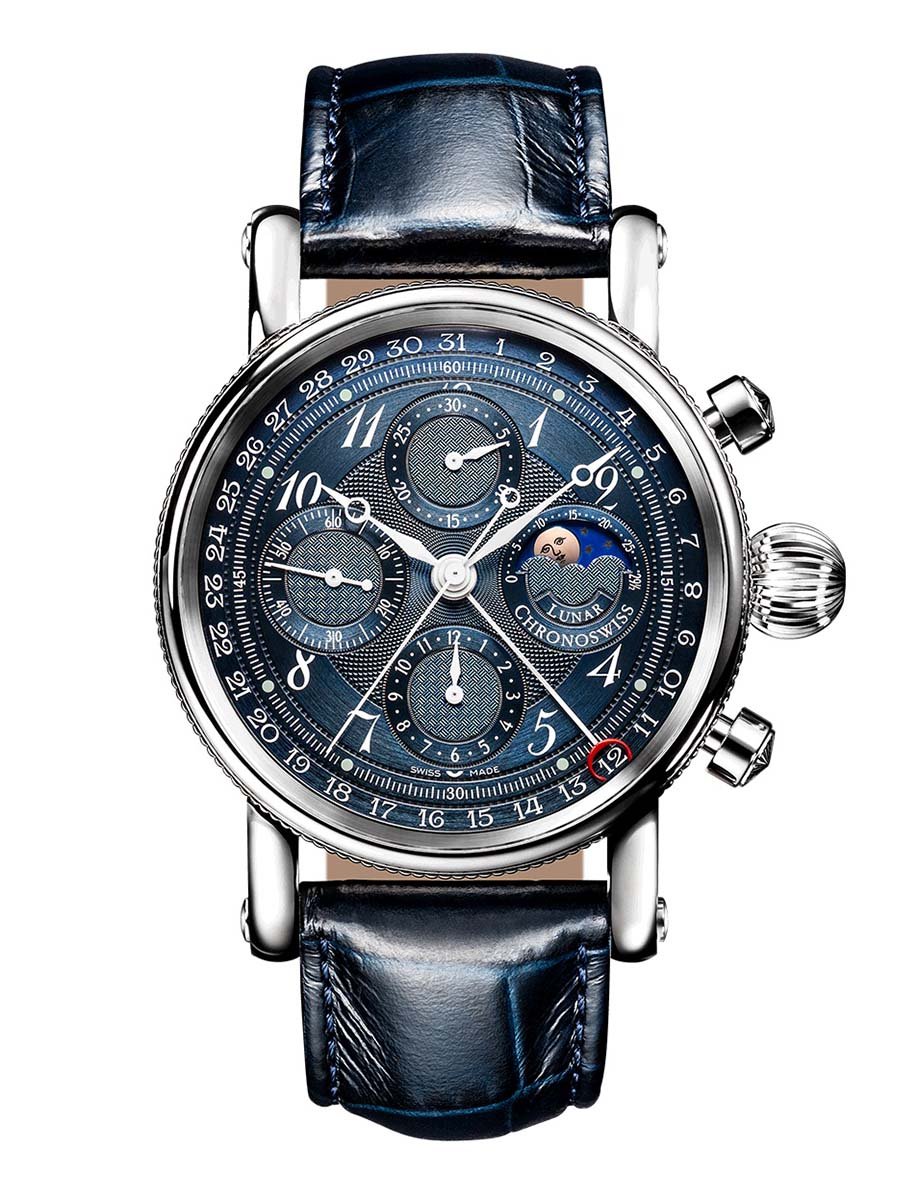
The Sirius case is a round, stepped construction with the family's signature fluted bezel and an onion crown at three o'clock. It reads as a dress watch from across the room and as something slightly unusual up close — the fluting catches light in a way a plain polished bezel never does, and the crown is large enough to be gripped easily, which is more than can be said for a lot of thin dress chronographs.
Chronoswiss has used both solid and display casebacks across the Sirius line, so the individual piece matters. A display back is a plus for a collector who wants to see the movement; a solid back is a plus for anyone who prefers a cleaner, thinner profile. The reference is catalogued in stainless steel, which is the sensible choice — the same watch in gold costs multiples more and does not deliver multiples more watch.
The dial is where Chronoswiss earns its keep. The house has always been good at galvanic finishing, and the blue dial of the CH-7543L-BL is the reason to choose this reference over a silver-dial sibling. Applied indices, crisp printing, and a moonphase aperture that is integrated into the layout rather than bolted on. This is a dial that rewards a loupe but does not require one.
On the chronograph side, the layout follows the classic architecture: a central chronograph seconds hand, a small running seconds subdial, and the counter subdials arranged symmetrically. The moonphase sits where the design wants it, not where the module forced it. That is not a given at this price point, and it is a large part of why the watch photographs so well.
One note for the detail-obsessed: the Sirius line has been offered with more than one dial finish and more than one strap configuration, and the suffix codes on the reference indicate those differences. If you are buying remotely, ask for a photograph of the caseback and the papers so you know exactly which configuration you are getting. On a low-volume independent, configuration errors are the most common source of disappointment in the pre-owned market.
The movement
Chronoswiss built its reputation on modified Swiss ébauches, and the chronograph line has historically been based on the Valjoux 7750 family — the workhorse automatic chronograph architecture that underpins a very large share of Swiss chronographs made since the 1970s. The moonphase chronograph variant of that family adds the lunar calendar to the existing chronograph and calendar works, which is why the layout on watches like this one tends to look the way it does.
What Chronoswiss did with those bases was the point. The house refinished, re-regulated and re-cased movements that left the factory as commodity items, and the resulting watches were sold on the strength of that work rather than on a proprietary calibre. That is worth understanding before you buy: you are not paying for an in-house movement, and you should not expect one. You are paying for a well-sorted, easily serviceable, robust automatic chronograph with a moonphase on top.
I want to be precise here rather than impressive. The exact Chronoswiss calibre designation for this reference is not something I can confirm from a verifiable source, and I would rather leave that blank than print a number that turns out to belong to a different model. What can be said with confidence is the architecture: automatic winding, a chronograph with the usual counter arrangement, a moonphase indication, and a balance running at the modern 28,800 vph beat that the 7750 family established. Buyers should confirm the calibre stamp on the movement or the caseback before purchase — on a watch like this, the movement number is part of the value.
Finishing on Chronoswiss movements of this generation is honest rather than spectacular: Côtes de Genève on the rotor and bridges where visible, blued screws on some examples, and a level of decoration that looks appropriate through a display back without pretending to be haute horlogerie. That is the correct ambition for a watch in this bracket. Over-finishing a 7750 base would be theatre; Chronoswiss resisted the temptation.
One technical point worth knowing if you are new to moonphases: a conventional lunar display of this type drifts by roughly one day every two and a half years, because the mechanism approximates the synodic month rather than tracking it exactly. That is normal, it is not a fault, and correcting it is a matter of a few clicks with the pusher or crown when the moon is full. If a seller tells you the moonphase is 'perfect,' they mean it is accurate enough — not that it is astronomically exact.
How it wears
The Sirius wears the way a classical Swiss dress chronograph should. The case is round and relatively low-slung, the lugs curve down toward the wrist rather than sitting flat on top of it, and the whole thing balances because the case is not especially tall relative to its width. On a leather strap with a pin buckle, it disappears under a cuff in the way a good dress watch is supposed to.
Weight is moderate. This is a steel watch on leather, not a bracelet watch, so there is no heft to speak of and no wrist fatigue after a full day. The onion crown is a genuine ergonomic advantage on a chronograph — you will actually use the pushers and the crown, and you will not need to take the watch off to do it.
The one thing to watch for is strap choice. A moonphase chronograph in a classical case lives or dies by its strap, and the difference between a well-made alligator and a stiff, over-padded aftermarket strap is the difference between a watch that looks expensive and one that looks like it is trying. Buy the watch, then budget properly for the strap.
There is also a sizing consideration that has nothing to do with numbers and everything to do with proportion: this is a design that flatters a wrist that can carry a classical round case, and it will look undersized on someone used to modern oversized sports watches. If your daily wear is a large dive watch, try this on before you commit. Collectors who rotate between a Submariner and a Sirius often describe the Chronoswiss as feeling 'small' for the first week and 'correct' thereafter — which is a useful way of saying that the design is proportionate to a classical brief, not to a modern one.
Accuracy and daily behaviour
An automatic chronograph built on the 7750 family, properly regulated, will typically run within roughly ten seconds a day in either direction, and often better. That is the honest expectation. It is not a chronometer-certified watch and Chronoswiss does not generally submit this line for certification, so do not buy it expecting COSC-grade consistency out of the box.
What you should expect is stability. The 7750 architecture is one of the most thoroughly understood movements in modern watchmaking: it is robust, it tolerates real use, and it can be brought back to spec by any competent watchmaker. A watch that has been sitting in a drawer for years may need a service before it performs, and that cost should be factored into the purchase price rather than discovered afterward.
Chronograph function on these movements is crisp and the reset is positive. If you use the chronograph regularly, you will not be disappointed. If you leave it running permanently, don't — running the chronograph continuously adds wear and does nothing for accuracy. The same applies to the moonphase: set it correctly and leave it alone.
When to wear it
This is a formal and dress watch first, a daily wearer second, and a travel companion third. The moonphase complication gives it an evening character that a plain chronograph does not have, and the blue dial keeps it from reading as strictly black-tie — it works with a suit, it works with a jacket and jeans, and it works at dinner.
It is not a sports watch. It is not a travel watch in the GMT sense. It is a watch for the person who wants one good classical piece that does more than tell the time, and who is comfortable being the only person in the room wearing it. If you need a single watch that covers the gym, the beach and the boardroom, this is not that watch — and no amount of strap swapping will make it one.
The market: what it costs and what it is worth
Here is the part that matters most to a serious collector. Chronoswiss does not have a strong secondary market, and the Sirius Lunar Chronograph is not an exception. Pre-owned examples of the Sirius chronograph family generally change hands in the low-to-mid four figures in US dollars, and a moonphase example in good condition sits at the upper end of that band. Retail pricing on a new Chronoswiss is meaningfully higher, which means the first owner takes the depreciation and the second owner gets the value.
That is the entire investment case, and it is not a growth story. It is a value story. You buy this watch used, at a price set by a market that does not care about it, and you own a moonphase chronograph from a real independent house for less than a steel sports watch from a brand with a waiting list. The trade-off is liquidity: if you need to sell quickly, you will sell to a dealer at a wholesale number, and that number will sting.
My read on the trend is depreciating relative to retail, stable in absolute terms. Chronoswiss is not going to zero — the brand is still in production, still independent, and still has a collector base — but it is also not going to appreciate the way a hyped reference does. There is no meaningful auction history for this reference; Chronoswiss appears only sporadically at the major houses, and when it does, it is usually the regulator or a rare early piece that draws attention, not a modern Sirius chronograph.
So: hold if you wear it, sell if you bought it as an investment. This is a watch to own, not to trade. And if you do decide to sell, sell privately to a collector who understands what it is, not into a dealer's bid. The spread between private and trade pricing on a low-liquidity independent is wide enough that it is worth the extra effort.
One more market note for buyers: because Chronoswiss is thinly traded, asking prices on listings are unreliable indicators of value. Look at completed sales, not asking prices, and be prepared to negotiate. Sellers of low-liquidity independents frequently start high and sit on inventory for months. Patience is worth real money here.
Service and ownership
Ownership is straightforward. The movement is a widely understood architecture, and any competent independent watchmaker can service it. You are not locked into a single authorised service centre, which is a real advantage on a watch at this price — service costs on a Valjoux-based chronograph are a fraction of what a manufacture calibre demands.
The caveat is parts. Chronoswiss is a small house, and while the base movement parts are plentiful, model-specific components — dials, hands, crowns, case parts — are not. If something cosmetic breaks, sourcing a replacement may take time. Buy a complete, unmolested example with original parts, and keep the papers if you can.
As a rule, budget for a service roughly every several years of regular wear, and expect that a watch bought at the bottom of the market may need one immediately. Factor that into your offer. A well-priced example that needs a service is often a worse deal than a slightly more expensive example that has just been through one, particularly if the seller can document the work.
What to check before you buy
Three things. First, confirm the configuration: dial colour, strap type, and the full reference suffix on the caseback. Second, confirm the movement has not been swapped or badly repaired — a photograph of the movement, or a service record, is worth more than any description. Third, check the chronograph and moonphase functions in person if you can: start, stop and reset the chronograph several times, and confirm the moonphase advances correctly rather than sticking. On a modular chronograph, a sticky moonphase is a service bill waiting to happen.
If you are buying remotely from an unknown seller, insist on a return window. Low-volume independents attract both genuine enthusiasts and optimistic flippers, and the difference between the two is usually whether they will let you send the watch back.
Alternatives worth considering
If you are shopping this category, you are shopping moonphase chronographs from independent and mid-tier houses. The Longines Master Collection moonphase chronograph is the obvious mainstream alternative — more brand recognition, a similar classical brief, and generally stronger resale. The Frederique Constant Slimline Moonphase Manufacture offers a more modern in-house-adjacent story at a comparable price, though without the chronograph. The Omega Speedmaster Moonphase is the aspirational step up, with a lunar display that is genuinely well executed and a secondary market that actually functions. And if you want the same complication with a different design philosophy, the Jaeger-LeCoultre Master Control Chronograph Calendar is the piece that makes the Chronoswiss look like what it is: a very good value rather than a great watch.
None of those alternatives has the Chronoswiss's specific charm. All of them are easier to sell. That is the trade you are making, and it is worth making consciously rather than by accident.
At the other end, if you simply want the look, the Chinese-made moonphase chronographs from Sea-Gull and similar brands deliver a surprising amount of the visual idea for a few hundred dollars. They are not the same watch and they do not pretend to be, but they are a legitimate way to test whether you actually like wearing a moonphase chronograph before you spend real money.
Verdict
The Chronoswiss Sirius Lunar Chronograph CH-7543L-BL is one of the better-kept secrets in classical watchmaking: a moonphase chronograph from an independent house, with a distinctive design language and a movement that any watchmaker can keep alive, trading at a price that reflects brand perception rather than watchmaking substance. Buy it pre-owned, buy it to wear, and be honest with yourself about the resale.
If you want a complication-forward dress watch that nobody else in the room is wearing, this is a genuinely smart purchase. If you want an asset, this is not it. The best outcome for an owner is simple: wear it often, service it properly, and let the market do whatever it is going to do without you watching.