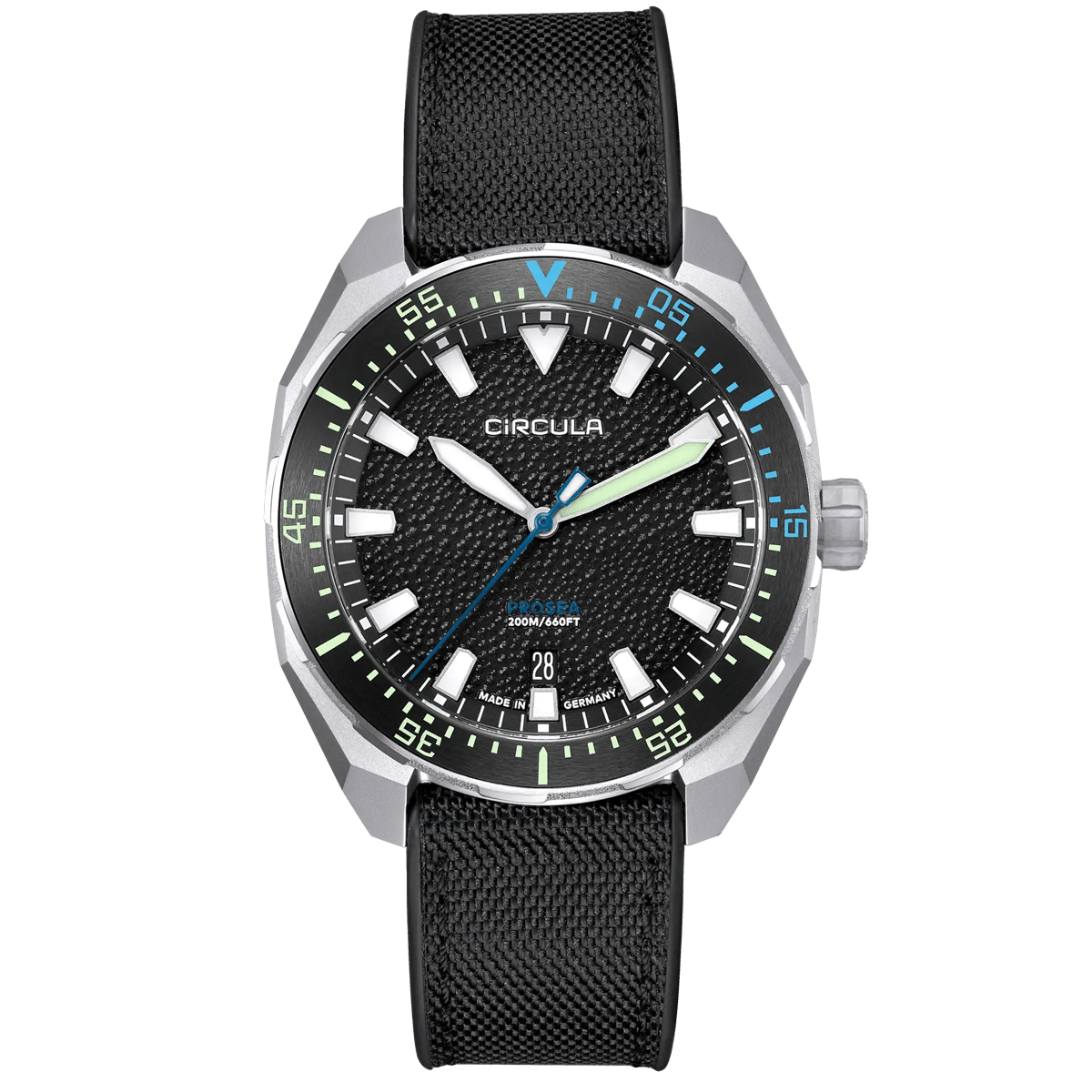
A Name from Pforzheim
Circula was founded in 1955 in Pforzheim, the Baden-Württemberg city that has been the centre of German jewellery and small-scale precision manufacturing since the eighteenth century. The original company built watches for a domestic market that was, in the post-war decades, both large and demanding. Like many mid-century German houses, it faded as quartz arrived and the industry consolidated.
The revival came in 2018, when Cornelius Huber — a descendant of the founding family — brought the name back with a small, tightly focused collection. The positioning was clear from the start: German assembly, Swiss movements, materials that punch above the price, and designs that reference the mid-century archive without cosplaying it. The ProTrail established the formula in the field-watch idiom. The ProSea applies it to diving.
That matters for how you read this watch. A revived brand has no heritage to coast on; it has to earn credibility with every case, every bezel action, every screw. Circula's answer has been to keep the range small and the specification consistent — Sellita movements, sapphire crystals, screw-down crowns, and German final assembly.
Case and Bezel
The ProSea's case is stainless steel, and it is finished in the two-tone manner that good tool watches have used for decades: brushed surfaces where the wrist and the eye meet, polished chamfers where a light-catching edge is wanted. The brushing is fine and even, the kind that reads as satin rather than scratch-prone coarseness. The lugs are drilled, which is a small thing that experienced collectors notice immediately — it makes strap changes a two-minute job with a spring-bar tool rather than a wrestling match.
The bezel is unidirectional and coin-edged, with a grip that is positive without being aggressive. The insert carries the usual dive-scale markings and a luminous pip at twelve. Rotation is crisp, with the kind of defined detents that suggest a properly tensioned spring rather than a decorative ring. This is one of the places where inexpensive divers most often betray themselves, and the ProSea does not.
The crystal is sapphire, with anti-reflective treatment that keeps the dial readable under bright overhead light without the blue haze that heavy coating can produce. The caseback is solid and screws down — no exhibition window here, which is the correct decision at this price. The crown is screw-down and sits at three o'clock, with enough crown-guard protection to keep it out of trouble without making it difficult to grip.
The Dial
Circula has kept the ProSea's dial disciplined. Applied indices, faceted enough to catch light at an angle, filled with luminous compound and framed in polished metal. The hour and minute hands are broad and unmistakably directional — the sort of handset you can read at a glance in murky water or in the half-light of an aircraft cabin. The seconds hand carries a luminous counterweight, a detail that costs almost nothing and improves legibility considerably.
The date sits at three o'clock in a framed aperture. It is not the most elegant solution — a no-date dial would be cleaner, and there are collectors who will say so — but a date is genuinely useful on a daily wearer, and the execution here is tidy rather than intrusive. The dial surface itself is restrained, with the kind of depth that comes from careful printing and applied furniture rather than from texture for its own sake.
Luminescence is Super-LumiNova, applied generously to the indices, hands and bezel pip. In practice it charges quickly under a few seconds of direct light and remains legible through the night. It is not the brightest compound on the market, but it is consistent, and consistency matters more than peak output when you are actually using the watch.
Movement: Sellita SW 200-1
Inside is a Sellita SW 200-1, the Swiss automatic that has become the default answer for small brands that want a reliable, serviceable, well-understood movement without paying for a manufacture calibre. It is a direct descendant of the ETA 2824 architecture, and that lineage is its greatest strength: any competent watchmaker anywhere in the world has the parts, the tools and the experience to work on it.
The specification is unremarkable in the best sense. Twenty-six jewels, a frequency of 28,800 vibrations per hour, a power reserve of around 38 hours, and a date function. Winding is bidirectional via a central rotor. The finishing is industrial — rhodium-plated bridges, circular graining, a decorated oscillating weight — and entirely appropriate. Nobody buys a ProSea for the view through a caseback, and Circula sensibly does not pretend otherwise by fitting one.
What the SW 200-1 gives the owner is predictability. It is not a movement that will surprise you, and in a dive watch that is a virtue. The trade-off is the power reserve: 38 hours is adequate for a watch worn daily but unforgiving if you rotate your collection. Leave the ProSea in the box over a long weekend and it will need setting on Monday morning.
On the Wrist
The ProSea wears like a watch designed by someone who actually wears watches. The case sits low and close to the wrist rather than perching on top of it, and the lugs curve down steeply enough that the watch stays put through the day. There is no sense of the head tipping forward or of the crown digging into the back of the hand — two of the most common failures in this segment.
Weight is moderate. Stainless steel on a full bracelet is never going to disappear, but the ProSea's proportions and the taper of its bracelet keep it from feeling like ballast. The bracelet articulates smoothly, with links that fold rather than hinge awkwardly, and the clasp closes with a reassuring click. On a rubber strap the watch becomes noticeably lighter and, for most owners, more comfortable in heat and water — which is worth considering, since a diver on rubber is the more honest configuration.
Balance is the thing that impresses most. The watch does not feel front-heavy, and it does not slide around the wrist during activity. That is harder to achieve than it sounds, and it is the difference between a watch you wear and a watch you merely own.
Accuracy
The SW 200-1 is a robust, well-regulated movement when it is set up properly, and Circula's examples generally arrive running within a handful of seconds a day. Expect something in the region of plus or minus ten seconds per day out of the box, with well-settled examples doing considerably better. There is no chronometer certification here, and Circula does not claim one.
In daily use, the practical story is simple: the ProSea keeps time well enough that you will not think about it. If you are the sort of collector who times a watch against a reference clock every morning, you will find it competes with far more expensive automatics. If you are the sort who sets it once a week, you will never notice the difference.
Pricing and Value
The ProSea sits in the low four figures in US dollars — roughly the same territory as a Christopher Ward C60 Trident Pro, an Oris Aquis Date, or a Longines HydroConquest. That is a crowded and competitive bracket, and it is worth being clear about what you are buying.
What you get is German assembly, a Swiss movement with global serviceability, sapphire crystal, a properly engineered bezel, drilled lugs and a bracelet that does not feel like an afterthought. What you do not get is a manufacture movement, a famous name on the dial, or the residual value that comes with either. The ProSea is a watch you buy to wear, not to flip.
On the secondary market, Circula's models trade below retail, as do most watches in this bracket. Expect to find used examples at a meaningful discount to list, and expect to wait for one to appear. That is not a criticism of the watch; it is simply the reality of buying from a small independent.
Alternatives Worth Considering
If you are shopping in this bracket, the Christopher Ward C60 Trident Pro offers a similar specification with a British design brief and a very strong bracelet. The Oris Aquis Date brings a genuinely distinctive case architecture and a longer brand history in diving. The Longines HydroConquest carries the weight of a name with real horological provenance and a wide service network. The Tudor Black Bay 58, at roughly double the money, is the benchmark against which everything in this segment is measured — and the ProSea does not embarrass itself in that comparison, which is a compliment worth stating plainly.
Below the ProSea, the Seiko Prospex range, the Orient Kamasu and even the humble Casio Duro deliver genuine dive-watch capability for less. They are not the same watch, and the differences show in the bezel action, the crystal and the finishing. But they are honest tools, and worth knowing about before you commit.
Variants and the Family
The reference PS-SH-BB designates the configuration reviewed here. Circula has periodically offered the ProSea with alternative dial colours and on rubber, each under its own reference, and the brand's wider sport line — the ProTrail among them — shares the same philosophy of Swiss movement, German assembly and restrained design.
That consistency is worth noting. Buying into a small brand is a bet on the people running it, and Circula's catalogue reads as though it was assembled by someone with a clear idea of what the brand should be. The ProSea is not an outlier in the range; it is the range's logic applied to water.
Service and Ownership
Ownership is one of the ProSea's quiet advantages. The Sellita SW 200-1 is one of the most widely serviced movements in the world. Any competent independent watchmaker can strip, clean and rebuild it, and parts are readily available through normal supply channels. You are not locked into a single service centre, and you are not paying manufacture prices for routine maintenance.
Circula itself supports its watches from Germany, and the brand's small scale means correspondence is with people who actually know the product. For a collector used to the anonymity of large-group service departments, that is a genuine pleasure — and it is part of what you are buying when you choose a small house over a conglomerate.
Verdict
The Circula ProSea is not a watch that will impress anyone who reads only dials. It is a watch that impresses people who look at bezel action, lug drilling, bracelet taper and movement choice — the unglamorous details that determine whether a watch is worth owning after the first month.
It is well made, sensibly specified, honestly priced and easy to live with. If you want a diver you can swim in, travel with and hand to a watchmaker without anxiety, the ProSea deserves a serious look. If you want a status object, buy something else — and the ProSea's makers would probably agree with you.