The Blue Orca, Named
Dive watches accumulate nicknames the way working boats accumulate paint. Seiko gave us the Turtle, the Monster and the Tuna. Citizen, which has been building professional dive watches since the 1960s, has its own folklore — and among the blue-dialed references in the Promaster Diver family, one has settled into collector shorthand as the Blue Orca. The name stuck not because of any marketing campaign, but because enthusiasts needed a way to talk about a specific configuration in a lineup that spans dozens of references across several dial colours and strap options.
What the nickname describes is a light-powered quartz diver from a manufacturer that has been making watches in Japan since 1918. There is no romance in that sentence, and that is precisely the point. The Blue Orca is not a watch you wind, not a watch you admire through a sapphire display back, and not a watch that will ever be discussed at auction. It is a watch you put on and forget about — which, as any engineer will tell you, is a considerably harder problem to solve than it sounds.
This review covers the movement architecture, the case and its finishing, how the watch actually wears over a full day, what real-world accuracy looks like in practice, and whether it earns a place in a considered young collection.
Citizen and the Promaster Line
Citizen Watch Co. traces its origins to the Shokosha Watch Research Institute, founded in Tokyo in 1918. The Citizen name arrived in 1924, and the company was formally incorporated in 1930. Over the following decades it became one of the most vertically integrated watchmakers in the world, producing its own movements, cases, dials and — critically for this review — its own quartz oscillators and integrated circuits. Very few manufacturers of any size can make that claim.
The Promaster banner was raised in 1989 as an umbrella for Citizen's instrument watches: dive, aviation and land. The dive segment is the one that matters here. Citizen's professional divers have long been defined by a particular set of priorities — legibility, durability and a refusal to charge for decoration. The Promaster Diver line continues that tradition in a package that costs less than a single service on a Swiss automatic.
Movement: Eco-Drive, Explained Without Apology
The Blue Orca runs on Citizen's Eco-Drive system, which is best understood as a quartz movement that has solved the battery problem. Instead of a disposable cell, an amorphous silicon photovoltaic ring sits beneath the dial and converts light — any light, artificial included — into electrical energy stored in a rechargeable cell. The watch charges while you wear it and holds its charge for months when you do not.
The architecture is quartz at its core: a 32,768 Hz oscillator, a divider circuit, a stepping motor and a date mechanism. What distinguishes it is that Citizen builds every one of those components in-house, from the crystal oscillator to the integrated circuit to the motor. That level of vertical integration is the quiet justification for the movement's reputation, and it is why Eco-Drive watches have survived decades of hard use in conditions that would embarrass far more expensive hardware.
Finishing, as you would expect, is industrial. There is no perlage, no anglage, no blued screws — because there is no display back, and because none of it would survive the design brief. This is a movement specified for a decade of indifferent treatment in salt water and sunlight, and judged against that brief it is close to flawless.
Power reserve on a full charge is measured in months rather than hours. Frequency is the standard quartz 32,768 Hz. There are no jewels worth counting and no complications beyond the date. It is not COSC certified, and it does not need to be — chronometer certification is a mechanical problem, and this is not a mechanical watch.
Case, Crystal and Finishing
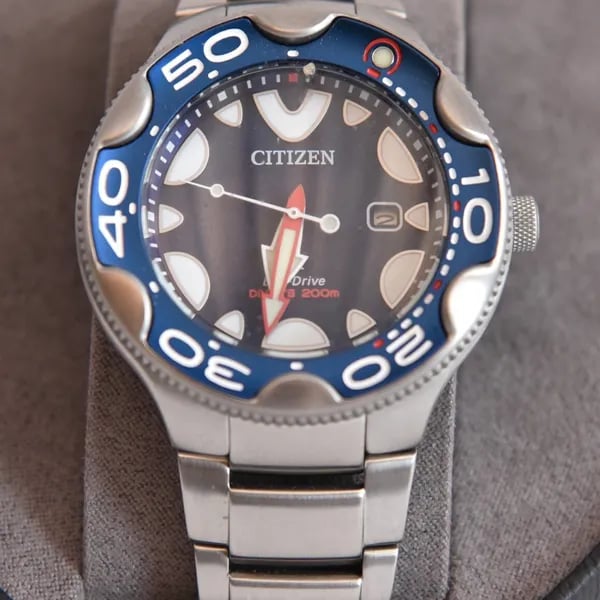
The case is stainless steel, with the broad, slightly asymmetric geometry that has defined Citizen's dive watches for a generation. The crown sits at four o'clock, tucked into a guard that keeps it clear of a wetsuit sleeve and, more practically, clear of the back of your hand. The bezel is unidirectional with a firm, positive click — not the buttery, over-damped action of a luxury diver, but the honest mechanical ratchet of a tool that expects to be turned with wet fingers.
The crystal is mineral. This is the single most contested specification on the watch. Mineral glass is more scratch-prone than sapphire, and on a watch intended for hard use it will eventually show it. It is also more shatter-resistant, which matters more than scratch resistance when you are knocking a bezel against a boat ladder. Citizen made a defensible engineering choice; whether you agree depends on whether you treat the watch as equipment or as jewellery.
Water resistance is rated to 200 metres, which places it squarely in the range of genuine recreational diving and far beyond anything most owners will ever ask of it. The finishing on the case is a mix of brushed surfaces with polished flanks — competent, consistent, and clearly produced by a manufacturer that has been stamping and machining cases at scale for a century.
The dial is where the Blue Orca earns its name. A deep blue surface — sunray-brushed on some references, matte on others — carries applied indices with a generous application of Citizen's proprietary luminous compound. Legibility is excellent in daylight and genuinely useful in darkness. The hands are broad and sword-shaped, with luminous fill that reaches the very tip. There is no ambiguity here, no design gesture that compromises reading the time at a glance. In a category where legibility is the entire point, the Blue Orca does not negotiate.
On the Wrist
A dive watch lives or dies by how it carries its mass, and the Blue Orca carries it low. The case sits close to the wrist, and because the crown is recessed at four o'clock there is no pressure point against the back of the hand during flexion. The bracelet — a three-link stainless design closed by a folding clasp — is functional rather than luxurious. The links are solid, the tolerances are tight, and the clasp does its job without drama. It will not be mistaken for a Swiss bracelet costing three times as much, but neither will it rattle or loosen over time.
Owners who prefer rubber will find the case equally at home on polyurethane, and the lug geometry accepts a wide range of aftermarket straps — a meaningful advantage at this price, since you can change the watch's character for the cost of a decent dinner. On rubber it reads as pure tool; on steel it reads as a slightly more serious everyday watch.
Weight is substantial without being fatiguing. The watch announces itself on the wrist and never disappears under a cuff, but it does not become a burden over a long day. The balance point is well judged, with the case head sitting centered rather than tipping forward on the wrist — a detail that separates a well-designed diver from a case that simply looks the part.
Accuracy and Day-to-Day Ownership
Eco-Drive quartz movements are typically rated to within roughly fifteen seconds per month. In practice, many examples run considerably better than that, and — crucially — the rate is stable. A mechanical watch varies with position, temperature and state of wind; a quartz movement does not. You set the Blue Orca once, then correct it only when the date needs adjusting at the end of a short month.
The ownership experience is defined by absence. There is no winding ritual, no power reserve to monitor, no fear of leaving it on a dresser for a fortnight. Light is abundant; the watch will find it. For a collector with several watches in rotation, this is a genuine practical advantage — the Blue Orca is always ready, which is more than can be said for most of the mechanical pieces it will sit beside.
The trade-off is emotional. There is no escapement to listen to, no rotor to feel spinning up, no sense that a human hand regulated this particular movement. If that matters to you — and for many collectors it does — the Blue Orca will never satisfy the itch. If it does not, the watch is simply better at being a watch.
The Case for Quartz in a Collector's Box
There is a persistent assumption among young collectors that a serious collection must be entirely mechanical. It is worth pushing back on. A mechanical watch is a beautiful solution to a problem that was solved more accurately and more cheaply by quartz in the 1970s. Owning one is a choice about values, not about performance. Owning a quartz watch alongside them is an acknowledgement that the values you are choosing are not the only ones that matter.
The Blue Orca is the argument for that position. It takes no space in your head, requires no planning, and delivers the time with more consistency than anything else in the box. Used properly, it makes the mechanical pieces more enjoyable rather than less, because it removes the low-grade anxiety of resetting and rewinding them every time you reach for one.
Variants and the Wider Family
The Blue Orca is best understood as a configuration rather than a single SKU. The Promaster Diver family spans black, blue and green dials, on bracelets and on rubber, with the same case architecture and the same Eco-Drive heart throughout. The blue-dial reference is the one that has attracted the nickname; the black-dial sibling is the same watch in a more sober suit.
The wider Promaster family includes the mechanical Fugu references, which offer an automatic alternative in a similar case, and the oversized Ecozilla, a 300-metre professional diver that makes the Blue Orca look restrained. Above these sit Citizen's Chronomaster and Series 8 lines, where the brand applies its most advanced finishing and its highest-accuracy quartz technology — a useful reminder that Citizen's ambitions run considerably higher than its price tags usually suggest.
Alternatives Worth Considering
At this price the competitive set is crowded and largely Japanese. Seiko's Prospex divers offer an automatic movement and a comparable sense of purpose, at the cost of accuracy and service complexity. Orient's Kamasu delivers an in-house automatic and a sapphire crystal for similar money, though its case finishing is a step behind. Casio's Duro remains the budget benchmark — quartz, 200 metres, and a price that makes the whole conversation slightly absurd.
If you want a Swiss name on the dial, Tissot's quartz Seastar line offers comparable specifications with a more formal case and a sapphire crystal. None of these watches is better than the Blue Orca at the specific job the Blue Orca was designed to do. Several of them are more interesting — and that is a distinction worth holding onto when you decide what to buy.
Value, Investment and Service
The Blue Orca is not an investment, and anyone who tells you otherwise is selling something. Mass-produced quartz dive watches depreciate from the moment the box is opened, and this one is no exception. Secondary market pricing typically lands well below retail, which is good news if you are buying and irrelevant if you are selling.
What the price buys is a genuinely over-engineered instrument from a manufacturer with total control over its supply chain. What it does not buy is scarcity, auction heritage, or the tactile reward of a mechanical movement. Buy it because you want a watch that works every single day without being asked; do not buy it expecting it to appreciate.
Service is a non-issue. Eco-Drive watches run for years without intervention, and when the energy cell eventually degrades, Citizen's service network and independent watchmakers alike can handle replacement at modest cost. There is no complicated automatic winding system to overhaul and no lubrication schedule to observe. The cost of ownership over a decade is, by the standards of this hobby, almost embarrassingly low.
The Verdict
The Citizen Blue Orca is a watch that refuses to pretend. It does not dress itself in the language of haute horlogerie, does not offer a display back to show finishing that is not there, and does not ask you to wind it. What it offers instead is a light-powered in-house movement, 200 metres of water resistance, and a legible, purposeful dial — all for less than the cost of a routine service on a Swiss automatic.
For a young collector building a rotation, that makes it close to indispensable. It is the watch you wear when you do not want to think about your watch, and it will still be running — accurately — long after more romantic pieces have gone back to the workshop. The Blue Orca is not the most exciting watch you will own. It may well be the most reliable, and there is a case to be made that reliability is the more valuable virtue.