The blazer-and-brine problem
Most dive watches are built for a fantasy. You are not going to 300 metres, you are not going to decompress, and the rotating bezel on your wrist is mostly a fidget toy. Corum, to its credit, has never really played that game. The Admiral's Cup line was never a dive watch pretending to be a tool — it was a regatta watch, which is a very different animal. Regatta watches are about timing starts, reading conditions, and looking correct on a pontoon in Cowes. They are social instruments as much as nautical ones.
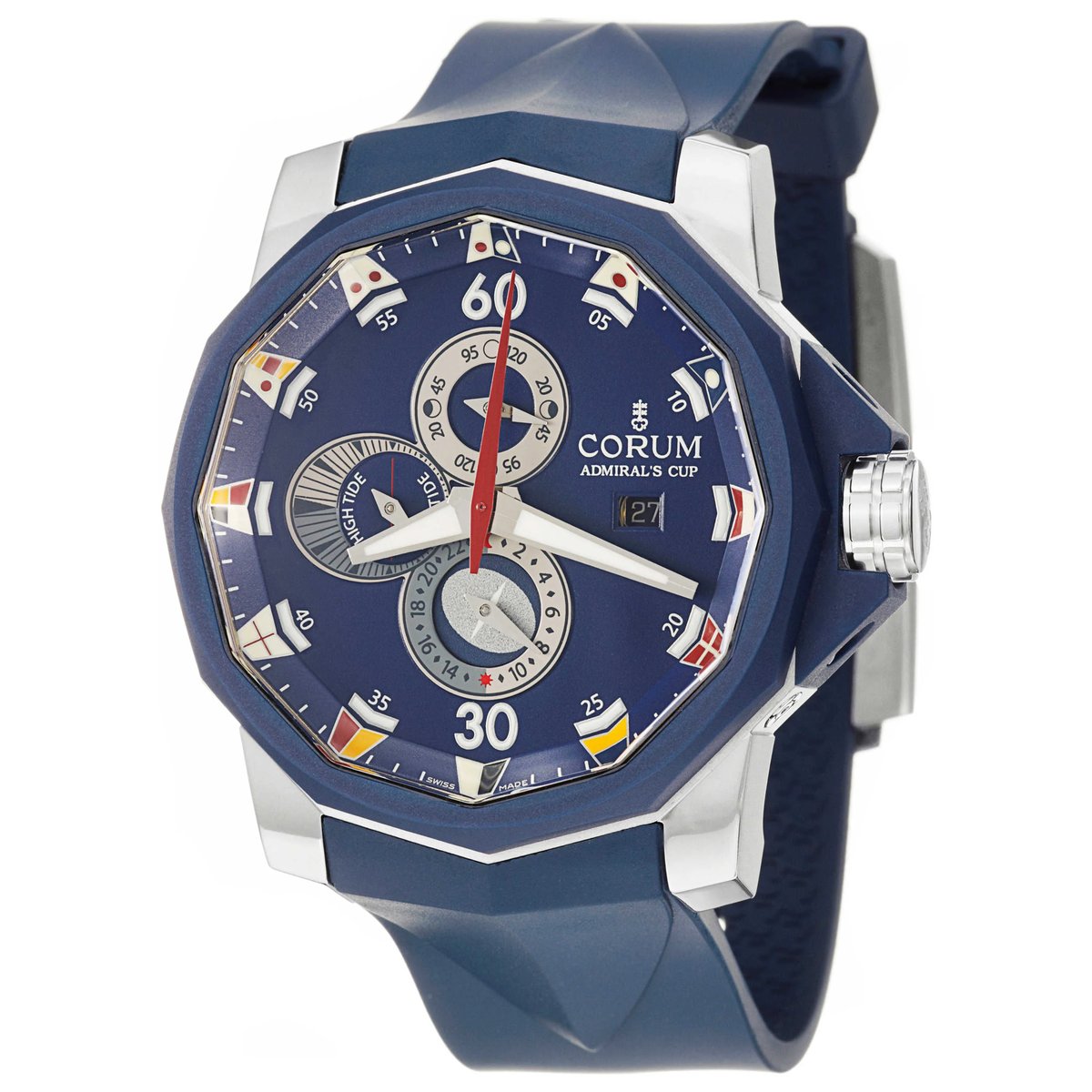
The Corum Admiral Tides, reference 977.630.20, leans all the way into that. It is a big, confident sports watch with a twelve-sided bezel, applique pennant markers standing in for numerals, and a tide indication that actually does something. It is not subtle. It is not trying to be subtle. And in a market where every other steel sports watch is chasing the same integrated-bracelet silhouette, that counts for something.
This is a review for people who already own a Submariner or an Aqua Terra and are wondering what else is out there. The Tides is not a better watch than those. It is a stranger one, and strange has value.
Twelve pennants and a grudge
Corum was founded in La Chaux-de-Fonds in 1955, and for most of its history it has been a house of gimmicks in the best sense — the Golden Bridge, the Bubble, the Rolls-Royce grille watch. The Admiral's Cup arrived in 1960, named for the Cowes regatta that was then the centre of the offshore sailing universe. For two decades it was a fairly conventional sports watch. Then, in the early 1980s, Corum did something that turned out to be permanent: it gave the Admiral's Cup a dodecagonal bezel and replaced the hour numerals with the International Code of Signals pennants.
That decision should have dated badly. Instead it became the whole identity. The pennants are why people recognise an Admiral's Cup from twenty feet away, and they are why the line has survived repeated reinventions, ownership changes and the general churn of the Swiss industry. Corum has been through a lot since the 1980s — different owners, different strategies, a long stretch where the Admiral's Cup carried the brand almost single-handedly. The pennant dial is the one constant.
The Tides variant takes that design language and adds the complication that makes the maritime theme literal rather than decorative. It is the most on-brand watch Corum makes, which is saying something for a company that also builds a movement shaped like a suspension bridge.
What a tide dial actually does
Here is the thing most people get wrong about tide watches: they are not forecasting anything. Tides are driven by the gravitational relationship between the Earth, the Moon and the Sun, and they are broadly predictable — which means a mechanical tide indicator is essentially a very slow astronomical calendar. The Tides tracks that cycle and displays where you are in it, so a glance at the dial tells you roughly how far you are from high or low water.
In practice, this is a watch for people who live near a coast, sail, fish, or surf. If you fall into one of those categories, the tide indication is genuinely useful — not in a life-or-death way, but in the same way a moonphase is useful to a gardener. It gives you a read on the world outside your window. If you live in a city and your relationship with the sea is limited to a summer holiday, it is theatre. But it is good theatre, and it is theatre that requires actual mechanical engineering rather than a printed dial.
The rest of the dial is standard Admiral's Cup: a date function, applied pennant markers, and a layout that prioritises legibility from a distance over subtlety up close. The hands are broad and readable. The whole thing is designed to be glanced at, not studied.
The engine room
Corum has never been precious about movement provenance, and the Tides follows that pattern. What you get is a conventional Swiss automatic — a supplied base calibre — with a tide module layered on top. Corum does not publish a single public calibre designation for this reference, and it does not submit the watch for COSC certification, so the honest answer to the movement question is that the specification sheet is thinner than the price tag once suggested.
That said, the practical reality is fine. A well-made Swiss automatic with a module is a known quantity: serviceable, reasonably robust, and accurate enough for daily life. Expect it to hold within roughly ten seconds a day in normal wear, with the usual positional variation. If you want tighter, a watchmaker can regulate it. The tide indication itself is not a chronometric function — it tracks a cycle, and small drift over weeks is normal and easy to correct.
The real caveat is service. The tide module is specialist territory, and parts access is not widely distributed to independent watchmakers. Plan on Corum's authorised network rather than your local guy, and budget accordingly. This is not a watch you buy and forget about for a decade.
On the wrist
The Tides is not a shrinking violet. The dodecagonal bezel, the broad lugs and the layered dial assembly give it real visual mass, and it sits on the wrist like something designed to be seen from the back of a boat. The rubber strap helps more than you would expect — it hugs rather than slides, and it stops the watch from feeling like a paperweight. Balance is good for a case this assertive, though the caseback sits proud enough that you will notice it against a tight shirt cuff.
On a smaller wrist it reads as a statement piece, which is fine, because the Admiral's Cup has never pretended to be discreet. The curved lugs pull the case down onto the wrist reasonably well, and the strap taper keeps the visual weight from spilling over the edges. If you are coming from slim dress watches, give it a week. If you wear divers or Panerais, you will feel at home on day one.
The one thing to think about is the bracelet-versus-strap question. The rubber is the more coherent choice — it suits the nautical brief, it is comfortable, and it keeps the watch from tipping into dress-watch territory it has no business occupying. A leather strap on this watch feels like a necktie on a lifeguard.
Living with it
Day to day, the Tides is an easy watch to own and a slightly awkward watch to explain. The tide indication invites questions, and the pennant markers invite more. That is either the point or the problem, depending on your personality. It is not a watch for someone who wants to blend in at a board meeting.
It is, however, a genuinely good travel watch. The tide function is a small piece of home you can carry to any coastline, and the case is robust enough to survive a holiday without anxiety. It works with a t-shirt and it works with a linen shirt, which is more than most sports watches can claim.
What it is not is a formal watch. The case is too tall, the dial too loud, and the whole thing too obviously designed for salt air. If you need one watch for everything, this is not it. If you need a second or third watch that does something none of your others do, it is a strong candidate.
The market
Here is where the Tides requires a clear head. Corum's secondary market is soft, and the Admiral's Cup in particular has never attracted the collector premium that its design originality arguably deserves. Original retail on this reference sat in the high four figures; pre-owned examples now trade in a broad band that puts them within reach of anyone considering a mid-range Swiss sports watch.
That is good news if you are buying and bad news if you are selling. The Tides is a depreciating asset in the literal sense — it will be worth less next year than this year, and the tide function, however charming, does not change that. Auction records are essentially non-existent for this reference, which tells you everything about its standing in the collector hierarchy.
The correct framing is this: you are buying a well-made, unusual, genuinely functional watch at a discount to its original price. That is a perfectly rational transaction. What you are not doing is making an investment. Buy it to wear, keep the box and papers if you can, and accept that resale will be a negotiation rather than a transaction.
Three alternatives worth considering
If you want the nautical-luxury brief without the servicing complications, the Omega Seamaster Aqua Terra is the obvious answer. It is better finished, better supported, and it holds value in a way Corum simply does not. The IWC Portugieser Yacht Club is the more polished sailing-club option, and it wears smaller than its dimensions suggest. And if what you actually want is a serious tool watch with genuine water credibility, the Blancpain Fifty Fathoms is the real thing rather than a themed one.
For pure value and liquidity, the Tudor Black Bay remains the answer to almost every question in this price bracket. It will not give you a tide dial, but it will give you a watch you can sell in a week.
The verdict
The Corum Admiral Tides is a watch for people who already own the sensible stuff and want something with a point of view. The tide indicator is a real function rather than a decorative flourish, the pennant dial is unmistakable, and the pre-owned entry point makes an oddball complication surprisingly reachable. It is comfortable, robust, and completely unembarrassed about what it is.
Go in knowing that Corum's resale curve is unkind and that service will be a specialist job. If you can live with those two facts, the Tides delivers something the mainstream Swiss sports watch market has largely stopped offering: genuine eccentricity, backed by genuine engineering.