Corum Bridges Titanium ref. 113.700.94/0001 0000
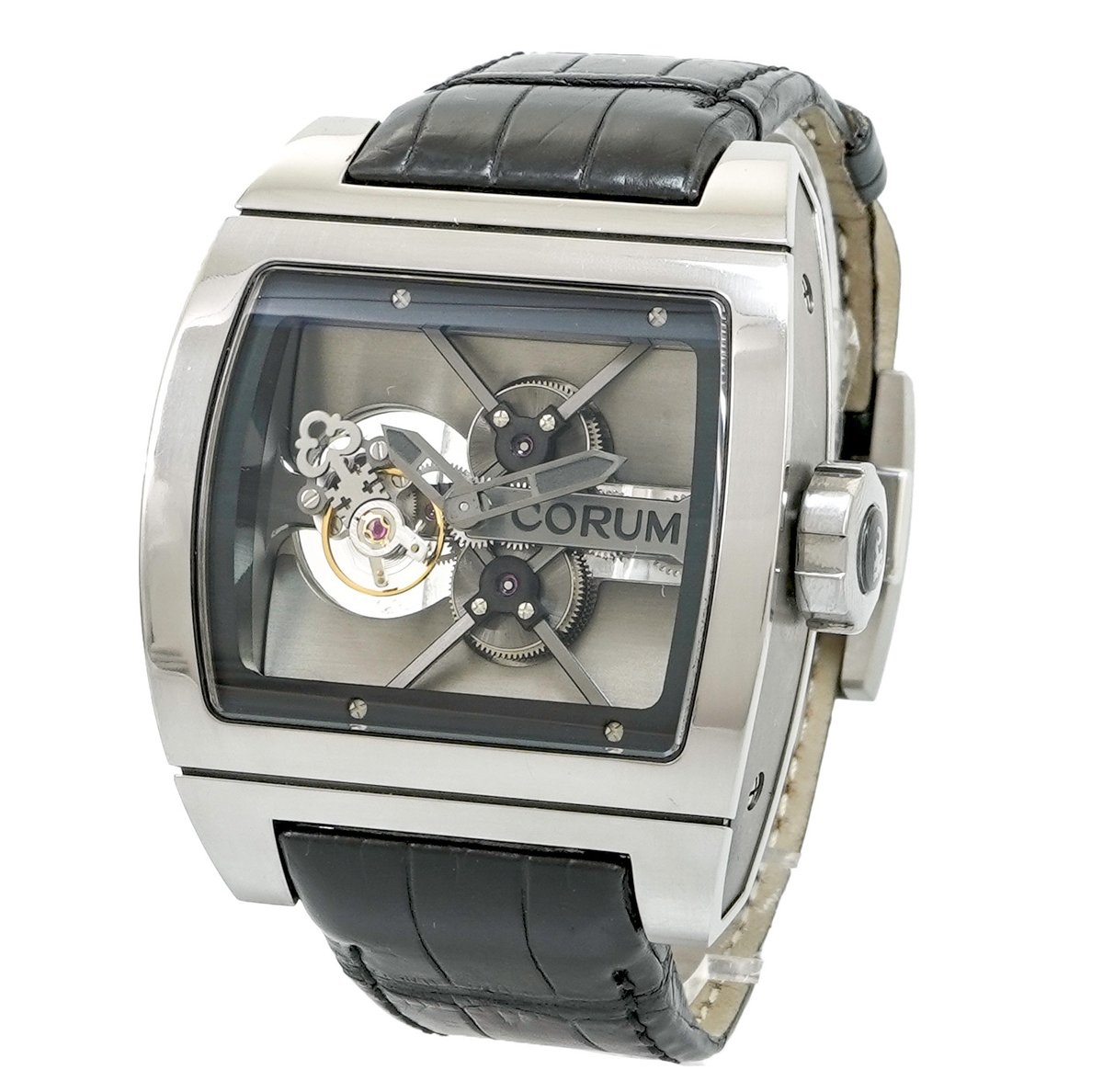
Some watches ask to be read at a glance. The Corum Bridges Titanium asks to be looked into. With its baguette movement suspended across an open dial, it is less a conventional timepiece than a piece of mechanical architecture strapped to the wrist. The reference 113.700.94/0001 0000 is the titanium expression of that idea: a 43mm round case, a black rubber strap, and Corum's signature linear calibre at the centre of the experience. It is not subtle, but it is surprisingly wearable.
This review is written from the perspective of daily wear. I care less about the poetry of the bridge and more about whether the watch disappears under a cuff, whether the strap irritates in heat, whether the time is readable in a restaurant, and whether the manual-wind ritual becomes a pleasure or a chore. The Bridges is a specialist object, but it can still be judged as a watch you actually put on.
Brand history and the Bridges idea
Corum was founded in 1955 in La Chaux-de-Fonds, Switzerland, by Gaston Ries and René Bannwart. The brand built its reputation on bold, sometimes eccentric ideas: the Admiral's Cup with its nautical pennants, the Coin Watch that hid a movement inside a gold coin, and the Golden Bridge, which placed a baguette-shaped movement inside a transparent rectangular case. That Golden Bridge, introduced in 1980, is the ancestor of the watch reviewed here. It proved that a movement could be the dial.
The Bridges collection takes that linear architecture and opens it up further. Where the Golden Bridge is often a rectangular dress watch with a single visible bridge, the Bridges family gives the movement more air and a round case. The result is a watch that feels like a display case for Corum's horological signature. The titanium reference 113.700.94/0001 0000 is one of the more everyday-friendly expressions of that idea, thanks to its lighter case and rubber strap.
The movement: a baguette on the wrist
The calibre is Corum's CO 113, a manual-wind baguette movement with a 40-hour power reserve and a frequency of 21,600 vibrations per hour. It is not a conventional round movement tucked behind a dial; it is a long, linear engine that runs vertically across the watch. The bridges, gears, and mainspring barrel are part of the visual composition. Winding it is a deliberate act, and because there is no rotor, the view stays clean and symmetrical.
The CO 113 is not COSC-certified, and that is fine. This is not a watch bought for chronometer paperwork. It is bought for the way the movement looks and the way it makes you interact with the watch. The finishing is industrial in the best sense: brushed surfaces, visible screws, and a sense of structure rather than decoration. It is in-house by Corum, which matters in a category where many skeleton watches use bought-in ébauches. The lack of a date and the absence of lume keep the dial pure, but they also define the watch's limitations.
Case, crystal, and strap: what you actually touch
The case is titanium, and that is the single biggest reason this Bridges works as a daily wearer. Titanium gives the watch a muted, slightly grey tone and, more importantly, keeps the weight down. On a watch with this much visual business, a heavy case would make it feel like a brick. The titanium case makes it feel like a tool for looking at, not a burden. The crystal is sapphire, which is what you want on a watch at this level. Water resistance is rated to 30 metres, so it is safe for rain and handwashing but not for swimming.
The strap is black rubber, and the clasp is a pin buckle. This is a smart pairing. A leather strap would make the Bridges feel more formal but also more precious; rubber makes it feel like something you can wear on a warm day without worrying about sweat. The pin buckle is simple and keeps the weight down. The overall package is not a bracelet watch, and that is a good thing. The open dial needs air around it, and a rubber strap gives the case room to breathe on the wrist.
Wrist feel and daily wear
At 43mm across, the Bridges Titanium has real presence, but it does not wear like a heavy 43mm sports watch. The titanium case is light, and the rubber strap hugs the wrist rather than sitting on top of it. The watch feels balanced, with most of the mass close to the wrist. It slips under a shirt cuff more easily than you might expect from a skeleton watch, though the open dial means it never disappears visually. You will notice it, and so will other people.
The manual-wind ritual is part of the ownership experience. With a 40-hour power reserve, you need to wind it every day or two if you want it to keep running. Some people find that annoying; others find it charming. I fall into the latter camp, but only because the winding action is smooth and the view of the movement makes it feel purposeful. If you are someone who wants to pick up a watch after a week and have it running, this is not that watch. If you enjoy a morning ritual, it is.
Comfort is helped by the lack of a date and the absence of lume. There is nothing to poke into the wrist, and the caseback sits flat enough to avoid hot spots. The rubber strap is soft and flexible, and the pin buckle is easy to adjust. In hot weather, the rubber can trap a little moisture, but it is far more forgiving than leather. For a watch with this much visual complexity, the physical experience is surprisingly simple.
Legibility, accuracy, and living with it
Let's be clear: the Bridges is not a legibility champion. The hands are skeletonised, the dial is open, and there is no lume. In daylight, the time is readable enough once your eye learns to separate the hands from the movement. In low light, you will struggle. This is a watch for dinners, offices, galleries, and weekends in the city, not for reading in a dark cinema or checking the time on a night flight. If legibility is your priority, look elsewhere.
Accuracy is typical for a non-certified manual-wind calibre. The CO 113 is not a high-frequency movement, and it is not designed for chronometer-grade precision. Real-world examples generally keep time within a handful of seconds per day, but you should expect some variation depending on position and winding. The 40-hour power reserve means that if you wind it at the same time each morning, it will be consistent. If you let it run down, you will need to reset it. There is no date to set, which makes that process quicker.
Living with the watch is a study in trade-offs. You give up lume, a date, automatic convenience, and water resistance beyond the basics. You get a movement that is genuinely interesting to look at, a case that is light and comfortable, and a watch that starts conversations. The Bridges is not a one-watch collection for most people, but it is a very good second or third watch for someone who wants something different.
Occasions and wrist presence
The Bridges Titanium is best suited to formal and dress occasions, but it can also work as a daily watch if your daily life is not too rough. It looks excellent with a suit because the open dial gives a flash of mechanical detail without being flashy in a precious-metal way. It also works with smart casual: a dark shirt, a jacket, and the rubber strap keep it from feeling too precious. I would not wear it for sport, and I would not take it swimming. Travel is possible, but the lack of lume and the manual wind make it less practical than a GMT or a dive watch.
On the wrist, the presence is strong. The 43mm case and the open dial make it a watch that people notice, even if they do not know what they are looking at. It has a sculptural quality that reads well from across a table. I would rate the wrist presence at 4 out of 5. It is not a subtle watch, but it is not oversized or aggressive either. It has confidence without shouting.
Variants, family, and alternatives
Corum has offered the Bridges in other materials and finishes, including precious metals and different strap combinations. This review focuses on the titanium reference 113.700.94/0001 0000 because it is the most wear-focused version. If you want more shine, a gold Bridges will deliver it, but it will also be heavier and more expensive. The titanium version is the one I would choose for regular wear.
Within the family, the Golden Bridge is the direct ancestor: a rectangular case with a baguette movement and a more formal attitude. The Golden Bridge Round 43 takes that idea into a round case, and the Bridges 43 is the broader collection that includes this titanium model. Other notable Corum models include the Admiral's Cup, the Coin Watch, the Bubble, and the Heritage collection. Each has its own character, but none shares the Bridges' specific architectural focus.
If you like the idea of a skeleton watch but want something more conventional, the Girard-Perregaux Bridges is the obvious comparison. It also treats bridges as the main event, but it is a very different watch in both price and attitude. The Arnold & Son Nebula is another skeletonised in-house movement with a strong architectural presence. The Bell & Ross BR 05 Skeleton is a more industrial, everyday take on the open dial. None of these is a direct substitute, but they occupy the same mental space.
For a more affordable alternative, the Orient Classic Skeleton offers an openworked dial and a mechanical movement at a fraction of the price. It does not have the baguette architecture or the titanium case, but it captures the spirit of a skeleton watch you can wear without fear. It is not a homage in the strict sense, but it is a sensible entry point for someone who likes the look and is not ready for the Corum.
Investment and service
The Bridges Titanium is not an investment piece. Original retail was around the $10,500 mark, and pre-owned examples now trade in the $4,500 to $7,500 range depending on condition, box, and papers. The trend is depreciating, which is typical for a niche skeleton watch from a brand that is not at the centre of the collector market. If you buy one, buy it because you love the design. Do not buy it expecting it to appreciate.
Service is a specialist matter. The baguette movement is not something every watchmaker sees, and the open construction means there is little room for error. Use a Corum-authorised service centre. I would not take this watch to a generalist. The lack of a date and the simple time-only function keep the service scope relatively contained, but the architecture still demands care. Budget for it as part of ownership.
Final verdict
The Corum Bridges Titanium is not the easiest watch to read, the most practical watch to travel with, or the safest place to park capital. It is, however, one of the most distinctive daily-wear skeletons at its pre-owned price. The titanium case is light and comfortable, the rubber strap makes it wearable in real life, and the CO 113 movement gives you something to look at every time you check the time. If you want a watch that feels like a piece of architecture on the wrist, it delivers.
Buy it pre-owned, buy it because you love the baguette movement, and accept its limitations. Do that, and the Bridges Titanium is a rewarding companion. Expect it to start conversations, not to keep perfect time, and you will enjoy it for what it is: a wearable display case for one of watchmaking's most unusual movements.