A Shape First, a Watch Second
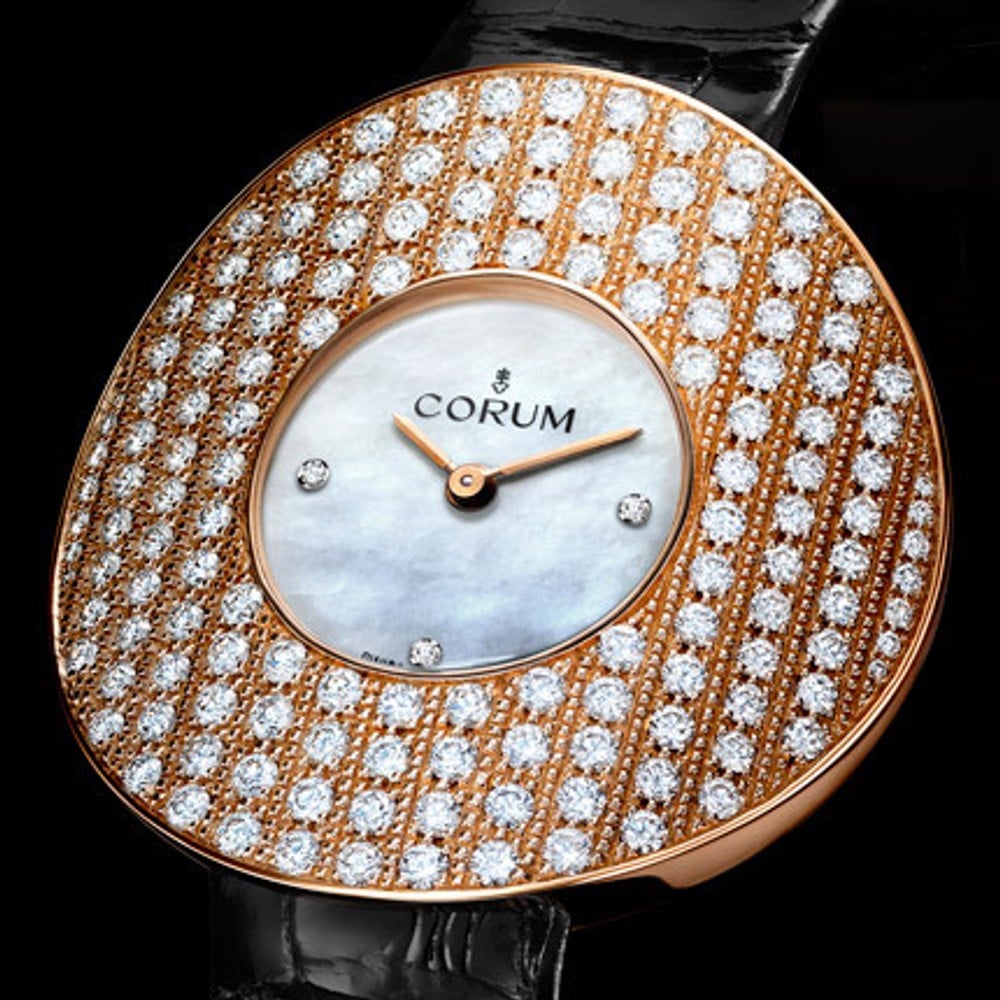
Corum has never been a house content to make a round watch and call it a day. From the Admiral's Cup's twelve-sided bezel to the Golden Bridge's exposed linear movement, the brand's identity was forged in the 1960s and 1970s on the conviction that a wristwatch could be a sculpture you wear. The Chinese Hat — catalogued here as reference 237.101.69/0081 PN01 — is one of the purest expressions of that conviction. Its case is a cone: a domed, tapering form that descends from a rounded crown to a wider base, the whole silhouette reading like the conical straw hat that gives the model its nickname.
This is not a watch that hides its intentions. Where most dress watches negotiate with the circle, the Chinese Hat simply declines the premise. The result is a piece that photographs like a design object and wears like a conversation. For the young collector who has already cycled through the usual suspects — the steel sports watch, the minimalist three-hander, the vintage chronograph — the Chinese Hat offers something increasingly rare: a genuinely unfamiliar silhouette from a recognized house, at a price that has not yet been colonized by the auction market.
What follows is a technical and practical appraisal: the case architecture, the movement inside, how it actually wears, and whether it deserves a place in a considered collection.
Corum: A House Built on the Unusual
Corum was founded in La Chaux-de-Fonds in 1955 by Gaston Ries and his nephew René Bannwart. Bannwart, a designer by training, gave the house its defining instinct: the watch as an object of wit and architecture rather than mere instrument. The Admiral's Cup, launched in 1960, put a twelve-sided bezel on a sports watch and made it a signature. The Coin Watch, introduced in the mid-1960s, split a gold coin and hid a movement inside. The Rolls-Royce grille watch and the Feather Watch followed in the 1970s, each a small act of horological theater.
The Chinese Hat belongs to that same lineage — the late-1970s and early-1980s period when Corum, like several Swiss houses, was experimenting with case geometry as a form of self-expression. It is a reminder that the brand's reputation was built not on vertical integration or movement manufacture but on design courage. That context matters when evaluating the Chinese Hat today: it is a design-led watch from a design-led house, and it should be judged on those terms.
There is also a practical dimension to this history. Because Corum was never a movement manufacturer in the modern sense, its vintage pieces are serviceable by a broad network of independent watchmakers rather than being captive to a single atelier. For a collector buying into a niche model, that independence is a quiet advantage.
The Case: Architecture of the Cone
The defining element is, of course, the case. The Chinese Hat's profile is conical — a rounded apex at the crown, flaring gently toward the base, with the dial set into the broader plane. The effect is soft rather than sharp; there are no hard facets here, only a continuous curve that catches light along its length. It is a form that reads differently from every angle, which is precisely the point.
The case is rendered in stainless steel, with the finishing kept restrained: polished surfaces that emphasize the curve rather than distract from it. A domed crystal follows the case's geometry, reinforcing the hat-like silhouette. The overall effect is of a single, continuous object rather than a collection of parts — the bezel, crystal, and case flow into one another without hard transitions.
Because the case is the entire argument, condition matters enormously on the secondary market. Polishing a conical case is not like polishing a round one: every pass of the wheel risks softening the very curve that defines the watch. A Chinese Hat with crisp, unpolished geometry is worth materially more than one that has been restored into a blob. Buyers should inspect the transition from the domed top to the flanks with particular care, and should be skeptical of any example that looks suspiciously smooth.
It is also worth noting what the case is not. It is not a tool watch case; there is no screw-down crown, no crown guards, and no meaningful water resistance to rely on. This is a dress object with a sense of humor, and it should be treated accordingly.
The Dial: Restraint as Strategy
The dial is deliberately quiet — a simple layout that lets the case do the talking. This is the correct decision. A busy dial inside a conical case would be a shouting match; Corum, to its credit, chose restraint. The dial's job is to be legible and to disappear into the architecture, and it performs that job without fuss.
That restraint also makes the Chinese Hat unusually versatile for a design-forward piece. It does not read as a novelty at a distance; it reads as a well-proportioned dress watch, and only reveals its strangeness up close. That duality — conservative at arm's length, radical at handshake distance — is part of its charm.
The Movement: A Workhorse Behind the Sculpture
Inside, the Chinese Hat carries an automatic movement of the period — a Swiss ébauche rather than an in-house calibre, which was entirely standard practice for Corum and most of its contemporaries at the time. The movement is best understood as a workhorse: reliable, serviceable, and entirely subordinate to the design brief. This is not a watch you buy for movement architecture, and Corum never pretended otherwise.
What matters practically is serviceability. Period Swiss automatics are well understood by independent watchmakers, and a competent service will restore reliable timekeeping. The complications are minimal — this is a time-only piece — which keeps the movement simple and the service straightforward. There is no COSC certification and no in-house manufacture claim; the Chinese Hat is honest about what it is.
The finishing inside the caseback is modest, as was typical. If you are the kind of collector who removes the back to admire anglage and Geneva stripes, this is not your watch. If you are the kind who values a movement that does its job quietly behind a genuinely original case, the Chinese Hat delivers exactly that. It is a reminder that horology is not only about what you can see through a sapphire back; sometimes the most interesting engineering is the engineering of a silhouette.
On the Wrist: How the Hat Wears
The Chinese Hat wears unlike anything else in a typical collection. The conical profile gives it a sculptural presence that is disproportionately large relative to its actual footprint — the eye reads the dome before it reads the dial. On the wrist, the case sits with a soft, rounded contact rather than the flat slab of a conventional round watch, and the curve distributes weight in a way that feels organic.
Balance is the key variable. Because the case is domed and the strap attaches at the base, the watch sits slightly proud of the wrist, which some wearers will find characterful and others will find fussy under a tight cuff. It is not a watch that disappears; it is a watch that announces itself. For formal wear, that is an asset. For a life spent typing at a desk, it is a reminder that you are wearing a design object.
The strap choice matters more than usual here. A slim leather strap in a complementary tone lets the case dominate, which is the correct hierarchy. A heavy bracelet would fight the silhouette. The original presentation — a leather strap with a simple pin buckle — remains the most coherent way to wear it, and collectors should resist the temptation to upgrade it into something heavier.
Accuracy and Daily Use
As with any period automatic, real-world accuracy depends on service history. A well-serviced example of this era's Swiss ébauche movements will typically run within roughly ten to twenty seconds per day, which is entirely acceptable for a vintage design piece. There is no chronometer certification and no expectation of modern precision; the Chinese Hat is a watch to be worn and enjoyed, not timed against a radio signal.
Daily use is feasible with caveats. The movement is robust, but the case is not a tool watch: there is no meaningful water resistance rating to rely on, and the domed crystal and curved surfaces deserve care around door frames and desk edges. Treat it as a dress watch with personality rather than a daily beater, and it will reward you for decades.
Occasions and Presence
The Chinese Hat is at its best in formal and dress contexts, where its sculptural case reads as intentional rather than eccentric. It works beautifully with tailoring — the conical profile peeking from a shirt cuff is a quiet provocation. It is less at home in sport or travel settings, where its lack of water resistance and delicate geometry become liabilities.
Wrist presence is high. On a five-point scale, I would place it at four: it is not a large watch, but the dome and the unusual silhouette give it an outsize visual footprint. It is a piece that invites comment, which is either the point or the problem depending on your temperament.
Variants and Family
The Chinese Hat family encompasses a range of dial and case executions, including gem-set and two-tone variants, though individual references are not comprehensively catalogued in public sources. The reviewed reference, 237.101.69/0081 PN01, represents the core design in its most legible form. Collectors should verify dial originality and case condition on any example, as the family's variations make mismatched parts a real risk.
Within Corum's broader output, the Chinese Hat sits alongside the Admiral's Cup, the Golden Bridge, the Coin Watch, the Rolls-Royce Grille, and the Feather Watch as part of the brand's design-forward canon. It is among the least documented and most overlooked of that group, which is precisely why it remains accessible.
Comparisons and Alternatives
There is no direct competitor to the Chinese Hat, because no other major house committed to a conical case in quite this way. The closest spiritual siblings are the era's other sculptural experiments: Vacheron Constantin's 1972 Prestige, with its asymmetric case; Cartier's Tank Asymétrique, which bent the rectangle into a wearable sculpture; and Piaget's Polo, with its rounded, bracelet-integrated form. Each shares the 1970s conviction that a watch could be a shape rather than a circle.
For buyers who want the conical idea at a lower entry point, small-batch microbrand homages occasionally appear, but they lack the historical provenance and the finishing discipline of the original. The Chinese Hat remains the definitive expression of the form, and its relative obscurity means it is still attainable.
Investment and Ownership
The Chinese Hat is a collector's curiosity rather than an investment vehicle. Pre-owned examples trade in the low-to-mid four figures depending on condition, gem-setting, and completeness, and the market is thin. There is no meaningful auction history to speak of, and liquidity is limited. The trend is best described as stable: the watch is not appreciating, but neither is it collapsing.
The correct way to hold one is to buy it because you love the design, service it properly, and wear it. Treat it as a piece of wearable design history rather than a store of value, and it will deliver exactly what it promises. Treat it as an asset, and you will be disappointed.
Service and Ownership Practicalities
Servicing is straightforward in principle: a competent independent watchmaker can handle a period Swiss automatic, and Corum's own network can support the model. The real constraint is cosmetic — parts for case components and crystals are scarce, so protecting the original geometry is the owner's primary responsibility. Budget for periodic servicing and resist the urge to polish.
Ownership, then, is a relationship rather than a transaction. The Chinese Hat asks for a little patience and a little care, and in return it gives you something no round watch can: a silhouette that is entirely its own.
Final Verdict
The Corum Chinese Hat ref. 237.101.69/0081 PN01 is a design-first watch from a house that never feared the unusual. It rewards the collector who values silhouette and story over spec-sheet muscle, and it offers a genuinely distinctive presence at a price that has not yet been inflated by fashion. It is not a daily driver, not an investment, and not for everyone — which is exactly why it belongs in a considered collection.