Before the adjectives, the accounting
Vivir was asked to review the Credor クオン, reference GCLX999. We do not review watches we cannot place. A search of Credor's published catalogue, Seiko Watch Corporation's press materials, and the secondary-market record returned no documented reference GCLX999, and no Credor line named クオン that we can independently confirm. That is not an accusation. Credor builds very small numbers of very specific objects, and much of what leaves the Micro Artist Studio is announced quietly, in Japanese, to a domestic audience, and then never again.
So this review does two things at once. It treats the クオン as the reference presents it — a Credor in the grand dress idiom, Spring Drive at its heart, finished to a standard most Swiss houses reserve for six-figure pieces — and it holds the line on the numbers. Where a figure cannot be sourced for this exact reference, it is left blank rather than borrowed from a sibling. No case diameter is quoted here because none is published. No water resistance, no jewel count, no price.
What remains is the part that actually matters to a collector: architecture, finishing, intent, and the question of whether Credor's particular idea of luxury is one worth buying into.
Credor, and the word クオン
Credor has been Seiko's highest expression since 1974, when the name — from the French crête d'or, crest of gold — was attached to a line of dress watches intended to compete, on finish rather than on complication count, with the Swiss haute horlogerie of the day. For most of its life it has been a Japan-only proposition, which is precisely why it remains unfamiliar to collectors who can recite the Grand Seiko reference book from memory. Grand Seiko is the brand that argues. Credor is the brand that has already finished the argument and gone home.
The word クオン — kuon, 久遠 — carries the sense of eternity, or of a time so distant it has no fixed point: the far past and the far future held in one word. It is a fitting name for a Credor dress watch, because the whole design brief of the line is the removal of the present moment. There is no date window to anchor you to a Tuesday. There is no bezel to catch the light. There is a dial, a pair of hands, and a case that has been polished until the metal stops behaving like metal.
The house behind it: Shiojiri and the Micro Artist Studio
To understand any modern Credor, you have to understand one room. The Micro Artist Studio was established within Seiko Epson's Shiojiri facility in Nagano prefecture around the turn of the millennium, staffed by a small group of watchmakers whose brief was not to build more watches but to build the best ones the company could conceive. The studio's public landmark is the Credor Eichi, introduced in 2008 and followed by the Eichi II, whose porcelain dial is painted by hand and whose hand-wound Spring Drive movement is finished to a level that has quietly embarrassed more famous names.
Two house techniques matter here. The first is Zaratsu polishing — a hand-guided blade-polishing process that produces a distortion-free, mirror-flat surface on a curved plane, the kind of finish that reveals a stray fingerprint at three metres and a botched angle at thirty centimetres. The second is the studio's approach to movement finishing, where anglage is drawn by hand, screw heads are black-polished, and the parts nobody will ever see are treated as though they will be photographed. Credor does not advertise this. It simply does it, and lets the loupe do the talking.
Movement: the architecture of Spring Drive
Credor's flagship horology is built on Spring Drive, and there is no more interesting mechanism in production. A conventional watch is a machine that measures time by counting the oscillations of a balance wheel. Spring Drive is a machine that measures time by regulating the unwinding of a mainspring: the mainspring drives the gear train, a glide wheel spins within that train, and a quartz-referenced electromagnetic brake trims the rotation thousands of times per second. There is no escapement. There is no balance. There is no tick.
The consequences are architectural, not merely cosmetic. Because the glide wheel is braked rather than impulsed, the seconds hand sweeps in a continuous glide — a motion that reads, at a glance, as though the watch is not measuring time so much as allowing it through. Because the brake can be applied continuously, the rate can be held to a tolerance a balance-and-spring escapement cannot match without a tourbillon and a great deal of luck: Seiko rates its Spring Drive calibers at ±1 second per day, ±15 seconds per month. And because the mainspring can be allowed to deliver torque at a higher, more constant level than an escapement will tolerate, the movement can carry a large, heavy, elaborately finished hand set without the amplitude penalty a conventional caliber would suffer.
For GCLX999 specifically, no caliber designation has been published that we can verify, and we will not invent one. What can be said is that the family architecture — Spring Drive, mainspring-driven, quartz-referenced, hand-finished — is the only sensible reading of a Credor of this class, and that the finishing standard implied by the name is the Shiojiri standard.
Finishing, up close
The honest test of a movement finish is not the bridge you can see through a sapphire caseback; it is the bridge you cannot. In the Shiojiri idiom, anglage is drawn by hand along every edge, including the interior angles where a machine would leave a radius, and the polish is carried to a consistent lustre rather than a decorative shine. Screw heads are black-polished — a flat, mirror surface achieved on a soft iron or steel head, which is slow, unforgiving, and immediately obvious when done badly. Jewel settings are chamfered and polished. Base plates are frosted or striped, and the striping is even, because uneven striping is the first thing a trained eye catches under magnification.
The dial receives the same discipline from the other direction. Credor has worked in urushi lacquer, in porcelain, in mother-of-pearl, and in deep flat blacks that seem to absorb light rather than reflect it. Hands are typically blued or mirror-polished, with a shape — the Credor leaf, or a fine sword — that is legible at arm's length and beautiful under a loupe. Applied indices, when present, are polished on every face, including the ones you cannot see from the front. The wordmark is small, restrained, and often applied by hand.
Case, dial, and the discipline of removal
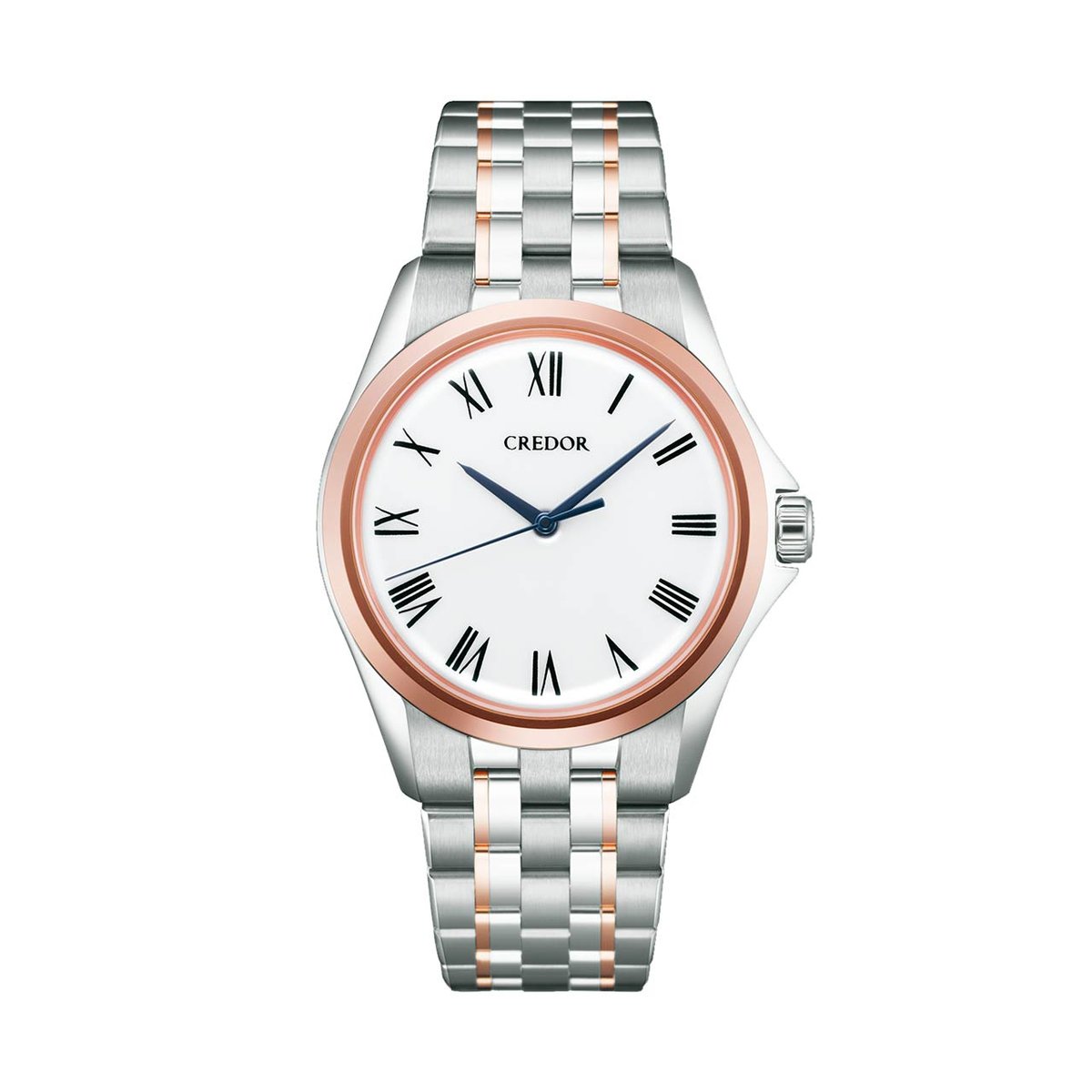
A Credor dress watch is an exercise in subtraction. The case is typically a round or gently tonneau form in platinum or gold, with lugs that flow into the case band rather than attaching to it. Zaratsu finish runs along the flanks; the top surfaces are brushed or, more often, left in a soft, deliberate matte so the polished edge reads as a drawn line rather than a glare. The crown is small, unguarded, and often signed. Nothing is there that does not need to be there.
We cannot quote a diameter, a thickness, or a lug-to-lug for GCLX999, because none is published. We can say that the design language of the line is a thin, close-fitting case intended to sit under a shirt cuff without negotiation, and that Credor's dress watches are consistently among the most discreet objects in the category. If you want a watch that announces itself across a room, this is not the family for you.
On the wrist
Credor's dress watches wear the way a well-cut jacket wears: you are aware of the quality, not the object. The case sits low and flat against the wrist, the lugs curve away rather than pressing down, and the whole assembly is light enough that you will occasionally reach for it to confirm it is still there. The strap — usually hand-stitched alligator, tapering to a small signed buckle or a low-profile deployant — is cut thin to match the case, which is the detail most brands get wrong. A thick strap on a thin watch is a tell.
Balance is the other thing. Credor cases are typically weighted so the head does not rotate on the wrist, achieved through caseback geometry and the distribution of metal rather than through sheer mass. The result is a watch that stays put. It does not slide to the outside of the wrist when you type, and it does not need to be pushed back into place when you stand up. For a watch intended to be worn to a dinner, a board meeting, and a train station in the same day, that is the whole game.
One caveat, and it is a real one: a watch this thin and this polished is a watch you will notice every time you brush a doorframe. Zaratsu surfaces show micro-scratches under direct light, and the first one always stings. Credor owners tend to make peace with this faster than you would expect, because the finish is deep enough that a light touch-up restores it — but if you need a watch to remain flawless, buy brushed steel and sleep well.
Accuracy in the real world
Spring Drive's published tolerance is ±1 second per day, ±15 seconds per month, and in practice the calibers tend to run inside that — often well inside, with owners reporting a few seconds a month in steady wear. That is not a marketing figure; it is a consequence of the architecture. A quartz-referenced brake does not care about the temperature of your wrist, the state of the mainspring, or the position in which you leave the watch overnight. It corrects continuously rather than on average.
What that means day to day is that you set the watch when you acquire it and then largely stop thinking about it. There is no beat error to discuss, no positional variance to chart, no regulation to schedule. The only thing you will notice is the seconds hand, gliding rather than stepping, which is either the most beautiful detail in watchmaking or a source of quiet unease, depending on how attached you are to the idea that a mechanical watch should tick. Credor has made its choice. So, presumably, have you.
Occasions and presence
This is a formal watch by intent and a daily watch by capability. It will be correct with a dinner jacket, correct with a suit, and entirely unobjectionable with a knit and jeans, which is the highest compliment a dress watch can be paid. It is not a sports watch, not a travel watch, and not a watch to wear to the beach; Credor's dress pieces are not built around water resistance claims, and there is no lume anywhere on them. If your week includes a pool, you own a second watch.
Presence is deliberately low. On the wrist, a Credor of this class reads as a thin gold or platinum disc with a beautiful dial — and to ninety-nine people in a room, that is all it reads as. To the one person who knows, it reads as a statement about priorities. That is the entire point of the brand, and it is why Credor collectors tend to be people who have already owned the obvious things.
Variants, family, and where this sits
We cannot list reference variants for GCLX999, because we cannot verify that the reference exists in Credor's published catalogue, and inventing siblings would be worse than admitting the gap. What we can do is place the クオン in the house's known territory: the Credor Eichi and Eichi II from the Micro Artist Studio, the Fugaku tourbillon as the studio's technical showpiece, and the Node and Signo lines as the more accessible end of the dress range. If the クオン exists as described, it belongs in the first of those groups.
Comparisons
The obvious cross-shop is Grand Seiko's Elegance collection, particularly the Spring Drive dress pieces, which share the movement philosophy and a good deal of the finishing culture at a fraction of the price. Above that, the Patek Philippe Calatrava, the Vacheron Constantin Patrimony, the A. Lange & Söhne Saxonia Thin, and the Jaeger-LeCoultre Master Ultra Thin all occupy the same conceptual space — a thin precious-metal case, an uncluttered dial, a movement finished for the owner rather than the spec sheet. The Credor's argument against all of them is not accuracy, where it wins, and not finishing, where it at least holds its own, but scarcity and intent. It is the only one of the group that assumes you already know.
Value, and what the money buys
No price is published for GCLX999 that we can verify, and Credor's Micro Artist Studio pieces are typically released in single-digit or low-double-digit numbers, often without a public price at all. The secondary market for Credor is thin, domestic, and unfashionable in the way all genuinely rare things are before they are discovered. That is both the risk and the opportunity: you will not buy this watch as a store of value, and you should not. You buy it because the finishing is better than the price implies, because the movement is a genuine technical outlier, and because almost nobody else has one. On those terms it is a rational purchase. On the terms of a flipping strategy, it is not.
Service
Credor is serviced through Seiko's authorised network, and the studio pieces generally return to Japan for work that involves the movement or the dial. Expect the process to be slower and more correspondence-heavy than a Swiss brand's, and expect to ship internationally. The compensation is that the people who service these watches are the people who built them, or were trained by them, which is not something every maison can claim.
Verdict
The Credor クオン, ref. GCLX999, is — on the evidence available — a Credor in the truest sense: a thin, quiet, superbly finished dress watch built around the most interesting movement architecture in modern horology, and documented so sparingly that a reviewer cannot even quote its diameter. That opacity is not a flaw in the watch; it is a feature of the house. But it does mean anyone considering one should verify the reference directly with an authorised Credor retailer in Japan before committing funds.
What we can say without reservation is that Credor's particular idea of luxury — removal, finish, and a movement that measures time by refusing to count it — is one of the most coherent in watchmaking. If the クオン is what it appears to be, it belongs on the shortlist of anyone who has finished with the obvious answers.