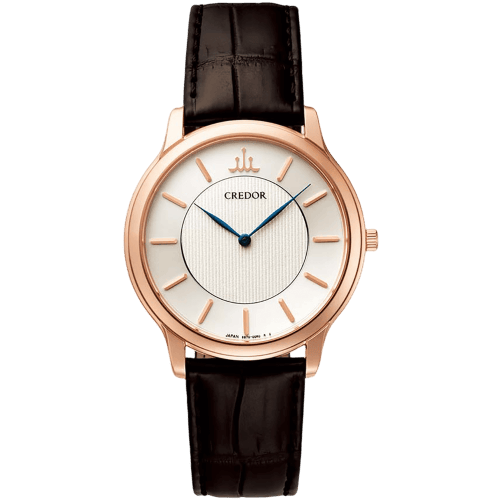
Credor Signo GSTE829: The Quietest Luxury Watch in the Room
There is a specific kind of collector who ends up hunting Credor. They have usually already owned a Grand Seiko, they have usually already flipped a Datejust, and they have arrived at the conclusion that the most interesting watch in a room is frequently the one nobody can identify. The Credor Signo GSTE829 is that watch — one of the many quiet references Credor has produced for the Japanese domestic market and never bothered to market to anyone else.
That is the first thing a serious buyer needs to understand about this reference: documentation is thin, English-language coverage is thinner, and much of what circulates online is second-hand assertion rather than factory specification. This review is written with that constraint stated up front. Where Credor has published a figure, we use it. Where it has not, we say so rather than filling the gap with a plausible-sounding number.
What we can say with confidence is that Signo is Credor's dress-watch line, that it sits at the intersection of Seiko's manufacturing capability and Credor's design restraint, and that GSTE829 is a reference built for people who consider a loud watch a failure of taste.
Credor: Seiko's Other Luxury Brand
Credor was launched in 1974 by Suwa Seikosha — the Seiko division that would eventually become the engine behind Grand Seiko and Spring Drive. The name derives from the French crete d'or, golden crest, and the brand was conceived from the outset as something above and beyond the mainstream Seiko catalogue. Where Grand Seiko chased chronometric excellence and later a distinctly Japanese grammar of case finishing, Credor chased craftsmanship: enamelling, urushi lacquer, hand-painted porcelain, and a kind of understatement that borders on the invisible.
The most famous Credor is the Eichi II, a hand-finished Spring Drive watch with a porcelain dial that sells for five figures and is, by any reasonable measure, one of the great dress watches of the modern era. But Credor is not only five-figure art pieces. The brand has always maintained a broad catalogue sold almost exclusively in Japan, and much of it — including the Signo line — is priced for people who want the Credor philosophy without the Credor collector premium.
That domestic-market focus matters enormously for the buyer. Credor references are catalogued in Japanese, distributed through Japanese retailers, and rarely given the English-language documentation that Grand Seiko receives. A reference like GSTE829 can be entirely legitimate and still have almost no footprint in Western databases. That is not a red flag in itself, but it does change how you should buy.
Where the Signo Sits in the Range
Signo is Credor's straightforward dress family: clean dials, restrained cases, and a strong emphasis on legibility and proportion over complication. It is the line you buy when you want a watch that works with a suit and disappears under a cuff. The design language is deliberately conservative — thin baton or applied indices, a narrow bezel, and dials that are usually white, silver or black rather than the saturated colours that dominate modern sports watches.
Within the Credor hierarchy, Signo is not the flagship. It is not the Eichi, and it is not the hand-engraved, lacquered or gem-set end of the catalogue. It is the everyday Credor — and for a certain kind of collector, that is precisely the appeal. You get the brand's finishing standards and its design discipline without paying for the artisanal excess. Think of it as the difference between buying a tailored suit and buying a bespoke one: the cut is the same, the cloth is slightly different, and the price is a fraction.
The Movement: Quartz, and Why That Is Not an Insult
The Signo line has historically leaned on Credor's high-grade quartz architecture, and that is the context in which GSTE829 should be understood. Credor quartz is not the disposable quartz of a department-store watch. Seiko's premium quartz calibres — the Twin Quartz and 9F families being the best known — are thermo-compensated, built with metal components where cheap quartz uses plastic, and regulated to tolerances that embarrass most mechanical watches.
The trade-off is philosophical rather than practical. A quartz Credor will keep time far better than almost any mechanical watch you can buy at any price. It will also require a battery change every few years and will never develop the romantic patina of a service history. Collectors who value horology as engineering tend to love these movements. Collectors who value horology as ritual tend to dismiss them. Both positions are defensible; only one of them gets you a watch that is accurate to within seconds a year.
What we will not do here is quote a specific caliber number for GSTE829. Credor does not publish a complete, consistent movement specification for every JDM reference, and the English-language record for this particular reference is not reliable enough to assert one with confidence. Buyers should ask a dealer to photograph the caseback and confirm the caliber marking before purchase. That is not a hedge born of laziness — it is the correct due-diligence step for any thinly documented Japanese reference, and any seller who resists the request is telling you something useful.
What the Spec Sheet Does and Does Not Tell You
Credor's Japanese catalogues are not always generous with dimensional data, and GSTE829 is a case in point. We are not going to invent a case diameter, a thickness, a lug-to-lug measurement or a water-resistance rating for this reference, because doing so would be fabrication dressed up as authority. If you are buying remotely, ask for caliper measurements and a photograph of the caseback. Any seller who cannot provide those is a seller you should not be sending money to.
What can be said is that the Signo formula is a thin, flat, dress-oriented case; a sapphire crystal; a dial designed for legibility rather than drama; and a strap-and-buckle arrangement rather than a heavy bracelet. It is a watch built to slide under a shirt cuff, not to sit on top of one. The absence of luminous material is a deliberate design decision, not an oversight — this is a watch for lit rooms.
On the Wrist
Dress watches live or die on how they sit, and Credor has spent decades getting this right. The Signo case is designed to be light and unobtrusive — the kind of watch you forget you are wearing until you need to check the time. Because the case is slim and the dial is clean, the visual weight is low, which means it reads as smaller on the wrist than its measurements might suggest. That is a feature, not a bug: a dress watch that dominates the wrist has misunderstood its job.
Balance matters more than mass here. A well-proportioned dress case with a light leather strap sits flat and stays put; a badly proportioned one slides around and catches on cuffs. Credor's case design is generally excellent in this respect, with lugs that curve down rather than out and a profile that keeps the watch close to the wrist. If you are used to a dive watch, the first hour will feel like you have forgotten to put a watch on at all.
Strap choice changes the character significantly. On a dark leather strap it is a formal watch; on a lighter, textured leather it becomes something you can wear with a jacket and jeans. This is the kind of reference that rewards owning two or three straps and rotating them seasonally. It is also the kind of reference that makes a heavy steel bracelet feel like a mistake.
Accuracy in Daily Life
If GSTE829 carries the grade of quartz movement that Credor typically fits to the Signo line, accuracy is a non-issue. Credor's better quartz calibres are specified to tolerances measured in seconds per year, not seconds per day, and even a standard high-grade quartz movement will hold within a few seconds a month. In practice, you will set this watch twice a year — at daylight-saving changes — and never think about it otherwise.
The practical caveat is battery service. A quartz watch that has been sitting in a drawer for years may have a leaking cell, and battery leakage is the single most common cause of terminal damage in quartz movements. If you are buying pre-owned, ask when the battery was last changed and inspect the movement for corrosion. A leaking cell can destroy a movement that is otherwise perfectly serviceable, and the repair cost can approach the value of the watch.
Occasions
This is a formal and dress watch first, a daily wearer second. It is at its best with tailoring, at a wedding, in a meeting, or on a plane where nobody wants to see a chronograph. It is not a sports watch, it is not a travel watch in the GMT sense, and it should not go near water beyond hand-washing. Within those limits it is extraordinarily versatile, because restraint is always in style. If you own one watch and it is this one, you will be correctly dressed for ninety per cent of the situations life actually presents.
Wrist Presence: 2/5
Two out of five, and deliberately so. The GSTE829 does not announce itself. It does not catch light across a room, it does not have a bezel that people recognise, and ninety-nine per cent of the people you meet will not know what it is. For collectors who have graduated past the need for recognition, that is the entire point. For collectors who have not, this watch will feel like a waste of money — and they should buy something else.
Variants and Family
Credor's JDM cataloguing means that sibling references in the Signo family are not consistently documented in English, and we will not list reference numbers we cannot verify. The practical guidance is this: within the Signo line you will find variations in dial colour, case metal, strap versus bracelet, and movement type, and those variations move the price meaningfully. Dial colour is the single biggest driver of desirability in Credor's dress references — a clean white or silver dial will always be easier to sell than an unusual one, and a dial with any discolouration or patina will be harder.
Case metal matters too. Steel Signo references are the volume product and the easiest to buy and sell. Gold references carry a material premium but a much narrower buyer pool, and they are the ones where a bad refinish is most expensive. If you are buying your first Credor, buy steel.
Alternatives Worth Considering
If you want the same philosophy from a better-documented catalogue, the Grand Seiko 9F quartz dress references are the obvious first stop. They share the corporate parent, the finishing standards and the quartz-first engineering, but they come with English documentation, international service and a much deeper secondary market. For most buyers outside Japan, that is the rational choice.
The Cartier Tank Must is the other obvious comparison, and it is a different proposition entirely: quartz, yes, but with a design icon's resale profile and a cultural weight that Credor will never have outside Japan. If you want a quartz dress watch that holds value, that is where you look.
On the mechanical side, a Nomos Tangente or a Grand Seiko mechanical dress reference gives you the same minimalism with a movement you can wind. You will lose the quartz accuracy and gain the ritual. Neither is objectively better; they are answers to different questions.
At the affordable end, the Orient Bambino and the Timex Marlin both deliver the general aesthetic for a fraction of the money. They are not the same watch — the finishing, the dial furniture and the case quality are in different leagues — but they are honest entry points for someone who wants to test whether they actually enjoy wearing a dress watch before spending Credor money.
Investment and Resale
Here is the part most reviews soften, and we will not. Credor Signo references are not investment watches. The brand has almost no collector infrastructure outside Japan, the references are hard to research, and quartz movements — however good — do not command the premiums that mechanical exotica do. Auction records for Credor are dominated by the Eichi and by vintage pieces with serious provenance; a Signo quartz reference is not a watch that appears at Phillips.
Expect to buy at a meaningful discount to original retail and to sell at a further discount to what you paid, unless you find a buyer who specifically wants a Credor. The liquidity is thin. That is not a reason to avoid the watch; it is a reason to buy it with the right expectations. If you want a Credor as an asset, buy an Eichi. If you want a Credor as a watch, the Signo is a superb way to get the brand's design language for a fraction of the flagship price.
There is one scenario in which a Signo does well: a collector in Japan or a Japan-focused collector abroad who specifically wants a clean, complete example in an unusual dial. In that market, condition and completeness matter far more than the reference number. Box, papers and an unpolished case will do more for your exit price than any amount of online enthusiasm.
Service and Ownership
Quartz service is simpler and cheaper than mechanical service, but it is not free. Budget for a battery change every few years and a movement service if the watch has been sitting. Credor is serviced through Seiko's authorised network, and while independent watchmakers can handle a quartz movement, anything involving case refinishing or dial work should go to an authorised centre — Credor's finishing is subtle and easy to ruin.
The bigger ownership question is parts. Credor is a Japanese domestic brand, and while Seiko's global service network is extensive, Credor-specific parts for older JDM references can be slow to source. Buy a complete watch with original components, and keep the paperwork if you get it. A Credor with a replaced crown or a refinished case is a Credor you will struggle to move.
Buying Guide: What to Check Before You Commit
First, confirm the caliber. Ask for a clear photograph of the caseback and, if possible, of the movement itself. Second, confirm the dimensions yourself with calipers if you are buying in person, or ask the seller to provide them if you are not. Third, ask about battery history and inspect for leakage. Fourth, examine the dial under raking light for moisture damage, which is the most common cosmetic failure on older quartz dress watches. Fifth, check that the case has not been polished to death — soft, rounded lug edges are the tell.
Finally, price it against the Japanese domestic secondary market rather than against Western listings. Credor is a Japan-first brand, and the deepest, most accurate pricing information lives in Japanese. If you are paying a significant premium over Japanese asking prices, you are paying for convenience, not for the watch.
Verdict
The Credor Signo GSTE829 is a watch for people who have stopped needing their watch to explain them. It is beautifully restrained, superbly made, and almost certainly more accurate than anything mechanical in its price bracket. It is also thinly documented, illiquid and unlikely to appreciate.
Buy it if you want a dress watch that does its job invisibly and you are comfortable doing your own due diligence. Skip it if you need resale certainty, English-language documentation, or a watch that other people will recognise. This is a connoisseur's purchase in the truest sense: the reward is in the wearing, not the ledger.