The Philosophical Foundation of the Credor Entrata
To understand the Credor Entrata 9579-6000, one must first understand the Japanese concept of Monozukuri—the art of making things. While the Swiss tradition often emphasizes the 'soul' of a mechanical movement, the Japanese approach, particularly within the walls of the Shizukuishi and Shinshu Watch Studios, treats the pursuit of precision as a spiritual endeavor in its own right. The Entrata, launched during a period of peak technical confidence for Seiko, was designed to be the 'entry' (hence Entrata) into this world of uncompromising standards.
The reference 9579-6000 is a product of the late 1980s and early 1990s, a time when the distinction between quartz and mechanical was not viewed through the lens of 'soul vs. soulless,' but rather through the lens of 'tradition vs. progress.' Credor, as the pinnacle of Seiko's luxury hierarchy, was tasked with proving that quartz could be high horology. The 9579-6000 does this not through loud complications, but through the obsessive refinement of every visible and invisible surface.
The Caliber 9579: Engineering Beyond the Battery
At the heart of the 9579-6000 lies the Caliber 9579. To the uninitiated, a quartz movement is a disposable circuit board. To the Credor engineer, it is a canvas. The 9579 is a high-accuracy quartz (HAQ) movement, designed to maintain a deviation of no more than 20 seconds per year. This is achieved through the selection of high-quality quartz crystals and a thermocompensation-like stability that resists the frequency shifts caused by temperature fluctuations.
Technically, the 9579 is a marvel of miniaturization. Unlike the mass-produced quartz movements found in entry-level timepieces, the 9579 features a train of seven jewels. These jewels serve a critical function: they reduce friction in the gear train that drives the hands, ensuring that the stepper motor can operate with maximum efficiency and minimum wear. Furthermore, the movement is housed within a gold-plated bridge structure. This is not merely for aesthetics; the bridge provides a rigid architecture that protects the delicate electronic components and allows for a level of serviceability that is virtually non-existent in modern consumer electronics. A watchmaker can actually disassemble, clean, and oil this movement, ensuring it remains functional for generations.
Case Architecture and Material Integrity
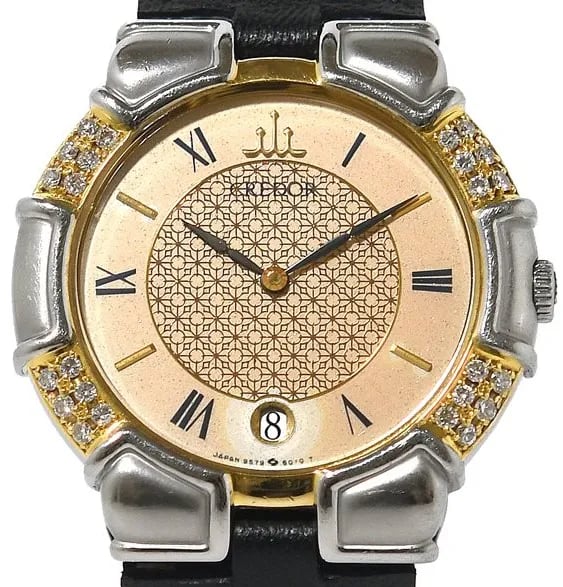
The case of the 9579-6000 is a study in geometric harmony. Measuring 33mm in diameter, it adheres to the classic proportions of the era. However, it is the integration of the bracelet that defines its silhouette. The transition from the case to the first link is seamless, creating a continuous flow of metal that wraps around the wrist. This reference frequently utilizes 18k yellow gold for the bezel and the center links of the bracelet, providing a warm contrast to the clinical brilliance of the stainless steel.
The finishing techniques applied here are what elevate Credor above its contemporaries. The 'Zaratsu' polishing—a technique that involves holding the case against a rotating tin plate—results in a mirror-like finish free of distortion. On the 9579-6000, this is contrasted with fine vertical brushing on the case flanks. The result is a play of light that changes character depending on the angle of the sun, a hallmark of Japanese design that prioritizes the interaction between the object and its environment.
The Dial: Micro-Textures and Legibility
The dial of the Entrata is where the 'Crest of Gold' identity truly shines. Often finished in a champagne or soft gold hue, the dial features a subtle texture that prevents glare and adds visual depth. The hour markers are applied batons, diamond-cut to perfection. Each facet of the marker is polished to ensure that even in low-light conditions, the smallest amount of ambient light is reflected back to the wearer.
At the 12 o'clock position sits the Credor logo—the stylized mountain peak that represents the three pillars of the brand: sensitivity, technology, and harmony. The date window at 3 o'clock is framed in gold, a small but significant detail that demonstrates the lack of cost-cutting. The hands are typically thin, needle-like batons that move with a deliberate, confident tick—a signature of the high-torque stepper motors used in Seiko's premium quartz calibers.
Wrist Experience and Ergonomics
Wearing the 9579-6000 is a lesson in ergonomic excellence. Because the movement is so thin, the center of gravity sits extremely close to the skin. The bracelet links are short, allowing the metal to contour precisely to the anatomy of the wrist. There is no 'hair-pulling' or pinching, a testament to the tight tolerances of the link assembly. The clasp is a discreet deployant style that maintains the slim profile of the bracelet, ensuring that the watch remains comfortable even during extended periods of wear.
For the modern collector who may be used to 40mm+ sports watches, the 33mm size of the Entrata requires a recalibration of expectations. It is not a watch that shouts; it is a watch that whispers. It fits perfectly into the current trend of 'quiet luxury,' where the value of the object is known only to the wearer and those with the technical knowledge to recognize it.
Investment Potential and Market Context
For years, vintage Credor was a well-kept secret among Japanese domestic market (JDM) enthusiasts. However, as the global horological community has become more educated on the merits of high-accuracy quartz and the history of Japanese luxury, prices have begun to stabilize and rise. The 9579-6000 represents an incredible value proposition. For less than the price of a modern entry-level mechanical watch from a Swiss 'lifestyle' brand, one can own a piece of genuine high horology with precious metal components.
As an investment, the Entrata is a 'slow burn.' It is unlikely to see the meteoric rise of a stainless steel Rolex, but its floor is incredibly solid. The rarity of these pieces in the West means that as demand for JDM luxury increases, the 9579-6000 will become increasingly difficult to source in mint condition. Collectors are beginning to realize that the 95 series quartz movements were the bridge to the legendary 9F series, making them a vital chapter in the history of the quartz timepiece.
Conclusion: The Connoisseur's Choice
The Credor Entrata 9579-6000 is not a watch for everyone. It will not satisfy those who require the sweeping second hand of a mechanical movement or the 'heft' of a modern diver. Instead, it is a watch for the connoisseur who appreciates the technical challenge of creating a movement that is accurate to within seconds per year. It is for the collector who values the heritage of the Shizukuishi artisans and who understands that luxury is often found in the details that others overlook.
In the 9579-6000, Credor achieved a perfect balance of form and function. It remains a testament to a time when Japan was not just participating in the luxury watch market, but was actively redefining it. For the sophisticated young collector, it offers a unique blend of neo-vintage charm and timeless technical excellence.