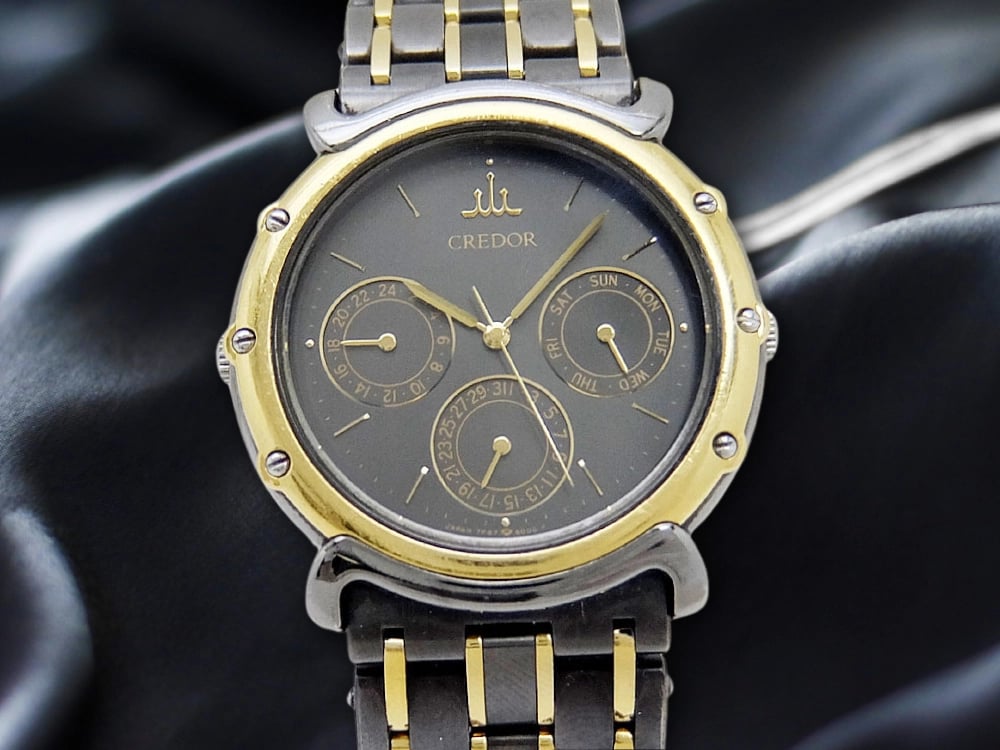
Introduction: The Case That Refuses to Be Assembled
Most watches are assemblies. A bezel is pressed onto a case band; lugs are milled into the flank; a crown interrupts the geometry at three o'clock. The Credor Lineacurva, reference GCET004, takes a different position. Its case reads as a single gesture — one continuous line that begins near the crown, sweeps across the bezel, and resolves into the lugs before turning back on itself. The name says as much: linea curva, the curved line.
Credor is Seiko's most exclusive marque, a Japan-domestic label that has spent five decades producing small numbers of hand-finished watches for a clientele that does not need to be persuaded by a logo. The Lineacurva is one of its more design-forward statements, a piece that sits at the intersection of sculpture and engineering. It is not a watch that shouts. It is a watch that hums.
Beneath the dial sits a Spring Drive movement — Seiko's singular contribution to watchmaking, a hybrid system in which a conventional mainspring drives a glide wheel whose speed is regulated by a quartz-referenced electromagnetic brake. The result is a seconds hand that sweeps in perfect silence, an accuracy that conventional mechanical watches cannot approach, and a level of finishing that belongs in a very different price bracket. The Lineacurva is, in short, an argument for looking past the usual names.
The Credor Context
Credor was established in 1974, the year Seiko decided that its most ambitious watchmaking should carry a name of its own. The word derives from the French crête d'or — golden crest — and the brand has spent the intervening half-century living up to the implication. Credor is not sold everywhere. It is, for the most part, a Japan-domestic proposition, distributed through a small number of specialist retailers and boutiques, with only occasional exports to select markets.
That scarcity is deliberate. Credor occupies the same conceptual space in Japan that A. Lange & Söhne or Vacheron Constantin occupies in Europe: a house where the finishing is done by hand, where production is measured in hundreds rather than thousands, and where the customer is assumed to know what they are looking at. The brand's flagship, the Eichi II, is widely regarded as one of the finest hand-finished watches made anywhere, with a porcelain dial painted by a single artisan and a Spring Drive movement decorated to a standard that embarrasses far more famous names.
The Lineacurva occupies a slightly different position in the catalogue. Where the Eichi II is a study in classical restraint, the Lineacurva is a study in form. It is Credor thinking out loud about what a modern dress watch might look like if it were designed from first principles rather than inherited conventions.
The Case: One Continuous Line
The defining feature of the Lineacurva is its case architecture. Conventional watch cases are built from discrete elements — bezel, mid-case, case back, lugs — each with its own geometry and its own visual weight. The Lineacurva collapses those elements into a single flowing form. The bezel does not sit on top of the case; it emerges from it. The lugs do not attach to the case; they extend from it, curving downward in a gesture that continues the line of the bezel.
The effect is subtle in photographs and unmistakable in person. From the front, the watch reads as a clean, round dress watch. From the side, the curve reveals itself — a gentle arc that runs from the crown, over the crystal, and down into the lugs. It is the kind of detail that takes months to notice and years to tire of.
The case is rendered in stainless steel, finished with the alternating brushed and polished surfaces that Credor has perfected over decades. The polishing is Zaratsu-style — a hand-applied, distortion-free mirror finish that requires the sort of patience only a Japanese atelier can sustain. The crystal is sapphire, and the case back is a sapphire display, allowing the movement to be seen.
Water resistance is modest, as befits a dress watch. This is not a piece for the pool or the beach; it is a piece for the office, the restaurant and the concert hall. Lume is absent, as it should be. The only complication is a discreet power-reserve indicator, a practical concession that suits the hand-wound movement.
What is most impressive about the case is not any single element but the coherence of the whole. Nothing looks added. Nothing looks subtracted. The Lineacurva's case is what happens when a designer is allowed to follow an idea to its conclusion.
The Dial
The dial of the Lineacurva is where the watch's restraint is most evident. Finished in a deep blue, it carries no text beyond the Credor signature and the Spring Drive indication. The hour markers are applied and faceted, catching light in a way that gives the dial depth without clutter. The hands are polished on their upper surfaces and brushed on their flanks, a detail that rewards close inspection.
What is most striking about the dial is its sense of depth. The applied markers sit high above the surface, and the printing is crisp and minimal. There is no date window, no busy subdial, no unnecessary text. The dial is a stage, and the hands are the performers.
The power-reserve indicator is integrated into the dial with the same restraint. It does not dominate the composition. It informs it. Owners of hand-wound watches will tell you that this is the one complication they actually use, and Credor has the good sense to present it without fuss.
The Movement: Spring Drive Cal. 9R31
Spring Drive is the most interesting thing to happen to mechanical watchmaking in the last fifty years, and it is almost entirely a Seiko invention. In a conventional mechanical watch, the mainspring's energy is released through an escapement — a lever-and-wheel system that ticks the seconds away at a fixed frequency. In a Spring Drive, the escapement is gone. The mainspring drives a glide wheel, and the glide wheel's rotation is regulated by an electromagnetic brake governed by a quartz crystal oscillator. The result is a movement that is mechanically powered but quartz-accurate, with a seconds hand that sweeps in a continuous, silent glide.
The Calibre 9R31 is a hand-wound Spring Drive with a power reserve of 120 hours — five days — and a power-reserve indicator on the dial. It is a beautifully finished movement: bridges with wide, mirror-polished bevels; blued screws; an architecture without a rotor that allows the gear train to be seen in full. The finishing is done by hand, and it shows.
What the 9R31 lacks in traditional haute horlogerie signalling — there are no Geneva stripes, no hand-engraved balance cock — it makes up for in engineering integrity. This is a movement that does something no Swiss calibre can do, and it does it with a level of decoration that stands comparison with anything at the price.
It is worth pausing on what Spring Drive actually represents. The Swiss industry spent the 1970s and 1980s in a state of existential crisis over quartz, and the resolution was, broadly, to retreat into mechanical purism. Seiko took the opposite path: it asked what would happen if you kept the soul of a mechanical watch — the mainspring, the gear train, the sweep — and replaced only the part that limits accuracy. Spring Drive is the answer. It is not a quartz watch with a mechanical power source; it is a mechanical watch with a quartz reference. The distinction matters, and it is the reason the Lineacurva feels like a piece of the future rather than a piece of nostalgia.
On the Wrist
The Lineacurva is a watch that disappears onto the wrist in the best sense. Its case is slim, its profile low, and its curvature means that it sits close to the skin rather than perching on top of it. The lugs curve downward aggressively, which allows the watch to hug the wrist even on smaller wrists. There is no sense of the watch floating or sliding.
The leather strap is supple and well-judged, tapering gently toward a deployant clasp. It is the sort of strap that looks better after six months than it did on day one, developing a patina that complements the watch's quiet character. The deployant is well-engineered, with a positive click and no sharp edges.
Weight is modest. This is not a heavy watch, and it does not feel insubstantial either. It feels considered. On the wrist, the Lineacurva reads as a dress watch first and a piece of engineering second — which is exactly the right order for a watch of this kind. It slips under a cuff without complaint and stays put through a working day.
Accuracy in Practice
Spring Drive movements are rated to ±1 second per day, which is roughly an order of magnitude better than a COSC-certified mechanical movement. In practice, most Spring Drive watches perform better than their rating, often running within a few seconds per month.
What this means for the owner is straightforward. You set the watch once and you forget about it. There is a weekly winding ritual — the 9R31 is hand-wound, with five days of autonomy — but there is no positional adjustment to make, no need to check against a reference clock, no drift to chase. The Lineacurva is, in this respect, among the most practical luxury watches you can buy.
The seconds hand, meanwhile, is the thing that will hold your attention. Spring Drive's glide motion is unlike anything else in watchmaking: perfectly smooth, perfectly silent, with none of the stutter of a conventional mechanical escapement. It is hypnotic in the way that a well-made object often is. Owners report that it becomes a small daily pleasure, a reminder that the watch on the wrist is doing something no other watch does.
Comparisons and Competition
The Lineacurva's natural competitors are the classic dress watches: the A. Lange & Söhne Saxonia Thin, the Jaeger-LeCoultre Master Ultra Thin, the Chopard L.U.C XPS, the Vacheron Constantin Patrimony. Each of these is a beautiful object, and each is finished to a high standard. None of them offers Spring Drive.
The closest comparison within the Seiko group is the Grand Seiko SBGY007 'Omiwatari', which uses a Spring Drive movement and occupies a similar conceptual space. The Grand Seiko is more overtly technical; the Credor is more overtly sculptural. Which you prefer is a matter of temperament.
Against Swiss alternatives, the Lineacurva's advantage is twofold. First, the movement does something genuinely different — Spring Drive is not a variation on a theme, it is a different theme. Second, the finishing is exceptional. Credor's hand-polishing is the equal of anything produced in the Vallée de Joux, and in some respects — particularly the Zaratsu case finishing — it is better.
The disadvantage is distribution and recognition. Outside Japan, few people will recognise a Credor. For some owners, that is a feature. For others, it is a bug. There is no correct answer, but it is worth being honest with yourself about which camp you fall into before you buy.
Ownership: Value, Service and the Long Game
Credor is not a brand that holds value in the way that Rolex or Patek Philippe does. It is a niche proposition, and its secondary market is thin. A Lineacurva bought at retail will likely trade below retail on the pre-owned market for the foreseeable future. That is worth knowing before you buy.
What the Lineacurva offers instead is intrinsic value. The finishing, the movement, the case architecture — these are things you can see and feel every day, and they do not depreciate. If you buy watches to wear rather than to flip, the Lineacurva makes a compelling case for itself.
Servicing is a consideration. Credor watches are serviced by Seiko's authorised service network, and Spring Drive movements require technicians trained specifically in the technology. Turnaround times can be longer than for a comparable Swiss watch, and parts availability outside Japan can be limited. Buy from an authorised dealer, keep your paperwork, and treat service as part of the cost of ownership rather than an afterthought.
Final Verdict
The Credor Lineacurva GCET004 is one of the most interesting dress watches on the market. Its case architecture is genuinely original, its movement is genuinely different, and its finishing is genuinely exceptional. It is not a watch for everyone — its distribution is limited, its resale is soft, and its brand recognition outside Japan is close to zero — but for the collector who values craft over cachet, it is close to ideal.
What the Lineacurva represents is a different idea of luxury: one in which the value is in the object itself rather than the name on the dial. That idea has always been Credor's project. The Lineacurva is its most persuasive expression yet.