Czapek Goutte d'Eau Ref. 1700 Review
The Czapek Goutte d'Eau ref. 1700 arrives in a market that is deeply divided. On one side are the integrated-bracelet sports watches that dominate social media, allocation lists and auction results. On the other are classical dress watches that quietly change hands among collectors who care about dial proportion, hand-winding and the intellectual pleasure of owning something less obvious. The Goutte d'Eau belongs firmly in the second camp.
That is not a weakness. It is a filter. Czapek has spent the modern revival building credibility through the Quai des Bergues, the Antarctique and the Faubourg de Cracovie. The Goutte d'Eau ref. 1700 draws on the brand's hand-wound, Geneva-facing identity and packages it for a buyer who already has a sports watch and wants a formal piece with more character than a generic Calatrava alternative. The question for this review is whether that package makes sense as a purchase, as a hold and as a long-term collection piece.
Brand context and manufacture history
François Czapek founded Czapek in Geneva in 1845, and the name has a legitimate place in mid-19th-century watchmaking. The modern revival has not tried to be a heritage pastiche. Instead, it has built a small but credible catalogue around in-house movements, classical finishing and a design language that references Geneva watchmaking without copying the most obvious references.
The Goutte d'Eau sits in the more traditional half of the catalogue. It is not an Antarctique-style sports watch, and it is not a tourbillon showpiece. It is a hand-wound dress watch with small seconds and a power-reserve display, which puts it in direct conversation with the Quai des Bergues family. For collectors, that matters because the Quai des Bergues is the line that established Czapek's classical credentials. The Goutte d'Eau ref. 1700 is best understood as a refined expression of that lineage rather than a standalone experiment.
The brand's modern history also explains the resale profile. Czapek is not Patek Philippe, and it does not have the same depth of auction records. It is an independent with a growing collector base, limited production and a design-led following. That creates a different ownership equation: you buy for the object and the maker, not for the assumption of instant liquidity.
Design and case
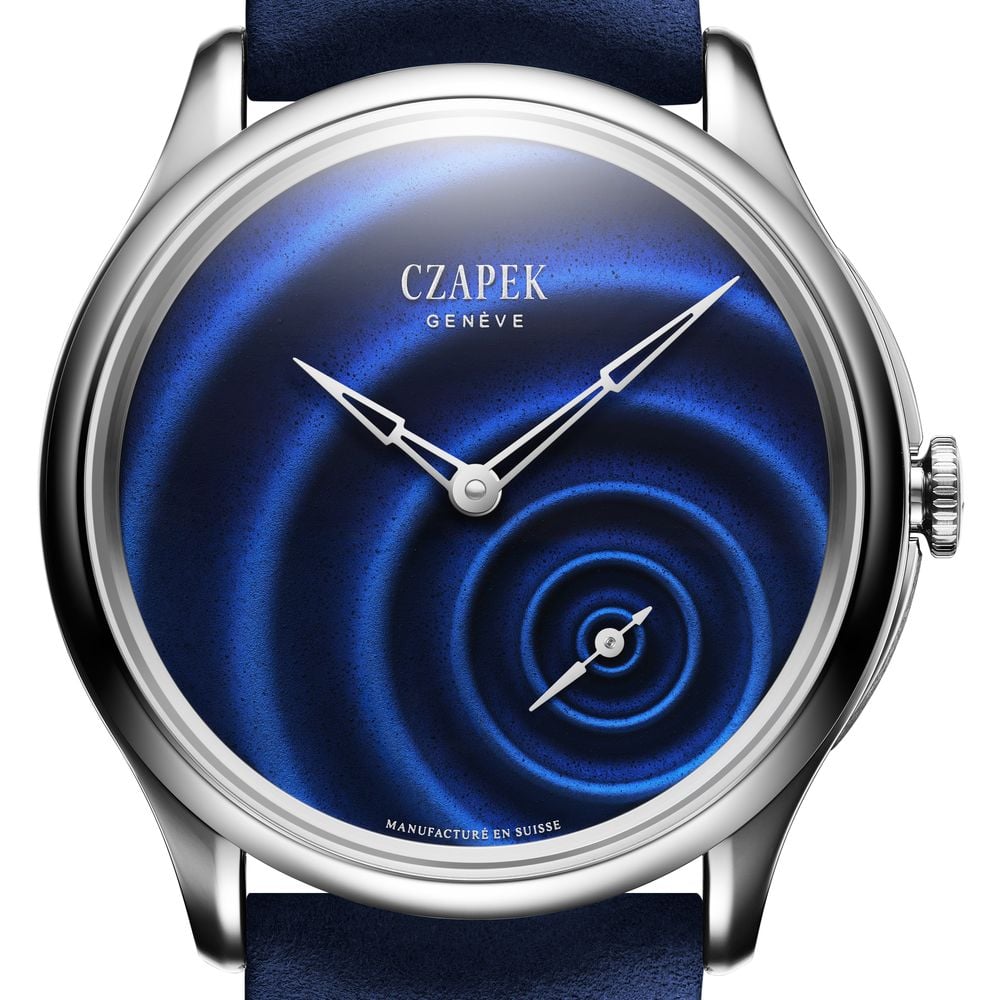
The ref. 1700 is presented in stainless steel, which is a sensible choice for a watch that is meant to be worn rather than locked away. Steel gives the Goutte d'Eau a more approachable daily-wear character than a precious-metal dress watch, while the sapphire crystal keeps the package practical for regular use. The watch is paired with a leather strap and a pin buckle, which reinforces the formal, traditional brief.
The Goutte d'Eau name points to the drop-shaped design language that runs through the dial and hands. This is not a watch that relies on aggressive case architecture or a skeletonized dial to make an impression. It relies on proportion, legibility and the kind of details that reveal themselves over time: the shape of the hands, the small-seconds layout, the power-reserve indicator and the restrained use of text. The dial is blue in the ref. 1700 configuration under review, and it gives the watch a slightly more contemporary feel than a conventional white or silver dress dial.
There is no lume, and that is appropriate. A dress watch does not need to glow in the dark, and adding luminous material would only compromise the dial's classical clarity. The absence of lume is a statement of intent: this is a watch for dinners, offices, weddings and travel days where the sleeve comes down and the phone stays in the pocket.
Movement and architecture
The Goutte d'Eau ref. 1700 uses Czapek's hand-wound Calibre SXH1. This is a twin-barrel movement with a seven-day power reserve, a small-seconds display and a power-reserve indication. The frequency is 21,600 vph, which is a traditional beat rate for a classical hand-wound calibre. It is not a high-beat movement, and it does not pretend to be a chronometer-certified sports engine. It is a movement designed for a dress watch with a weekly winding ritual.
That seven-day reserve is one of the most attractive features of the watch. It means the owner can wind it once a week and then enjoy a long window of running time without the anxiety of a short power reserve. It also makes the watch more practical for a rotation. You can wear it on a Monday, put it back in the box and pick it up again later in the week without resetting it every time.
The SXH1 is an in-house calibre, and Czapek finishes it for visible enjoyment through the caseback. The architecture is classical rather than futuristic: bridges, barrels and a regulation system that look appropriate in a hand-wound dress watch. This is not a movement that tries to compete with a Lange on sheer decorative density, but it has enough character to justify the independent price bracket. The fact that it is not COSC-certified is worth noting, but it is not a dealbreaker for this category. Dress-watch buyers should care more about stability, serviceability and the pleasure of winding than about a certificate.
Wrist feel and daily wear
The Goutte d'Eau wears like a proper dress watch. It is round, balanced and unobtrusive under a cuff. The steel case gives it a more versatile daily-wear character than a gold Quai des Bergues, and the leather strap keeps the overall package light. It does not have the wrist presence of an integrated sports watch, and it is not trying to. The pleasure comes from the dial, the winding feel and the way the watch sits quietly under tailoring.
For collectors who are used to heavy steel sports watches, the first reaction may be that the Goutte d'Eau feels delicate. That impression fades after a day or two. The watch is comfortable for desk work, dinners and travel days that do not involve serious physical activity. It is not a beach watch, a gym watch or a watch for manual labor. It is a formal piece with enough daily-wear civility to be worn more often than a pure occasion watch.
The pin buckle and leather strap are part of that experience. A deployant clasp would add convenience, but the pin buckle keeps the watch traditional and light. Owners who wear the watch frequently may eventually want a second strap in a different color, but the standard leather pairing is appropriate for the ref. 1700's brief.
Accuracy and ownership expectations
The SXH1 is not marketed as a chronometer, and buyers should not expect quartz-like accuracy. A modern independent hand-wound movement should deliver a stable rate in daily wear, but it will be sensitive to winding consistency, resting position and temperature. The practical approach is to wear the watch for a few weeks, note its average daily deviation and have it regulated if it falls outside your personal tolerance.
The seven-day power reserve helps accuracy in one important way: it reduces the chance of the watch running down and needing a full reset. A watch that is consistently wound and worn will generally be easier to live with than one that is stopped and restarted all the time. For a collector with a multi-watch rotation, that is a meaningful advantage.
Service should be handled through Czapek authorized partners. The brand is still small enough that service lead times and costs should be confirmed directly before purchase, especially for a watch that may have been bought on the secondary market. This is not a movement that every local watchmaker should touch. The authorized route is the sensible one.
Market position and investment case
The Goutte d'Eau ref. 1700 is a niche watch within a niche brand. That is both its appeal and its limitation. On the appeal side, it offers something that mainstream dress watches do not: a hand-wound in-house movement, a distinctive dial language and the credibility of an independent Geneva maker. On the limitation side, it does not have the liquidity of a Patek Philippe Calatrava or the auction depth of a Lange 1815.
Resale data for the ref. 1700 is thin. Standard steel Czapek dress watches tend to trade at or below retail on the secondary market, while limited editions and special dials can command premiums. The Goutte d'Eau should be treated as a stable rather than appreciating asset. If you buy it well, wear it and keep the full set, you are unlikely to face a catastrophic loss. If you buy it at a premium expecting it to behave like a sports-watch allocation, you are likely to be disappointed.
The hold-versus-sell judgment is therefore straightforward. Hold if you value the hand-wound experience and the independent design. Sell only if you need liquidity, if the watch is not getting wrist time or if you have an opportunity to upgrade into a more established dress-watch reference. This is not a piece to flip for a quick profit. It is a piece to own for the long term and enjoy on the wrist.
Comparisons and alternatives
The most obvious comparison is the Patek Philippe Calatrava 5196. The Patek has stronger liquidity, a more established auction record and a broader buyer base. The Czapek counters with a seven-day power reserve, a more distinctive dial and the appeal of independent ownership. For a collector who already has a Patek, the Goutte d'Eau is a more interesting second dress watch. For a first-time luxury buyer, the Patek is the safer financial choice.
The A. Lange and Söhne 1815 is another natural rival. It offers German hand-wound craftsmanship, small seconds and a very formal presentation. The Lange is more engineering-led and more expensive on the secondary market. The Czapek is softer, more Geneva in spirit and less intimidating to wear every day.
The F.P. Journe Chronomètre Bleu is the cult independent alternative. It has a blue dial, a hand-wound movement and a collector base that treats it almost like a currency. The Czapek does not have that level of demand, but it also does not carry the same premium. For buyers who want independent character without paying Chronomètre Bleu money, the Goutte d'Eau is a reasonable compromise.
On the affordable side, the Orient Bambino and Seiko Presage Cocktail Time offer dress-watch silhouettes at a fraction of the price. They are not true substitutes for a Czapek, but they show how much of the visual language can be approximated at entry level. The difference is in the movement, finishing, brand history and the ownership experience.
Pros and cons
The strongest argument for the Goutte d'Eau is its hand-wound in-house movement with a seven-day power reserve. That is a real engineering feature, not a marketing line. The second argument is design: the watch looks like a Czapek, not like a generic dress watch. The third is comfort. It wears well under a cuff and is easy to live with on formal and semi-formal days.
The weaknesses are equally clear. It is not COSC-certified, it has no lume and it is not a sports watch. More importantly, the secondary market is thin. Buyers who need liquidity should look elsewhere. Buyers who want a watch that rewards ownership and wearing will find more to like.
Final verdict
The Czapek Goutte d'Eau ref. 1700 is a collector's dress watch rather than a speculative asset. It delivers the hand-wound ritual, independent design and historical grounding that Czapek does well. It is comfortable, legible and distinctive enough to justify its place in a serious collection.
Buy it for the experience and the scarcity. Do not buy it expecting Calatrava-level liquidity or sports-watch hype. If you understand that distinction, the ref. 1700 is a rewarding long-term hold.