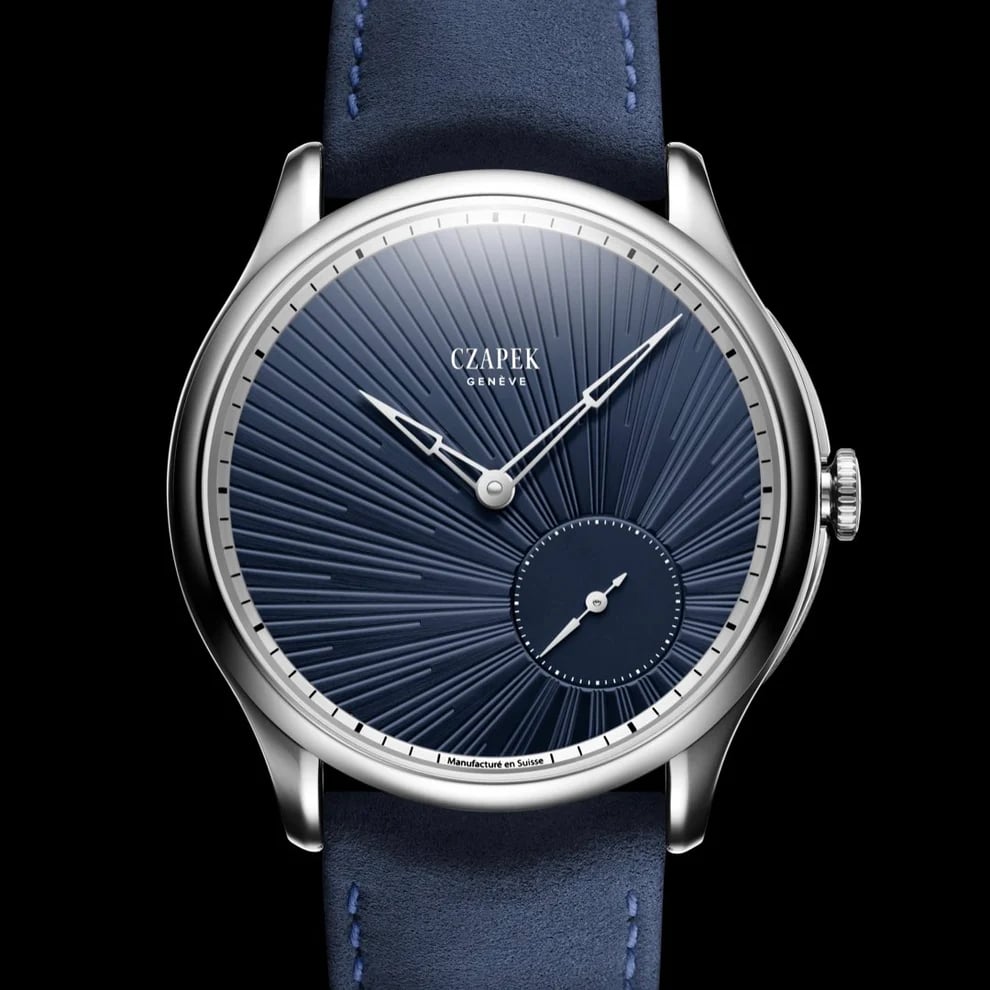
There are watches that impress through complication, and watches that impress through discipline. The Czapek Guilloché Soleil, reference 6987, belongs firmly to the second camp. It is a manually wound dress watch from the Quai des Bergues family, and its central argument is not a tourbillon or a split-seconds chronograph. The argument is a dial: a hand-guilloché Soleil surface that radiates from the centre in fine, engine-turned lines, catching light with a restlessness that no flat lacquer dial can imitate.
Czapek and Cie is a revived maison, but the Guilloché Soleil is not a heritage reissue in the literal sense. It is a contemporary watch that uses old techniques to create a modern object of desire. For young collectors who have spent time with mass-produced luxury, the appeal is the evidence of the hand. The guilloché pattern is not a printed texture. It is cut, and that changes the way the dial behaves under a sleeve, at a dinner table, or in the flat light of a winter afternoon.
A brief history of the maison
François Czapek was a Geneva watchmaker of Polish origin whose mid-nineteenth-century workshop supplied complicated watches to European aristocracy. His story is intertwined with the early history of Patek Philippe, and the modern brand has been careful not to overclaim that connection. Instead, Czapek and Cie was revived in 2015 with a clear brief: to make watches that feel Geneva in their proportions, finishing, and mechanical honesty.
The Quai des Bergues collection was the first expression of that revival. It introduced the brand's signature layout, with a small seconds subdial and a power reserve indicator arranged across the dial, and it established the Calibre SXH1 as the beating heart of the classical line. The Guilloché Soleil takes that architecture and dresses it in a dial finish that demands a different level of patience from the maker. Hand guilloché is slow work, and it shows.
Movement architecture: Calibre SXH1
The movement is the exclusive Calibre SXH1, a manually wound calibre developed with Chronode. It uses twin barrels to deliver a seven-day power reserve, which is a meaningful figure for a dress watch. Seven days means the watch can be worn on a Friday, set down for the weekend, and picked up again on Monday without the ritual of resetting and rewinding from scratch. More importantly, the long reserve allows the mainsprings to deliver torque more evenly across the running period, which is good for rate stability.
The SXH1 beats at 21,600 vibrations per hour and uses 31 jewels. Those figures are not chosen for bravado. The lower frequency is traditional for a classical manually wound movement, and it gives the seconds hand a gentle sweep rather than a nervous tick. The twin-barrel architecture is visible through the sapphire caseback, along with hand-bevelled bridges, circular graining, and a frosted mainplate. The finishing is not jewellery-store flash; it is the kind of finishing that reveals itself under a loupe and rewards the owner who takes the time to look.
Because the movement is manual, the watch asks for a weekly interaction. That is not a drawback for the intended buyer. It is part of the ownership experience. Winding a twin-barrel calibre with a seven-day reserve is a deliberate act, and it creates a relationship with the watch that an automatic winding system can never quite replicate. The crown is easy to grip, and the resistance feels mechanical rather than fragile.
Dial and case: the Soleil guilloché
The dial is the reason this reference exists. The Soleil guilloché pattern is cut by hand in radiating lines, creating a sunburst effect that shifts continuously as the wrist moves. In a deep blue execution, the effect is subtle rather than theatrical. The lines are fine enough to read as texture at arm's length, but they become individual cuts under close inspection. The two subdials are integrated into the composition without disturbing the visual balance, and the absence of a date keeps the dial clean and classical.
The case is stainless steel, which is the correct choice for a watch that is meant to be worn rather than worshipped. It is polished in the traditional manner, with a profile that is compact and elegant rather than oversized. The sapphire crystal is domed enough to give the dial a slight warmth, and the sapphire caseback frames the movement without turning the watch into a display piece. This is a dress watch, not a sports watch, and it makes no apology for that.
The strap is leather, as it should be, and the pin buckle keeps the package traditional. The overall impression is of a watch that has been edited rather than designed by committee. There are no unnecessary flourishes, no oversized crown guards, no aggressive lugs. The Guilloché Soleil relies on proportion and finish, and that is a harder discipline than novelty.
On the wrist
On the wrist, the Guilloché Soleil wears like a proper dress watch. The case is compact by modern standards, and the curved lugs allow it to sit close to the wrist without overhang. The strap is supple from the start, and the watch settles into position quickly. Because the movement is manual and the case is relatively slim, there is no rotor mass shifting against the wrist. The watch feels light enough for all-day wear but substantial enough to remind you that it is mechanical.
The lack of a date and the balanced subdial layout make it easy to read at a glance. The power reserve indicator is a useful complication for a manually wound watch, and it turns the weekly winding routine into a small ritual. The watch does not demand attention in a crowded room, but it rewards attention at close range. That is the correct behaviour for a dress watch with this kind of dial craft.
Accuracy and daily expectations
The SXH1 is not chronometer-certified, so the owner should expect a well-regulated mechanical rate rather than a laboratory guarantee. In practice, a healthy example should prove stable and predictable, with variation influenced more by position and winding habits than by temperature swings. The seven-day power reserve means the watch can be left for several days without stopping, but it rewards regular winding and consistent use.
For a manually wound dress watch, precision is only part of the story. The pleasure of the movement comes from its architecture, its finishing, and the way it delivers power across the long reserve. The Guilloché Soleil is not a watch for someone who wants to set it once and forget it. It is a watch for someone who enjoys the act of winding, the feel of the crown, and the knowledge that the mainsprings are doing their work in twin barrels.
Occasions and wearability
The Guilloché Soleil is at its best with formal and dress attire. It sits comfortably under a cuff, and its dial has enough visual interest to hold its own in a dinner setting without competing with a tie or a pocket square. It can also be worn daily by someone whose wardrobe leans towards tailoring, knitwear, and smart casual. It is not a sports watch, and it should not be treated as one, but it is robust enough for the ordinary knocks of desk life.
Because it is manually wound, it is also a good travel companion for collectors who like a ritual at the end of the day. The seven-day reserve means it can survive a week away from the winder, and the lack of a date means there is nothing to reset after a few days off. It is a watch that simplifies rather than complicates.
Reference and variants
The reference 6987 is the base expression of the Guilloché Soleil, with a blue Soleil guilloché dial, a stainless steel case, and an alligator leather strap. Czapek has produced other dial variants and limited editions within the Quai des Bergues family, but the 6987 is the purest statement of the concept. Collectors should confirm the exact dial colour and production numbers with the brand or an authorized retailer, as limited editions can vary by market and year.
Market and investment value
The Guilloché Soleil sits in the upper tier of the Quai des Bergues range, which is appropriate given the hand-guilloché dial and the seven-day movement. Pricing has been stable rather than speculative. The watch is not a steel sports watch with a waiting list, and it is unlikely to behave like one. Instead, it appeals to collectors who value independent watchmaking, hand-finishing, and classical proportions.
On the pre-owned market, well-kept examples trade in a range that reflects the original retail price rather than a significant premium. That is healthy for a watch of this type. It means the buyer can focus on the object rather than on the exit. The limited production and the hand-dial craft give it a better-than-average following among independent-minded collectors, but it should be bought for pleasure first.
Service and ownership
Service should be arranged through Czapek or an authorized partner. The SXH1 is an exclusive calibre, and the hand-guilloché dial requires care during any intervention. Ownership is therefore not as simple as dropping the watch at a local mall. But that is part of the independent-brand experience. The reward is a direct relationship with a maison that is still small enough to care about individual pieces.
Final verdict
The Czapek Guilloché Soleil ref. 6987 is a dress watch for collectors who value dial craft and mechanical ritual over trends. Its hand-guilloché surface and seven-day manual movement form a coherent, deeply traditional package, while the compact case keeps it wearable in modern life. It is not the obvious choice, and that is precisely the point. For the discerning young collector, it offers a rare combination: the quiet confidence of a classical watch and the tactile pleasure of independent watchmaking.